







Freedom of movement should not be a taxable right
Published Feb 6, 2026 12:05 am
|
Updated Feb 5, 2026 04:33 pm


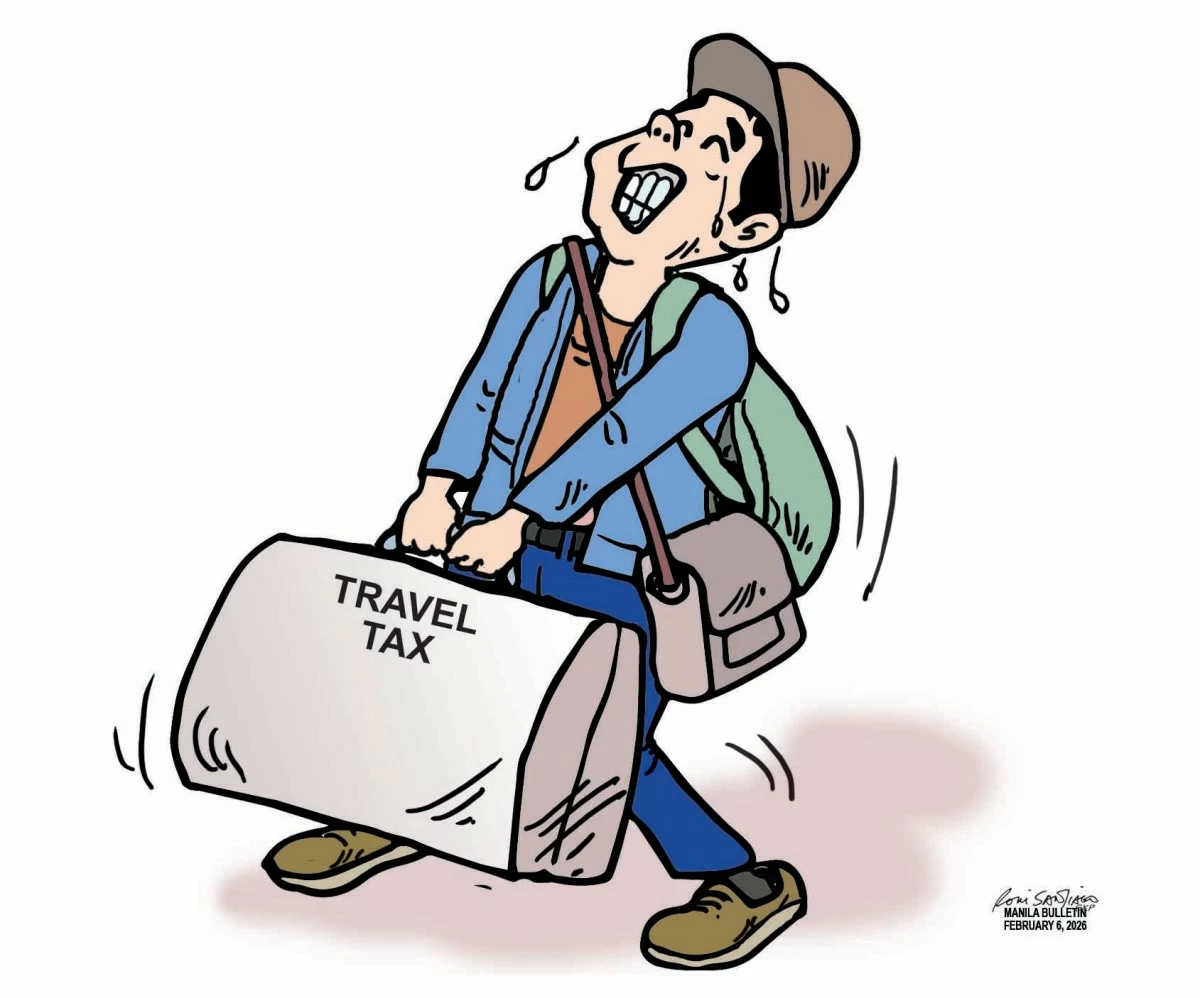
The travel tax is a substantial burden, particularly for ordinary Filipinos.
That is how House Majority Leader Sandro Marcos describes the current levy on traveling Filipinos. Just imagine a travel tax of ₱2,700 for first-class passage and ₱1,620 for economy? This is an anachronism that places a financial barrier on a constitutionally protected right to travel. For a family of four, the tax can amount to ₱6,480—an amount that, for many households, represents a significant portion of monthly disposable income.
In a country where overseas travel is often undertaken not for leisure but for employment, education, family reunification, or medical necessity, the travel tax functions less as a neutral fee and more as a penalty on mobility. In effect, it taxes ambition, opportunity, and economic participation beyond the country’s borders.
Beyond its economic impact lies a more serious constitutional concern. Article III, Section 6 of the 1987 Constitution guarantees the right to travel, allowing its impairment only in the interest of national security, public safety, or public health. The travel tax does not fall under any of these narrowly defined exceptions. While it does not explicitly prohibit travel, it undeniably impairs it by imposing a cost that disproportionately affects lower-income Filipinos. A right that can be freely exercised only by those with sufficient means ceases to be a right in practice and becomes a conditional privilege.
This is why the passage of Rep. Marcos’ House Bill No. 7443—which seeks its immediate abolition, compels the nation to confront an uncomfortable truth—is crucial
Proponents of the travel tax often justify its existence by pointing to its beneficiaries. Fifty percent goes to tourism development through the Tourism Infrastructure and Enterprise Zone Authority; 40 percent to tourism-related higher education via the Commission on Higher Education; and 10 percent to cultural development through the National Commission for Culture and the Arts. These institutions serve legitimate and valuable national objectives, no doubt about that. However sound, public policy demands that constitutional rights not be compromised for the sake of administrative convenience. Funding public goods by restricting the exercise of a fundamental liberty sets a troubling precedent.
The anticipated revenue loss from abolishing the travel tax, while real, is neither catastrophic nor irreplaceable. Tourism infrastructure can be financed through the national budget or through more equitable mechanisms, such as taxes on luxury tourism services, gaming revenues, or high-end hospitality enterprises that directly benefit from tourism growth. CHED’s tourism education programs are more appropriately supported through the general education budget, ensuring stability and coherence in human capital development. Cultural funding for the NCCA may be strengthened through earmarked portions of value-added tax, sin taxes, or revenues generated by the creative industries themselves.
Moreover, the abolition of the travel tax may ultimately stimulate broader economic activity. Lower travel costs encourage greater mobility, increased airline traffic, higher airport revenues, and expanded tourism-related spending. Overseas employment, business travel, and international education—each facilitated by freer movement—contribute to remittances, investments, and knowledge transfer that far exceed the narrow fiscal gains of a travel tax.
At its core, House Bill No. 7443 is not merely a policy and fiscal reform. It is a reaffirmation of constitutional principle and a compliance to a constitutional right. A democratic state that values liberty should not impose a boarding fee on freedom of movement. Abolishing the travel tax aligns law with the Constitution and policy with fairness. It sends a clear message that in the Philippines, the right to travel is not for sale. In fact, it should have never been.