






 Business
Trade & Industry
Factory output rebounds in December 2025, but full-year production slightly down
Business
Trade & Industry
Factory output rebounds in December 2025, but full-year production slightly down
Factory output rebounds in December 2025, but full-year production slightly down


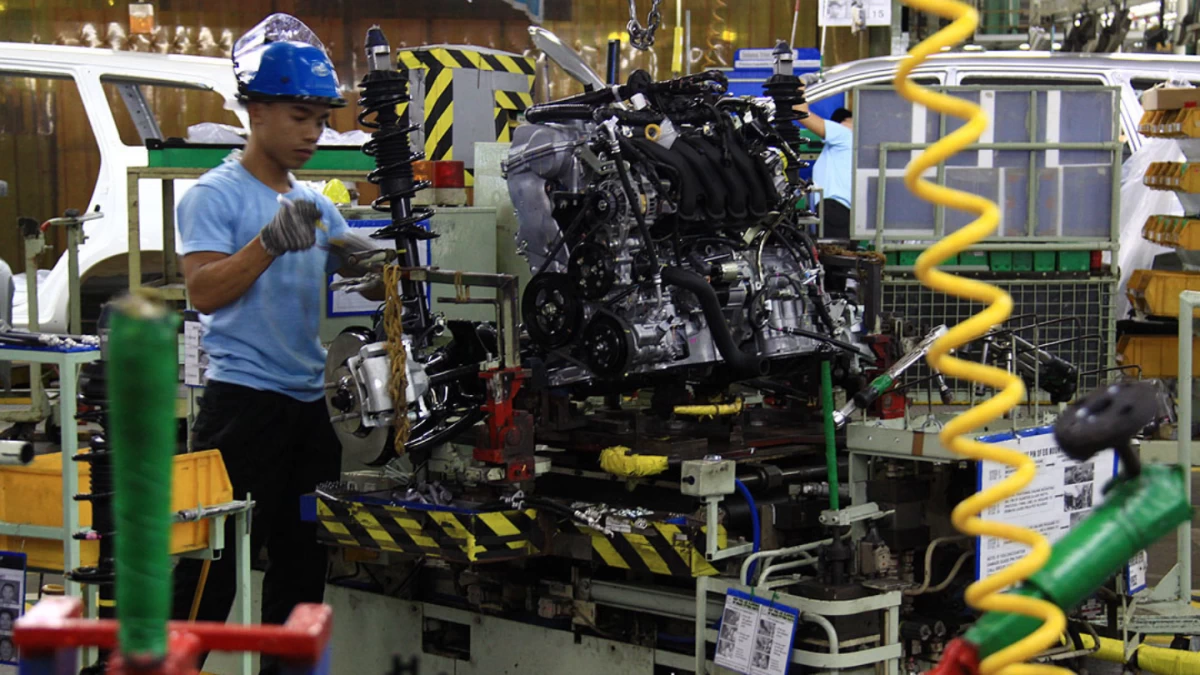
Domestic factory output rose in the final month of 2025, reversing a November decline as a deepening infrastructure corruption probe weighed on production, the Philippine Statistics Authority (PSA) reported.
The PSA’s latest monthly integrated survey of selected industries (MISSI), released Friday, Feb. 6, showed that the volume of production index (VoPI)—a key measure of factory output—grew one percent year-on-year in December 2025, up from 0.5 percent in the same month in 2024, following a 1.1-percent decline in November.
Despite the year-end uptick, VoPI slipped by 0.02 percent for full-year 2025, down from a 0.7-percent increase in 2024 and 4.9-percent growth in 2023.
The PSA said the year-on-year rise in manufacturing VoPI last December was primarily driven by manufacture of other non-metallic mineral products, which surged 31.4 percent from six percent in November.
Other key contributors included manufacture of food products, which grew 10.4 percent from 7.6 percent, and manufacture of machinery and equipment, except electrical, which rebounded to a 10.1-percent increase from a 10.7-percent decline in November.
While 12 of the 19 remaining industry divisions posted annual increases in December 2025, the PSA said the other seven recorded declines in their manufacturing VoPI during the period. These included manufacture of basic metals (-22.4 percent), chemicals and chemical products (-24.8 percent), and coke and refined petroleum products (-11 percent).
The rise in VoPI for food manufacturing in December was driven by faster growth in five of eight industry groups, led by dairy products, which jumped 44.3 percent, while the remaining three groups recorded slower annual growth compared with November.
Meanwhile, the value of production index (VaPI)—which measures output in monetary terms—also rose 1.9 percent in December 2025, up from 0.3 percent in December 2024 and reversing a one-percent decline in November.
In contrast to VoPI’s full-year dip, VaPI increased by 0.4 percent in 2025, although this was lower than the 6.3-percent growth recorded in 2023 and marked a reversal from the 0.02-percent decline in 2024.
The PSA said the year-on-year increase in manufacturing VaPI in December 2025 was likewise driven mainly by manufacture of other non-metallic mineral products, whose growth surged 29.5 percent from 4.4 percent in November.
The sector contributed 23.2 percent to the overall uptrend and ranked as the eighth-largest contributor in computing manufacturing VaPI among 22 industry divisions.
The PSA added that other key contributors to the December rise in manufacturing VaPI were manufacture of transport equipment, which grew 6.7 percent from 0.2 percent in November, and manufacture of machinery and equipment, except electrical, which rebounded to a 9.7-percent increase from an 11.1-percent decline the previous month.
While 12 of the 19 remaining industry divisions posted annual increases, the PSA said the other seven recorded declines in their manufacturing VaPI during the period.
Michael Ricafort, chief economist at Rizal Commercial Banking Corp. (RCBC), told Manila Bulletin that the rise in VoPI and VaPI in December was largely driven by seasonal demand, increased sales, and heightened business activity during the Christmas season, as well as improved weather conditions compared with previous months.
“Lower Fed [United States (US) Federal Reserve] and BSP [Bangko Sentral ng Pilipinas] interest rates also reduced borrowing costs for manufacturers and other producers, thereby increasing sales and production activities,” he said.
Ricafort added that the data reflect the continued growth and resilience of exports, supported by the diversification of export markets and products despite higher US tariffs, trade tensions, and other protectionist measures.
He stressed that the government’s catch-up spending—particularly on infrastructure to offset the slowdown in the latter part of 2025—combined with priority anti-corruption and good-governance measures, as well as potential further rate and reserve requirement cuts by the BSP, could help stimulate economic activity and growth, ultimately supporting stronger local manufacturing performance.