







DOTr open to lower terminal fees to curb costly airfares
Published Feb 6, 2026 12:34 am
|
Updated Feb 6, 2026 07:22 am


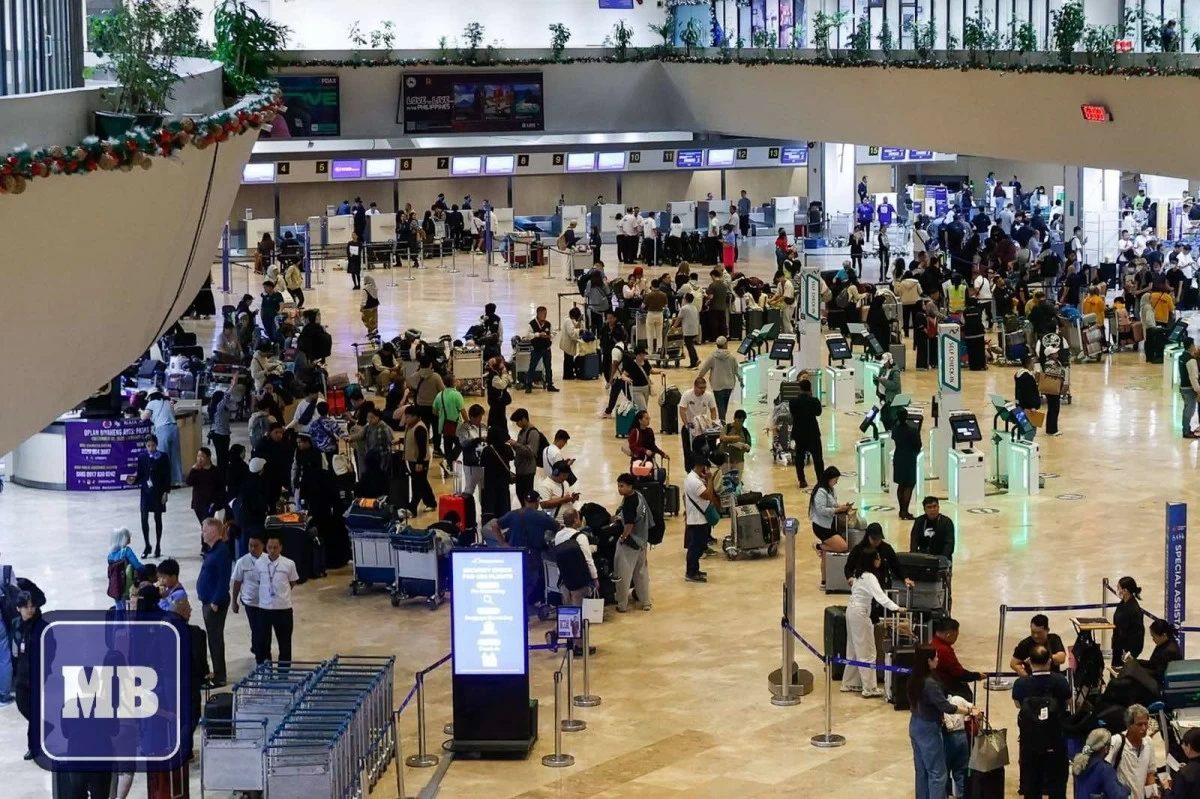
Passengers flock to NAIA Terminal 1 in Pasay City on Sunday, Dec. 21, as they travel abroad to celebrate Christmas and New Year, with airport authorities expecting increased passenger traffic during the peak holiday season. (Photo by John Louie Abrina I MB)
The Department of Transportation (DOTr) will study the prospect of reducing the passenger service charge (PSC) included in tickets at government-managed airports as part of a broader effort to make domestic travel more affordable.
Acting Transportation Secretary Giovanni Lopez said the DOTr is looking at bringing down the PSC, or terminal fees, imposed by the Civil Aviation Authority of the Philippines (CAAP) amid concerns that flying locally is now more expensive than traveling abroad.
“For airports under the CAAP, we will look into how the terminal fee can be reduced. We will review this, and if it can still be lowered, we will lower it,” Lopez said in a radio interview.
“If we can bring it down to the bare minimum, we will do so as well,” he added.
The PSC is a fee charged to each departing passenger and is already included in the ticket upon booking.
Funds generated from terminal fees go directly to airport maintenance, improvement works, and even the salaries of utility personnel, as CAAP does not rely on funding from the national government, according to Lopez.
In April last year, CAAP raised the PSC for international flights from the previous ₱784 to ₱900.
For domestic flights, passengers pay ₱350 at international airports, ₱300 at principal class 1 airports, ₱200 at principal class 2 airports, and ₱100 at community airports.
The PSC applies to all passengers except children under two years old, overseas Filipino workers (OFWs) traveling abroad, transit passengers, and those denied entry.
Airports managed by CAAP include Bohol, Davao, Iloilo, Kalibo, Laoag, Puerto Princesa, Bacolod, Dumaguete, Naga, Tacloban, Baguio, Camiguin, Catarman, Siargao, Ormoc, and Virac.
This does not cover airports operated by the private sector, such as the Ninoy Aquino International Airport (NAIA). Last year, NAIA also raised terminal fees to ₱950 for international departing passengers and ₱390 for domestic flights, from ₱550 and ₱200, respectively.
The PSC is different from the travel tax, which is separately charged to Filipinos flying abroad at ₱1,620 for economy class and ₱2,700 for first class.
Lopez said he is already in talks with the Tourism Infrastructure and Enterprise Zone Authority (TIEZA) and the Department of Tourism (DOT) over concerns surrounding the travel tax, which helps fund tourism infrastructure development and tourism-related educational programs, among others.
He added that the DOTr will also study the 12-percent value-added tax (VAT) imposed on plane tickets as part of its effort to make air travel in the Philippines more accessible to the general public.
In terms of airport infrastructure, Lopez said it is now the government’s policy to build runways spanning at least 2,100 meters to accommodate larger aircraft instead of limiting operations to turboprops.
Turboprop aircraft can carry fewer than 100 passengers per flight, unlike larger jets such as the A330, which can seat up to 459.
By extending runways, Lopez said the government could bring down airfares to popular tourist destinations such as Siargao.
In addition, he said the DOTr and CAAP are also pushing for the night-rating of regional airports to expand flight options.
“When an airport is night-rated, our countrymen can travel at night and in the early hours of the morning—what we usually call red-eye flights—and in practice, fares for these are cheaper,” said Lopez.