







Coding the future of entertainment
"Art is but a measurement of sacrifice and tears."
Published Feb 5, 2026 10:30 am


A couple of weeks ago, I watched the film “Saturday Night,” directed by Jason Reitman (Juno, Up in the Air, Ghostbusters: Afterlife), which purports to tell the true story behind the airing of the very first episode of SNL, and one line struck me: “Art is but a measurement of sacrifice and tears.”
Today, the biggest buzzword is AI. People praise it, people hate it. There’s always some big news about it. For instance, it is harmful to the climate because it requires large amounts of water to cool the infrastructure. AI companies hoarded memory chips, making RAM and storage really expensive, among other things.
I find myself on the fence when it comes to AI. It has a place in this world; it can be used for good. I do believe it can be used to solve some problems. However, I don’t think we’re there yet.
Watching an AI-generated movie
Google invited us, along with media friends, to watch an AI-generated film. This was generated and edited by the duo Rodson Verr Suarez and Darryll Rapacon, who were among the top five among 3,500 entries in Google’s international AI Film Award, for their entry, “Portrait No. 72.”
Stepping on the brakes a bit, I have to say “AI film” does not make sense for me, since “film” and “filming” are the processes of capturing images per frame into a film stock. So, I’ll use the term “movie” instead, which is the short form for “Moving Picture,” and that makes much more sense for me, especially when talking about a video generated with an AI.
Besides, calling a video “film” is just some artsy fartsy thing anyway.
The AI movie Portrait No. 72 is less than ten minutes long and tells the story of an Indian photographer who photographs the dead. The concept is interesting and heartwarming, not quite Oscar-bait, but there is tenderness to it. It’s here on YouTube if you want to watch it.
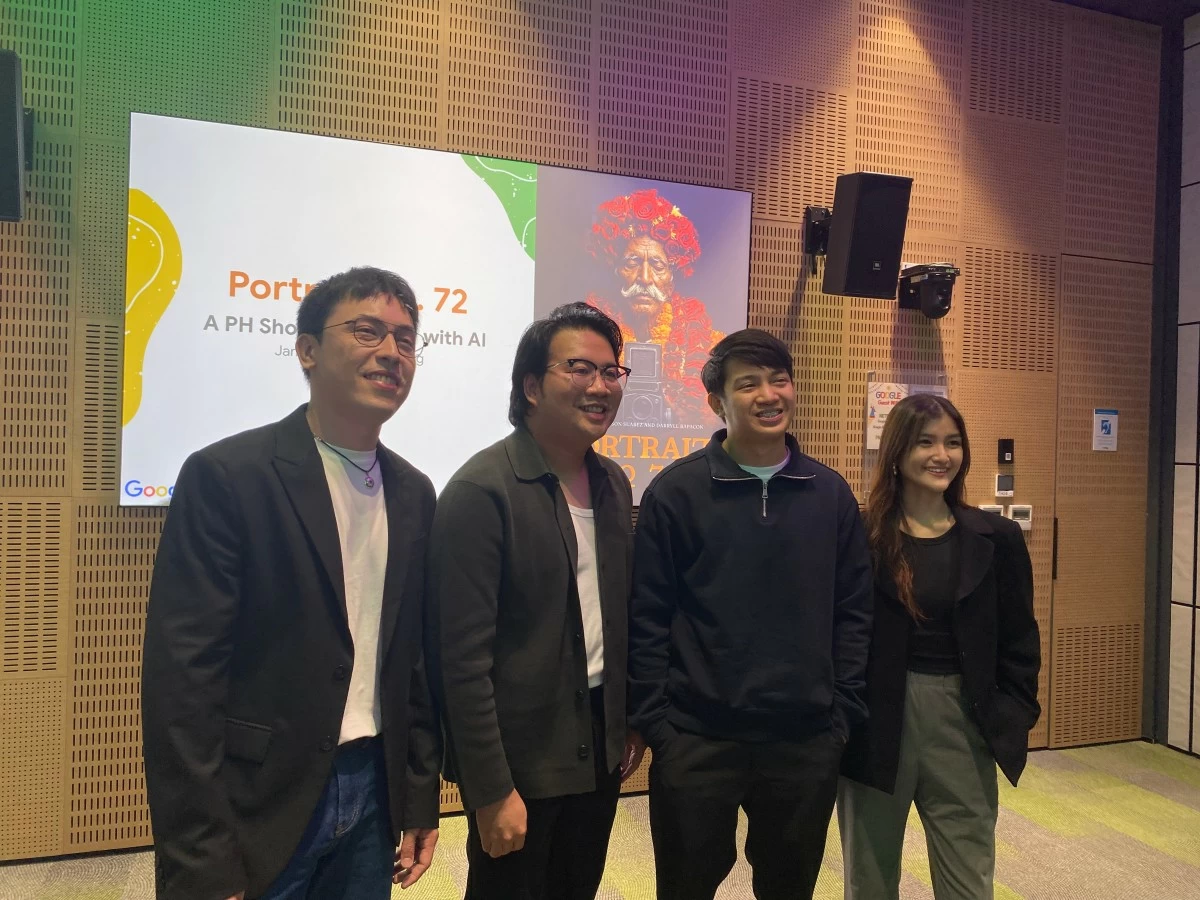
Suarez and Rapacon have worked on a project they truly believe in, and during the Q&A, they showed a lot of heart in its development. The scenes generated to make the movie came from Google’s own AI video generator, Veo, now on its third version. It’s a powerful piece of tech, impressive, and terrifying in how it can generate images that we can mistake for real-life people and events.
Veo can generate 8-second clips and can take minutes before the scene is fully processed. So it’s easy to see how this can be a long and arduous process to make.
Creating an AI movie
Suarez and Rapacon said they generated thousands of videos just to get the right scene. One of the misconceptions of AI moviemaking is that you prompt in a story, and the whole feature is generated. Suarez and Rapacon said, " It doesn’t work that way. They would generate it scene by scene and then edit them into a movie.
There were challenges, which included character consistency, which they were able to solve by adding identifying elements, such as putting an orange scarf on one character, so no matter the scene, no matter the slight changes to the character’s appearance, so long as he had that orange scarf, we would be able to identify him. Got to admit, that was clever and creative.
The AI wasn’t perfect, though. For instance, there are scenes where the character brushes his teeth in a very awkward way. There was another scene where, while he was developing his film negatives, there was a small red light by the side, but behind him was a window with very bright sunlight coming in. There are instances where two characters are talking about something grim and sad, but they are seen smiling as if their day was struck with big fortunes.
These scenes were made from an earlier version of Veo, and, now that it’s already Veo 3, we can only imagine how much more powerful and efficient it is. And even though it still has limitations, give it time, a year or so, maybe not even, the distinction between real and AI-generated may disappear.
But for now, I found the AI-generated characters lacking. It is easy to have an idea and tell the computer to make someone look sad.
Part of the creative process in filmmaking as a director is being able to draw out the raw emotions from their actors. And the actors themselves have the skill to bring it out and show it to the world. There are other considerations that the film crew must take into account, such as the manipulation of light, how much light should be used, what kind of light, the direction, and all of that. It’s one big process that can get messy. And AI seems like it’s trying to get rid of the messiness.
I suppose, in this case, the difference between AI moviemaking and filmmaking is that AI moviemaking showcases the creators’ prompting skills and, in turn, shows how effective their coding skills are. At the same time, traditional filmmaking is a gallery of artists showcasing all their talents in a single project, which involves directing, writing, cinematography, editing, and acting.
Suarez and Rapacon said they have worked hard to make this movie. Typing thousands of words into each prompt and generating thousands of scenes, looking for the perfect one. Or the one that fits best.
Google Veo can generate 8-second clips, which can take a couple of minutes to process. Imagine doing that thousands of times.
Reality bites
It just makes me think, wouldn’t it have been easier to just hire a film crew with actors? Ah, but of course, budget and time. You don’t have to interact with a lot of people, and you don’t have to quit your job, like how some directors in the past would.
Rapacon also compared AI movie-making to photographers’ initial resistance to Photoshop. Going through some history, photographers of the late ‘80s and early ‘90s resisted Photoshop because of skepticism in digital formats, the high cost of the software, and the fears of digital manipulation.
Many photographers have spent years mastering darkroom techniques and felt that software-based tools were cheating. I suppose that bit is something many of us can relate to, since that type of reasoning still exists today. One may even argue it’s the same with generative AI.
However, the way I still look at it, Photoshop may have needed a different skillset, which is understanding the digital format, software, and a different workflow. But the core principles of image editing between traditional darkroom techniques and Photoshop remain the same, which aim to enhance and correct an image with the manipulation of light and color. It still needed hours of effort, discipline, and understanding of image editing.
Generative AI, on the other hand, is, without a doubt, easier and faster; it requires a widely different set of skills, which is how well you can describe something–aka prompting. The AI is already trained on a countless amount of data taken from all over the world, uploaded from every single electronic device. So, when you describe something such as “a man looking sad, mournful, on the verge of tears as he contemplates his existence,” the AI has a fairly good grasp of that thanks to all the data it was trained on.
With generative AI, you don’t really have to worry about the lighting, the set, or the crew. You don’t have to sell your own house, as some indie filmmakers are known to do, just to have enough money to fund their project or to pitch their projects to studio executives. They can just spend weeks, maybe months, generating scene after scene, in their own home, anywhere that may be, without worrying about all the nightmarish logistics.
The human element
Suarez said the human element in these AI movies is the person or people who edit them. Rapacon mentioned that, for him, making an AI movie is about knowing how to edit these scenes. This scene may work better here, instead of there. He added that in AI moviemaking, every shot has a purpose.
And those words became an eye-opener for me, making me question and ponder deeply, if filmmakers such as Steven Spielberg, David Finch, Wes Anderson, Ridley Scott, Chris Columbus, Denis Villeneuve, Sergio Leone, even Michael Bay, and so on, would take shots of their scenes without intention or purpose. It made me wonder how they approached filmmaking, if it’s the same as how Suarez and Rapacon see it: editing scenes to form a coherent narrative, while trying to evoke a feeling out of it.
Maybe the one thing that continues to irk me, and will always do, and I say this without shame and yes, full of fear, is what AI enthusiasts say about how technology will not replace human talent.
They say AI technology is not here to replace human workers. And this is not aimed at Suarez and Rapacon or their project; there are at least 3,500 others out there. But in the generation of an AI movie, it took only a few people. It did not need a light crew; it did not need other writers and editors to refine the script; it did not need a cinematographer, and it did not need actors. How is that not replacing human talents? Not using humans because the machine can do it is technically a replacement.
Other people in the tech industry have told me that humans will not be replaced by AI, but they will be replaced by humans who know how to use AI, and that’s a scenario I can see happening. Imagine that, making a movie with the two, or three, maybe five, of you, sitting down somewhere, prompting and prompting and prompting to get that perfect scene. How exciting does that sound?
Google has hinted that this isn’t about replacing talent in the industry. It’s about making creativity accessible. But the thing is, creativity and storytelling have always been accessible for many years. Musicians have SoundCloud and BandCamp, game developers have Valve and Itch.io, authors have Amazon, Smashwords, Royal Road, Wattpad, and video enthusiasts have YouTube, which is owned by Google. There are fundraising platforms, Kickstarter, BackerKit, Indiegogo, to name a few, that can help raise funds–I know, I know, easier said than done.
Kane Parsons, a YouTuber known for his Backrooms webseries, has been picked up by A24 to direct his own Backrooms feature film. David Sandberg had a very short and simple horror film called “Lights Out,” which became popular enough that he got to direct his own debut film of the same name. He would soon also direct “Annabelle: Creation” and “Shazam.”
Twins, Danny and Michael Philippou, started out as comedy horror YouTubers and are now directing hits like “Talk to Me” and “Bring Her Back.”
Of course, this took time for it all to happen. And only time will tell if we’ll have AI movie creators who will get to direct their own features. At this point, anything is possible, really. I mean, you’ve got Darren Aronofsky (Requiem for a Dream, Black Swan, Mother!, The Whale) making an entire series with AI.
So what we’re getting is prompters or coders who are generating scenes and an editor who pieces them together. This will only intensify, as Amazon invested in a platform called Showrunner some time ago. This is an AI platform that generates videos and “episodes” based on a prompt. Will this spell the doom of cinema?
I don’t think so. They’ve been saying that since television became a thing in the ‘30s and ‘40s. But the work of human-made art, such as movies, books, and games, will become more expensive as the entertainment industry becomes a coding haven.