







NDRRMC prepares for Tropical Depression 'Basyang'
Published Feb 4, 2026 04:08 pm


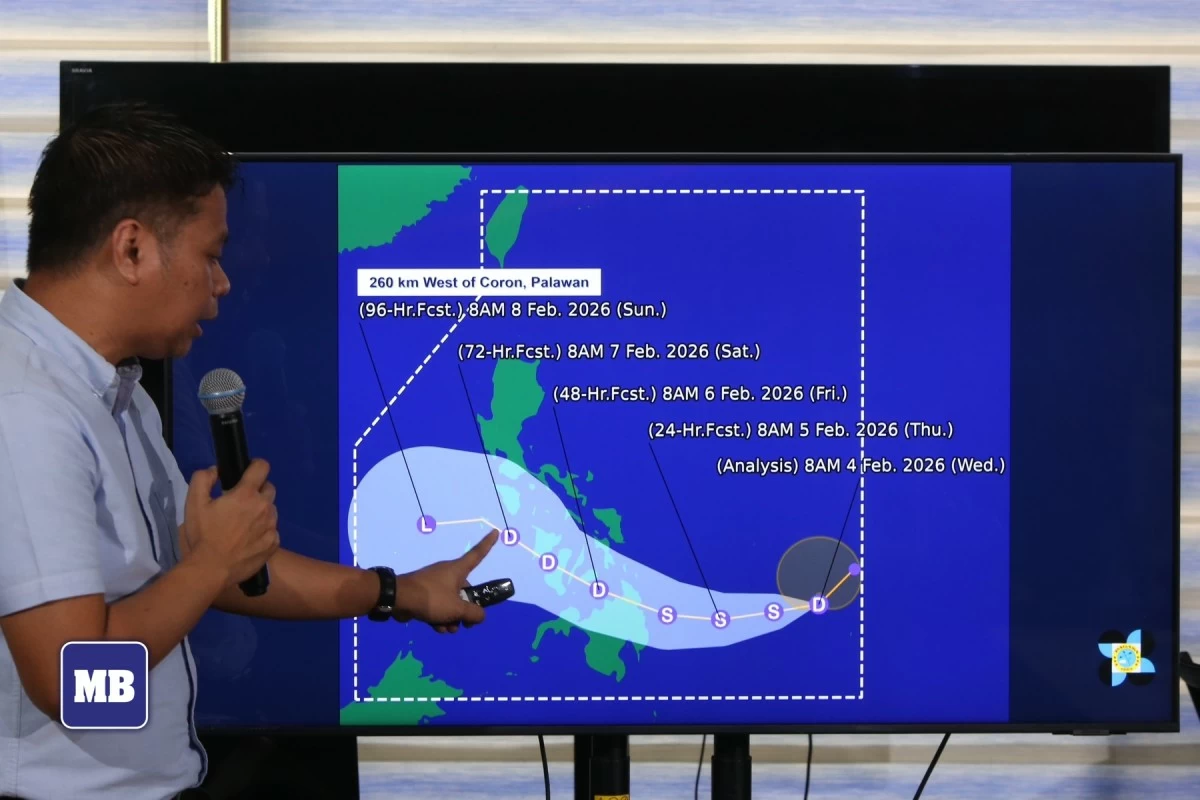
Philippine Atmospheric, Geophysical and Astronomical Services Administration (PAGASA) assistant weather services chief Chris Perez gives updates on Tropical Depression Basyang, the country’s second cyclone for 2026, during a briefing at the PAGASA Weather and Flood Forecasting Center in Quezon City on Feb. 4, 2026. (Santi San Juan/Manila Bulletin)
The National Disaster Risk Reduction and Management Council (NDRRMC) has ordered nationwide preparedness measures as Tropical Depression (TD) “Basyang” threatens the eastern part of Mindanao.
In a memorandum order issued by NDRRMC Executive Director and Office of Civil Defense (OCD) Administrator Usec. Harold Cabreros on Tuesday, Feb. 3, it directed national agencies, regional and local disaster councils, and all OCD regional offices to strictly coordinate their preparedness measures ahead of Basyang’s possible impact and implement actions under the minimum preparedness checklist.
Under the minimum preparedness checklist, the NDRRM Operations Center at Camp Aguinaldo in Quezon City may be placed on Blue or Red Alert while emergency response teams are being prepositioned, and food and water inventories must be checked.
At present, the NDRRM Operations Center is under Blue Alert which means response agencies are on standby.
“The directive of the President [Ferdinand Marcos Jr.] is to ensure a timely, orderly, and swift response to the needs of our fellow Filipinos,” OCD spokesperson Junie Castillo shared.
The NDRRMC told agencies to intensify information dissemination of preparedness measures, noting that accurate and timely advisories must reach the public through short message service (SMS), radio, social media, and community announcements.
It also ordered the Department of the Interior and Local Government (DILG), Department of Environment and Natural Resources-Mines and Geosciences Bureau (DENR-MGB), Department of Transportation (DOTr), Department of Public Works and Highways (DPWH), OCD regional offices, and local DRRM offices to ensure the installation of warning signs in landslide-prone and flood-prone areas.
“What we need to closely monitor is whether our areas are included in the DENR-MGB list. These are the areas identified as flood-prone and rain-induced landslide-prone. If they are, it is very important to conduct pre-disaster assessments,” Castillo mentioned.
“This is to determine where, when, and how intense the possible rainfall, flooding, or landslides may be in their respective areas,” he added.
For transport safety, the NDRRMC directed the DOTr to issue advisories and suspend trips when needed. It called for strict enforcement of “pre-emptive evacuation” in high-risk communities and cited the possible implementation of a “no-sail” policy in would-be affected areas.
The NDRRMC instructed agencies to secure alternate routes and humanitarian corridors while resource prepositioning and readiness of search and rescue personnel, vehicles, and equipment were ordered in coordination with the Armed Forces of the Philippines (AFP), Philippine National Police (PNP), Bureau of Fire Protection (BFP), and Philippine Coast Guard (PCG).
The monitoring of tide forecasts, road networks, and river channels in danger zones was also ordered by the NDRRMC. It reminded local officials to reinforce safety protocols such as “duck, cover, hold” in areas with earthquake activity or near active volcanoes.
Regional and local disaster councils were likewise directed to conduct Pre-Disaster Risk Assessment (PDRA) scenario-building meetings with stakeholders. Local government units (LGUs) were told to prepare for preemptive evacuations and resource mobilization.
“Our reminder to the public is to listen to the advisories of local government units. At this time, our response agencies and response clusters are already on standby. This is based on the discussions during the PDRA at the national inter-agency coordinating cell,” Castillo said.
Basyang was last located at 735 km East of Hinatuan, Surigao del Sur as of 11 a.m. on Wednesday, Feb. 4.
Aside from Basyang, the NDRRMC warned that a shearline is also affecting parts of the Visayas and Mindanao while the northeast monsoon (amihan) continues to affect Batanes and the Babuyan Islands.