






Manila Bulletin
 Philippines
National
Mayon sulfur dioxide emissions hit 15-year high as effusive eruption continues
Philippines
National
Mayon sulfur dioxide emissions hit 15-year high as effusive eruption continues
Philippines
National
Mayon sulfur dioxide emissions hit 15-year high as effusive eruption continues
Mayon sulfur dioxide emissions hit 15-year high as effusive eruption continues
Published Feb 4, 2026 07:50 pm


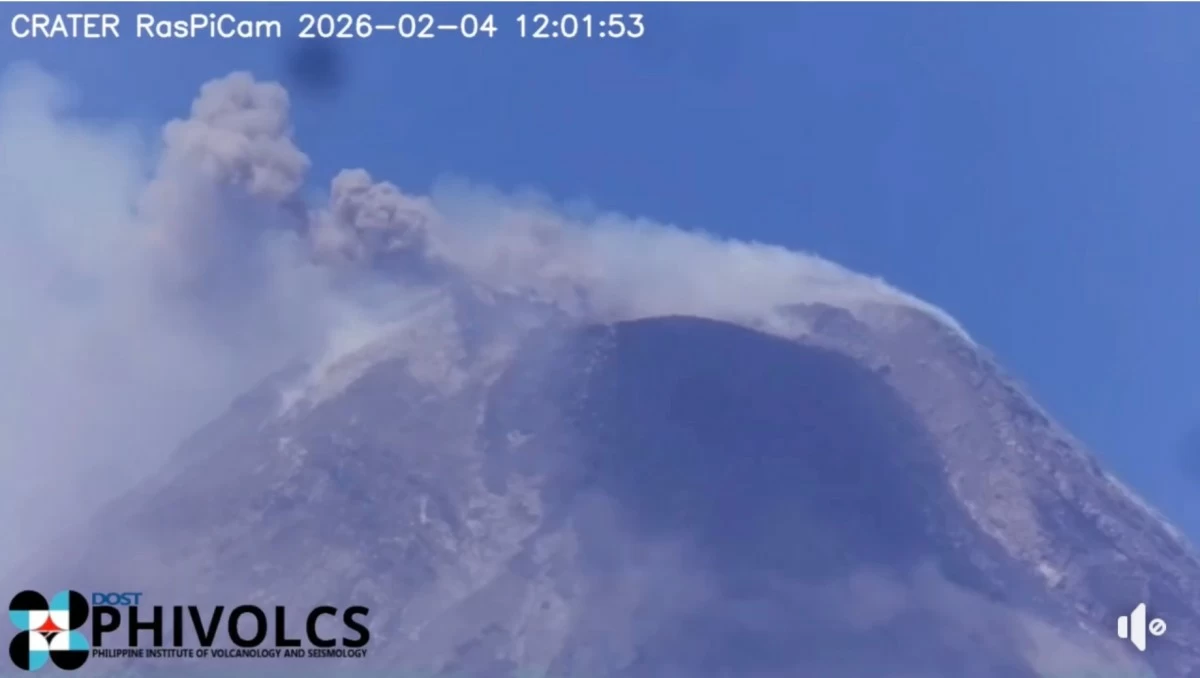
Ash emission from Mayon Volcano’s summit crater at 12:01 p.m. on Feb. 4, 2026, generated a grayish plume that rose about 50 meters above the crater before drifting west-northwest, as recorded by the Mayon Volcano Observatory’s Crater RasPiCamera. Alert Level 3 remains in effect. Entry into the six-kilometer permanent danger zone is prohibited. (Philippine Institute of Volcanology and Seismology/Screenshot)
A surge of volcanic sulfur dioxide from Mayon Volcano has pushed emissions to their highest level in 15 years on the 29th day of its effusive eruption, the Philippine Institute of Volcanology and Seismology (Phivolcs) said on Wednesday, Feb. 4.
Based on campaign spectrometry measurements this month, Phivolcs said sulfur dioxide degassing has shown an increasing trend, with average emissions on Feb. 3 reaching 6,569 tons per day—the highest recorded since 2011.
The running monthly average has climbed to 5,503 tons per day, more than double January’s average of 2,571 tons per day.
Phivolcs noted that the rise in gas output has not been accompanied by similar increases in rockfall activity, pyroclastic density currents (PDCs) or “uson,” or other signs of faster lava extrusion at the summit crater.
However, strong degassing from the summit with aseismic ash emission was observed during the day.
Phivolcs warned that elevated sulfur dioxide levels, even over a relatively short period, could indicate new magma intrusion within the volcano, which may lead to further eruptive activity.
Mayon remains under Alert Level 3 as effusive eruption at the summit continues, but Phivolcs said the chances of lava fountaining or a moderately explosive eruption have increased again.
Under this alert level, ongoing lava effusion can continue to generate lava flows, collapse-fed rockfalls, and PDCs on the southern and eastern upper slopes, while possible lava fountaining or moderate explosions could affect all sectors of the volcano.
The public was reminded to stay out of the six-kilometer radius permanent danger zone because of the hazards posed by lava flows, rockfalls, and PDCs.
Residents within the eight-kilometer radius were also advised to be ready for possible evacuation if monitoring parameters escalate and the alert level is raised to Alert Level 4.
Phivolcs also urged increased vigilance against lahars and sediment-laden streamflows along channels draining the volcano, especially with the possibility of prolonged heavy rains over Albay due to Tropical Depression Basyang.
Civil aviation authorities were also advised to warn pilots against flying near the summit, as ash from any sudden eruption could pose a danger to aircraft.