






Manila Bulletin
 Philippines
National
Sultan Kudarat earthquake swarm shows fewer tremors but high-magnitude quakes still possible — Phivolcs
Philippines
National
Sultan Kudarat earthquake swarm shows fewer tremors but high-magnitude quakes still possible — Phivolcs
Philippines
National
Sultan Kudarat earthquake swarm shows fewer tremors but high-magnitude quakes still possible — Phivolcs
Sultan Kudarat earthquake swarm shows fewer tremors but high-magnitude quakes still possible — Phivolcs
Published Feb 3, 2026 12:24 pm


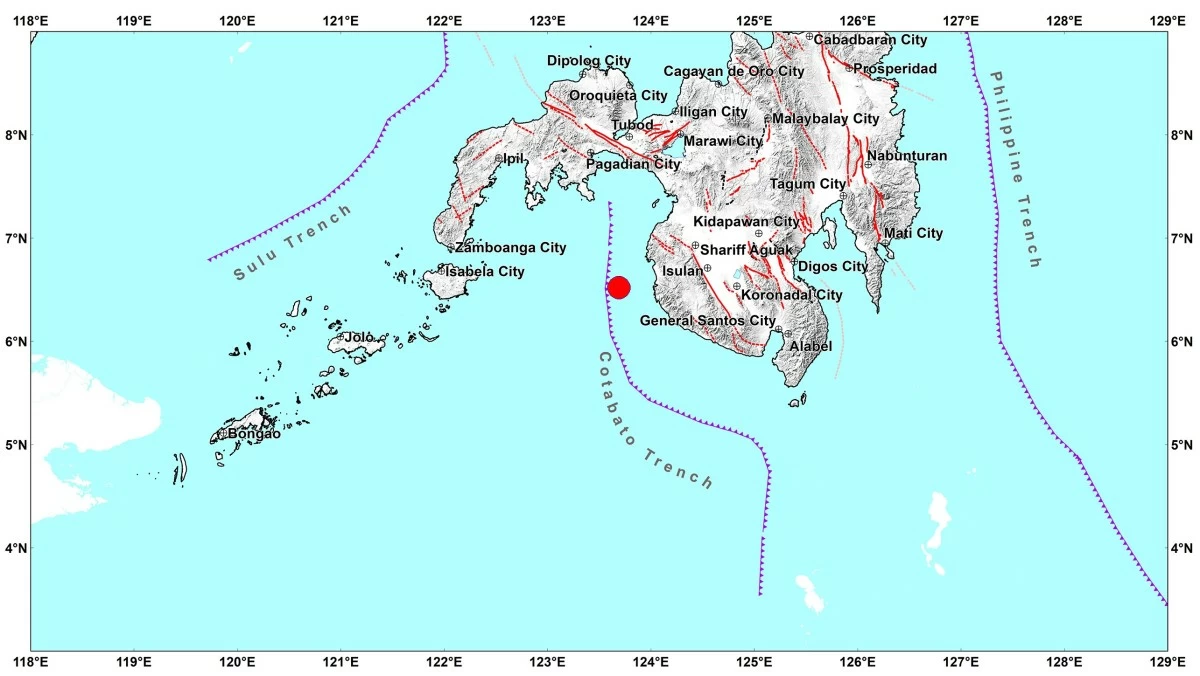
Map showing the epicenter of the 5.9-magnitude earthquake on Jan. 28, 2026, the strongest tremor recorded so far in the ongoing offshore Sultan Kudarat earthquake swarm, as reported by the Philippine Institute of Volcanology and Seismology (Phivolcs).
The earthquake swarm offshore of Sultan Kudarat, which began on Jan. 19, is producing fewer tremors per day, the Philippine Institute of Volcanology and Seismology (Phivolcs) said on Tuesday, Feb. 3, but warned that strong earthquakes could still occur.
Phivolcs said the tremors are generated by movement along the Cotabato Trench.
“As of now, there is a lowering in the number of earthquakes recorded per day, but we cannot say for sure that another high-magnitude quake will not occur, just like what happened on Jan. 28 with the magnitude 5.9 earthquake,” it said.
Phivolcs added that while the frequency of earthquakes is decreasing, this does not necessarily mean the energy released by each tremor is lower.
“Pwede kasi mas kaunti pero mataas naman ang magnitude, or measure of energy, ng mga earthquake. Again, hindi po ito conclusive (There may be fewer earthquakes, but their magnitudes, or measure of energy, can still be high. Again, this is not conclusive),” it said.
From Jan. 19 until 8 a.m. on Feb. 3, 3,319 tremors were recorded offshore of Sultan Kudarat, with 1,010 plotted by at least three seismic monitoring stations and 114 felt by residents.
Recorded magnitudes ranged from 1.3 to 5.9.
Phivolcs assured the public that it continues to monitor the situation closely and will provide updates should any significant developments occur.