








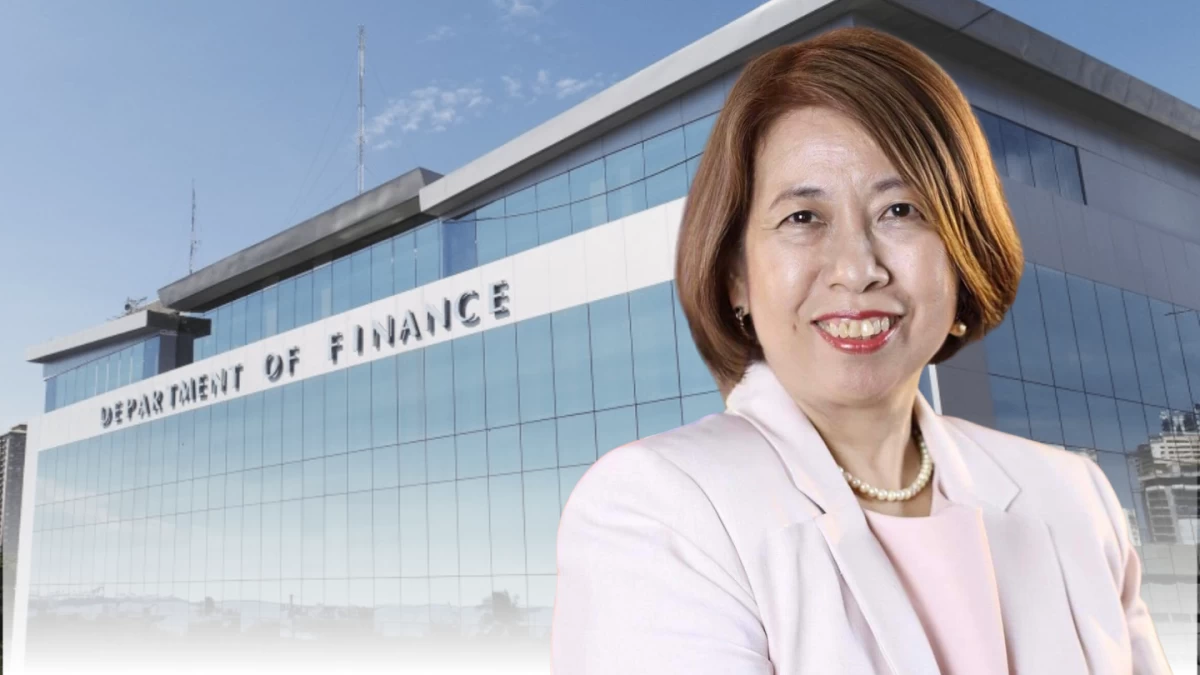
Often one of the few women representing the Philippines on the global stage, Maria Teresa Habitan reflects on her rise through the Department of Finance. Comparing her experience to Hidden Figures, Habitan credits the “strength and clash of principles” among female leaders for navigating the country through historic economic hurdles and legislative battles.
Who knew that helping a friend find her way to a finance job application on Mabini Street could launch a long-term career in fiscal management? For Maria Teresa Habitan, that chance act was the first of many “happy accidents” that would shape her rise to veteran status.
Habitan first stepped through the gates of the Department of Finance (DOF) in the waning years of dictator Ferdinand Marcos Sr.’s collapsing administration. She would exit decades later, shortly after the election of the dictator’s son, Ferdinand Marcos Jr., to the presidency.
Fresh out of university in the 1970s, Habitan soon found herself standing before a whirring, scraping xerox machine, reproducing finance documents, or feeding papers into screeching fax machines to send scanned files.
Moments later, she would find herself seated in a meeting, representing the DOF, being asked— while spooning soup—about matters she barely understood. She would evenetually get quietly rescued by someone else in the room.
Habitan readily admits that, despite earning an economics degree from the University of the Philippines (UP), much of the discussion in those early high-level meetings went over her head.
For the long-serving finance assistant secretary, the first five years of her nearly four-and-a-half-decade career at the DOF were spent reconciling classroom theory with the realities on the ground.
She recalls her first flight to Washington, braving America’s cold weather in a borrowed jacket.
Before long, however, the pressure of navigating the Philippines’ mounting foreign debt set in, forcing Habitan to fully grasp the weight of helping manage a nation’s fragile economy.
“I felt the pressure when the Philippines had a debt crisis in October 1983,” Habitan told this author. Under the fading rule of Marcos Sr., the country became the first in Asia to be swept into the debt crisis of the 1980s—an economic blow compounded by political uncertainty.
To gain breathing room amid swelling obligations to foreign lenders, the Philippines sought a three-month moratorium on debt servicing. Three years later, the International Monetary Fund (IMF) slightly eased its terms, though only within limits, as the country’s debt continued to balloon despite ongoing reforms.
Defense
Several times, Habitan felt the urge to defend the Philippines from foreign ridicule—yet she and her colleagues also shared the instinct to disappear from the judging gaze.
She recalled one such moment during a debt seminar in Thailand, where reports showed ASEAN economies in solid fiscal shape—except for the Philippines. The Mexican resource person repeatedly singled out the country, prompting Habitan and her colleagues to quietly retreat from view.
“There were four of us from the Philippines, all women, and at first we just wanted to go home,” she said. “But over lunch, we ended up at a table with a Mexican speaker—he didn’t even realize there were Filipinos in the seminar.”
After that shared meal, the speaker noticeably eased his focus on the Philippines. “That’s when I realized that charm can actually work,” Habitan told Manila Bulletin, her chin-length, medium-brown bob framing a face that has since become familiar in fiscal circles.
Habitan is often seen in sleeveless tops paired with slacks, or a blazer matched with a knee-length skirt, finished with closed-toe pumps. She typically accents her composed presence with golden pearl stud earrings and a matching necklace.
Standing beside her were three other female officials—a scene reminiscent of the film Hidden Figures, with one crucial difference: these women were not working behind the scenes. They were visibly present, holding their ground in direct dialogue with multilateral lenders.
“Almost all the secretaries and economic managers were men, but all their deputies and undersecretaries were women—and they were incredibly strong,” Habitan said.
“You could see them in action during IMF negotiations, and in the Development Budget Coordination Committee (DBCC) meetings as well. You could really witness the clash of principles—it was impressive,” she added.
Habitan spoke of this with unmistakable feminist pride—a disposition perhaps shaped by her fondness for strong-minded heroines in the novels she read, or maybe by her own taste for the boldly spicy flavors of pinangat.
Still, she acknowledged the difficulty of negotiating with the country’s creditors.
“You feel like a victim. You know you’re at fault—but it’s their fault too. They’re the creditors. So why did they keep lending to us without doing their due diligence?” she said, noting that the hardship was heightened by the fact that the Philippines stood alone with a debt problem at the time.
Part of her regular work involved presenting the more positive developments in Philippine economic policy to debt watchers and the IMF. “It’s like defending your thesis every quarter—with the IMF,” she said.
“We knew what we wanted to do technically—but Congress had to legislate it,” Habitan explained, adding that this legislative hurdle was often the main obstacle to reforms the Department of Finance sought to implement.
‘Lost’ battles
Guided by her philosophy on taxation, Habitan believes that no tax measure is ever truly wasted, given that the legislative process is long and far from instant. If anything, she says, patience is essential, as the passage of future laws is often delayed.
“Pushing for policy reform isn’t instant noodles—it’s a slow burn. You can’t do it all at once. You need to study, and you need to work with people who don’t always agree with you,” she told this author.
Among the reforms that have faced repeated deferment since the DOF’s push in the 1990s are CREATE MORE, fiscal incentives reform, and amendments to the mining law.
Even with this reality, Habitan said the country needs fiscal authorities who are principled enough to firmly hold the DOF’s ground amid public pressure. This, she noted, is often where fiscal managers are misunderstood—mistaken for being “heartless” or “arrogant,” labels she herself has received.
“One can listen and, at the same time, stay firm in one’s position,” she said. “Even if I know I’ll lose the hearing, I put the DOF position on record.”
Now vice chancellor of the Philippine Tax Academy (PTA), overseeing the Local Government Finance Institute (LGFI), Habitan continues to stand by the tax philosophy that defined her career.
For her, “everybody should pay at least a minimum tax—no matter what,” underpinning her belief that taxes are the lifeblood of government, funding services ultimately meant to benefit the people who pay them.
At the same time, she stressed that tax authorities must de-complexify the process of paying taxes. She stressed compliance should be simpler, fairer, and more humane, as red tape only hinders efficient tax collection.
Habitan keeps her fingers crossed for a more informed citizenry, particularly on why tax revenues are collected. For the DOF, meanwhile, she hopes for a corps of staff deeply invested in policy work—engaging stakeholders and advancing comprehensive tax education.
“Taxes are unpopular. Be ready to be unpopular if you’re with the DOF. You’re not here to be loved. You should aim to be respected,” the veteran said, adding that clear principles must be matched with political courage and savviness, as taxes remain “the most difficult kind of legislation.”
Perhaps what would truly make this veteran happy—aside from solving puzzles and binge-watching K-dramas—is witnessing a renewed sense of patriotism, expressed through progressive tax measures.
Pride-worthy, even, if foreign players could take a closer look at how the Philippine government operates and consider it as a model—as was the case with the Philippines being a model of transparency for the extractive industries that Habitan once headed.