ADVERTISEMENT

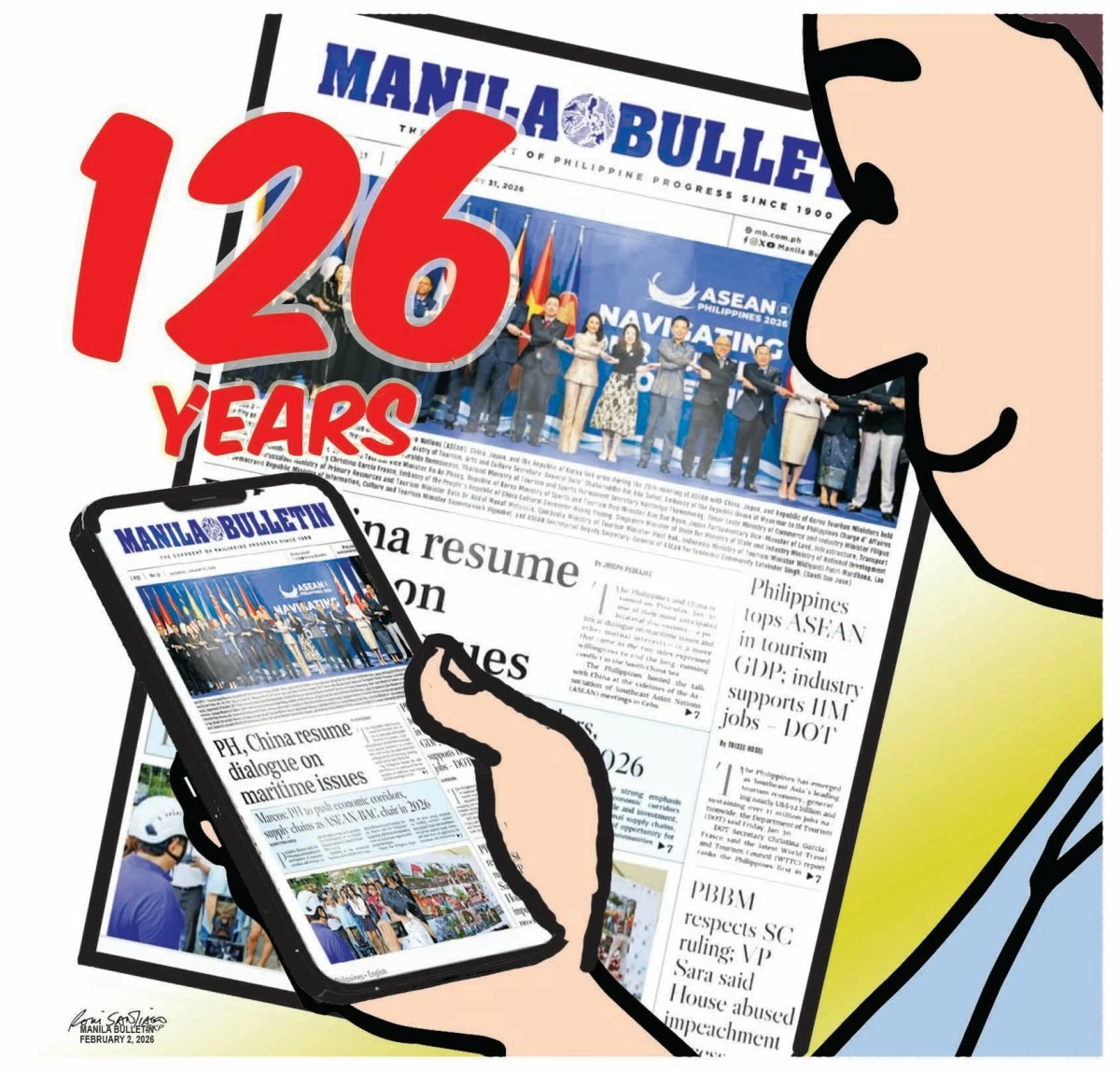
Manila Bulletin today: Why 126 years still matter

Published Feb 2, 2026 12:05 am  |  Updated Feb 1, 2026 04:22 pm
The Manila Bulletin’s 126th anniversary is more than a milestone worth commemorating. It is a moment to reflect on the enduring relevance of credible journalism at a time when the nation is once again undergoing uncertainty, disruption, and deep public questioning.
The Philippines today is defined by headline events that test public trust and national resolve: economic anxieties amid global volatility, climate-driven disasters that expose governance gaps, a digitally accelerated information ecosystem prone to distortion, and a young, restless population demanding transparency, accountability, and opportunity. In this context, the continued presence of a newspaper of record is not a matter of nostalgia; it is a democratic necessity.
For more than a century, the Manila Bulletin has chronicled the country’s evolution from colonial rule to independence; from authoritarianism to restored democracy; from analog to digital life. That long view gives the Bulletin a unique moral and civic responsibility. Its relevance today lies not only in reporting events as they unfold, but in helping Filipinos understand why they matter, how they connect, and what they mean for the future of the nation.
In an age when outrage travels faster than facts — and opinion often masquerades as truth — the value of verification, context, and restraint cannot be overstated. The Manila Bulletin’s anniversary affirms the importance of journalism that informs without rabble-rousing, critiques without condescending, and holds power to account without surrendering to partisanship. These qualities are especially vital as Filipinos confront issues such as corruption, climate resilience, food and energy security, digital transformation, and geopolitical uncertainty in the region.
Yet anniversaries are not only about honoring legacy; they are about heeding the imperatives.
For mainstream Philippine newspapers, the first imperative is to rebuild and sustain public trust. This means doubling down on accuracy, transparency, and ethical rigor—clearly separating news from opinion, correcting errors promptly, and resisting the pressures of speed that compromise substance.
Second is the imperative to remain relevant to younger audiences without diluting standards. Digital natives do not reject journalism; they reject irrelevance. Newspapers must meet them where they are—on mobile platforms and social spaces—while offering depth, perspective, and storytelling that algorithms alone cannot provide.
Third is the need to invest in journalists and journalism itself. Technology may change how news is delivered, but it cannot replace human judgment, courage, and compassion. Continuous training and updating, newsroom innovation, and protection of editorial independence are non-negotiable if newspapers are to thrive.
Finally, mainstream media must continue to champion hope grounded in truth. This does not mean glossing over hard realities. It means telling stories of solutions, resilience, and shared responsibility—stories that empower citizens to act rather than disengage.
At 126, the Manila Bulletin stands as both witness and participant in the nation’s continuing story. Its celebration is, ultimately, a reaffirmation of a simple but powerful belief: that an informed public is the strongest foundation of a free, progressive, and humane society. In honoring the past, the Manila Bulletin renews its commitment to the future—serving as an “Exponent of Philippine Progress” in a world that needs truth more than ever.
ADVERTISEMENT
.most-popular .layout-ratio{ padding-bottom: 79.13%; } @media (min-width: 768px) and (max-width: 1024px) { .widget-title { font-size: 15px !important; } }

{{ articles_filter_1561_widget.title }}

.most-popular .layout-ratio{ padding-bottom: 79.13%; } @media (min-width: 768px) and (max-width: 1024px) { .widget-title { font-size: 15px !important; } }

{{ articles_filter_1562_widget.title }}

.most-popular .layout-ratio{ padding-bottom: 79.13%; } @media (min-width: 768px) and (max-width: 1024px) { .widget-title { font-size: 15px !important; } }

{{ articles_filter_1563_widget.title }}

{{ articles_filter_1564_widget.title }}

.mb-article-details { position: relative; } .mb-article-details .article-body-preview, .mb-article-details .article-body-summary{ font-size: 17px; line-height: 30px; font-family: "Libre Caslon Text", serif; color: #000; } .mb-article-details .article-body-preview iframe , .mb-article-details .article-body-summary iframe{ width: 100%; margin: auto; } .read-more-background { background: linear-gradient(180deg, color(display-p3 1.000 1.000 1.000 / 0) 13.75%, color(display-p3 1.000 1.000 1.000 / 0.8) 30.79%, color(display-p3 1.000 1.000 1.000) 72.5%); position: absolute; height: 200px; width: 100%; bottom: 0; display: flex; justify-content: center; align-items: center; padding: 0; } .read-more-background a{ color: #000; } .read-more-btn { padding: 17px 45px; font-family: Inter; font-weight: 700; font-size: 18px; line-height: 16px; text-align: center; vertical-align: middle; border: 1px solid black; background-color: white; } .hidden { display: none; }
function initializeAllSwipers() { // Get all hidden inputs with cms_article_id document.querySelectorAll('[id^="cms_article_id_"]').forEach(function (input) { const cmsArticleId = input.value; const articleSelector = '#article-' + cmsArticleId + ' .body_images'; const swiperElement = document.querySelector(articleSelector); if (swiperElement && !swiperElement.classList.contains('swiper-initialized')) { new Swiper(articleSelector, { loop: true, pagination: false, navigation: { nextEl: '#article-' + cmsArticleId + ' .swiper-button-next', prevEl: '#article-' + cmsArticleId + ' .swiper-button-prev', }, }); } }); } setTimeout(initializeAllSwipers, 3000); const intersectionObserver = new IntersectionObserver( (entries) => { entries.forEach((entry) => { if (entry.isIntersecting) { const newUrl = entry.target.getAttribute("data-url"); if (newUrl) { history.pushState(null, null, newUrl); let article = entry.target; // Extract metadata const author = article.querySelector('.author-section').textContent.replace('By', '').trim(); const section = article.querySelector('.section-info ').textContent.replace(' ', ' '); const title = article.querySelector('.article-title h1').textContent; // Parse URL for Chartbeat path format const parsedUrl = new URL(newUrl, window.location.origin); const cleanUrl = parsedUrl.host + parsedUrl.pathname; // Update Chartbeat configuration if (typeof window._sf_async_config !== 'undefined') { window._sf_async_config.path = cleanUrl; window._sf_async_config.sections = section; window._sf_async_config.authors = author; } // Track virtual page view with Chartbeat if (typeof pSUPERFLY !== 'undefined' && typeof pSUPERFLY.virtualPage === 'function') { try { pSUPERFLY.virtualPage({ path: cleanUrl, title: title, sections: section, authors: author }); } catch (error) { console.error('ping error', error); } } // Optional: Update document title if (title && title !== document.title) { document.title = title; } } } }); }, { threshold: 0.1 } ); function showArticleBody(button) { const article = button.closest("article"); const summary = article.querySelector(".article-body-summary"); const body = article.querySelector(".article-body-preview"); const readMoreSection = article.querySelector(".read-more-background"); // Hide summary and read-more section summary.style.display = "none"; readMoreSection.style.display = "none"; // Show the full article body body.classList.remove("hidden"); } document.addEventListener("DOMContentLoaded", () => { let loadCount = 0; // Track how many times articles are loaded const offset = [1, 2, 3, 4, 5, 6, 7, 8, 9, 10]; // Offset values const currentUrl = window.location.pathname.substring(1); let isLoading = false; // Prevent multiple calls if (!currentUrl) { console.log("Current URL is invalid."); return; } const sentinel = document.getElementById("load-more-sentinel"); if (!sentinel) { console.log("Sentinel element not found."); return; } function isSentinelVisible() { const rect = sentinel.getBoundingClientRect(); return ( rect.top < window.innerHeight && rect.bottom >= 0 ); } function onScroll() { if (isLoading) return; if (isSentinelVisible()) { if (loadCount >= offset.length) { console.log("Maximum load attempts reached."); window.removeEventListener("scroll", onScroll); return; } isLoading = true; const currentOffset = offset[loadCount]; window.loadMoreItems().then(() => { let article = document.querySelector('#widget_1690 > div:nth-last-of-type(2) article'); intersectionObserver.observe(article) loadCount++; }).catch(error => { console.error("Error loading more items:", error); }).finally(() => { isLoading = false; }); } } window.addEventListener("scroll", onScroll); });

Sign up by email to receive news.