ADVERTISEMENT

Good manners: Have we forgotten how to share space?

Published Feb 1, 2026 12:05 am
In the dense metro cities, life is lived in close quarters. We line up, squeeze in, wait our turn, and share limited space with millions of others every single day. In such environments, good manners are not ornamental; they are essential. Yet increasingly, one wonders if this quiet social contract is beginning to fray.
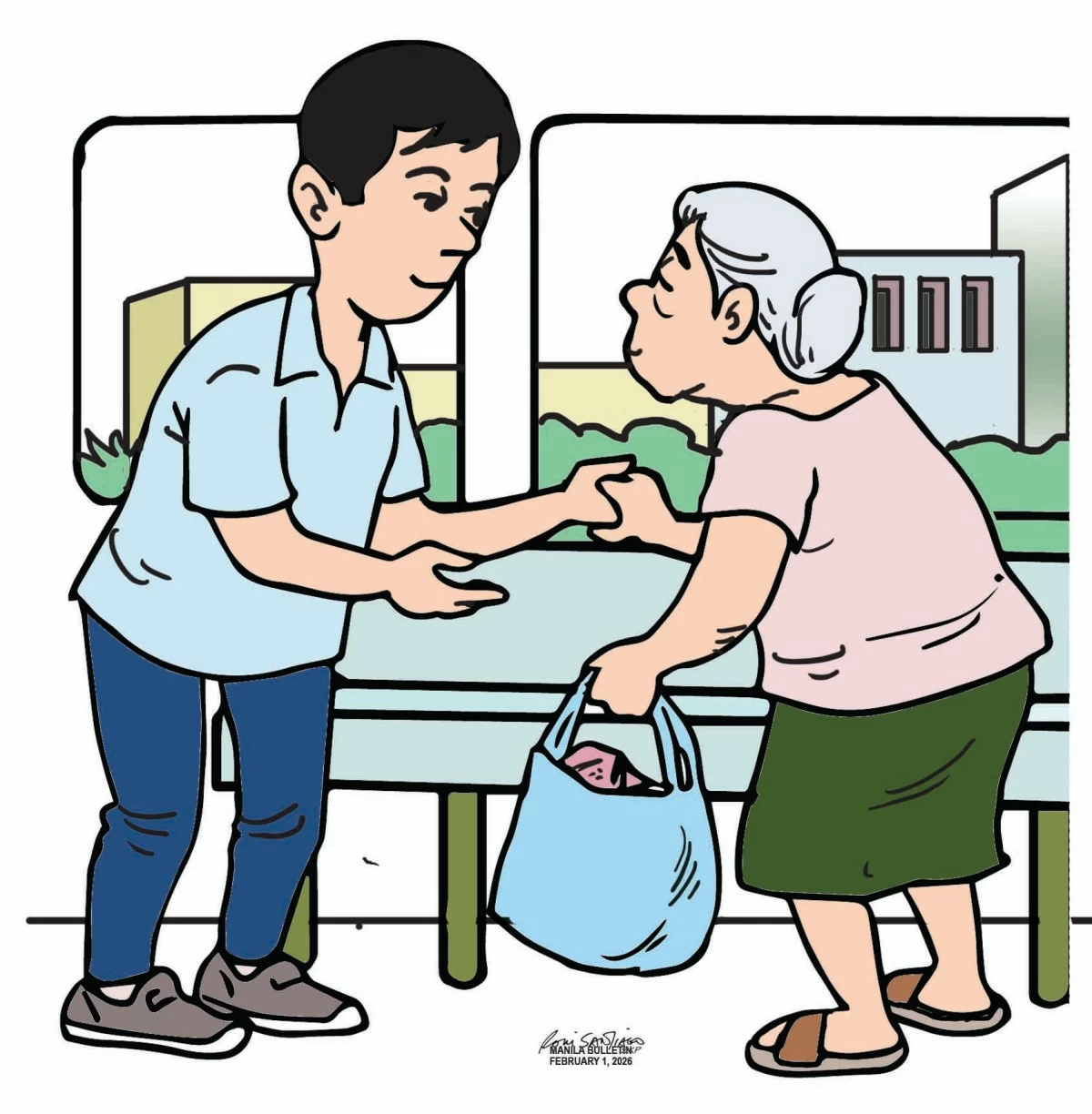
Take a scene familiar to many urban commuters. At an MRT or LRT station during rush hour, an elderly woman stands patiently near the door, hoping for a seat. The train arrives, packed as usual. Younger passengers—students and young professionals—remain seated, eyes glued to their phones, earbuds in, bodies angled away. No one is openly rude, yet no one moves. The train pulls away, leaving courtesy behind.
Or consider a busy mall restroom in Makati or Quezon City. A senior citizen waits in line, clearly tired. Suddenly, a child darts ahead, cutting the queue. The accompanying adult says nothing. Others avert their gaze. It is a small incident, easily dismissed, but it speaks volumes about what is tolerated—and what is no longer taught.
In crowded fast food restaurants around city centers, tables are often filled with groups of young people laughing loudly, shouting across one another, phones blaring videos without headphones. Nearby diners—families with children, elderly couples, workers grabbing a quick meal—endure the noise in silence. Courtesy, once instinctive in shared spaces, now feels optional.
These moments are not acts of malice. They are symptoms of something subtler and more troubling: a growing indifference to others. Metro life is stressful, fast-paced, and impersonal, and it trains people to focus inward just to cope. But when consideration disappears from public behavior, the city becomes harsher than it needs to be.
For many Filipinos, this shift is particularly painful because it contrasts sharply with the values we were raised on. Respect for elders, awareness of one’s surroundings, and sensitivity to others were once non-negotiable. Schools reinforced these values through Good Manners and Right Conduct classes, which—however basic they may have seemed—created a shared moral foundation. Today, with these lessons largely absent from formal education, values formation is left to families alone, many of whom are already stretched thin by economic and social pressures.
Do we need GMRC back? Perhaps not in its old form, but certainly in spirit. Urban life today presents new challenges: digital distractions, overcrowding, cultural diversity. Children and young people need guidance on how to act considerately in modern public spaces—on trains, online, in malls, and on the streets. Respect must be taught not as blind obedience, but as empathy in action.
Yet schools cannot do this alone. Parents, guardians, and adults in general must reclaim their role as everyday teachers of courtesy. Correcting a child gently for cutting a line, standing up for an elderly passenger, lowering one’s voice in public—these small acts model behavior far more powerfully than any lecture.
The hopeful truth is this: manners can return as quietly as they faded. A seat offered. A voice softened. A line respected. Cities do not have to be cold places. With a little intention and collective effort, our metro spaces can once again reflect the best of who we are as Filipinos—thoughtful, respectful, and mindful that we are never alone in the crowd.
ADVERTISEMENT
.most-popular .layout-ratio{ padding-bottom: 79.13%; } @media (min-width: 768px) and (max-width: 1024px) { .widget-title { font-size: 15px !important; } }

{{ articles_filter_1561_widget.title }}

.most-popular .layout-ratio{ padding-bottom: 79.13%; } @media (min-width: 768px) and (max-width: 1024px) { .widget-title { font-size: 15px !important; } }

{{ articles_filter_1562_widget.title }}

.most-popular .layout-ratio{ padding-bottom: 79.13%; } @media (min-width: 768px) and (max-width: 1024px) { .widget-title { font-size: 15px !important; } }

{{ articles_filter_1563_widget.title }}

{{ articles_filter_1564_widget.title }}

.mb-article-details { position: relative; } .mb-article-details .article-body-preview, .mb-article-details .article-body-summary{ font-size: 17px; line-height: 30px; font-family: "Libre Caslon Text", serif; color: #000; } .mb-article-details .article-body-preview iframe , .mb-article-details .article-body-summary iframe{ width: 100%; margin: auto; } .read-more-background { background: linear-gradient(180deg, color(display-p3 1.000 1.000 1.000 / 0) 13.75%, color(display-p3 1.000 1.000 1.000 / 0.8) 30.79%, color(display-p3 1.000 1.000 1.000) 72.5%); position: absolute; height: 200px; width: 100%; bottom: 0; display: flex; justify-content: center; align-items: center; padding: 0; } .read-more-background a{ color: #000; } .read-more-btn { padding: 17px 45px; font-family: Inter; font-weight: 700; font-size: 18px; line-height: 16px; text-align: center; vertical-align: middle; border: 1px solid black; background-color: white; } .hidden { display: none; }
function initializeAllSwipers() { // Get all hidden inputs with cms_article_id document.querySelectorAll('[id^="cms_article_id_"]').forEach(function (input) { const cmsArticleId = input.value; const articleSelector = '#article-' + cmsArticleId + ' .body_images'; const swiperElement = document.querySelector(articleSelector); if (swiperElement && !swiperElement.classList.contains('swiper-initialized')) { new Swiper(articleSelector, { loop: true, pagination: false, navigation: { nextEl: '#article-' + cmsArticleId + ' .swiper-button-next', prevEl: '#article-' + cmsArticleId + ' .swiper-button-prev', }, }); } }); } setTimeout(initializeAllSwipers, 3000); const intersectionObserver = new IntersectionObserver( (entries) => { entries.forEach((entry) => { if (entry.isIntersecting) { const newUrl = entry.target.getAttribute("data-url"); if (newUrl) { history.pushState(null, null, newUrl); let article = entry.target; // Extract metadata const author = article.querySelector('.author-section').textContent.replace('By', '').trim(); const section = article.querySelector('.section-info ').textContent.replace(' ', ' '); const title = article.querySelector('.article-title h1').textContent; // Parse URL for Chartbeat path format const parsedUrl = new URL(newUrl, window.location.origin); const cleanUrl = parsedUrl.host + parsedUrl.pathname; // Update Chartbeat configuration if (typeof window._sf_async_config !== 'undefined') { window._sf_async_config.path = cleanUrl; window._sf_async_config.sections = section; window._sf_async_config.authors = author; } // Track virtual page view with Chartbeat if (typeof pSUPERFLY !== 'undefined' && typeof pSUPERFLY.virtualPage === 'function') { try { pSUPERFLY.virtualPage({ path: cleanUrl, title: title, sections: section, authors: author }); } catch (error) { console.error('ping error', error); } } // Optional: Update document title if (title && title !== document.title) { document.title = title; } } } }); }, { threshold: 0.1 } ); function showArticleBody(button) { const article = button.closest("article"); const summary = article.querySelector(".article-body-summary"); const body = article.querySelector(".article-body-preview"); const readMoreSection = article.querySelector(".read-more-background"); // Hide summary and read-more section summary.style.display = "none"; readMoreSection.style.display = "none"; // Show the full article body body.classList.remove("hidden"); } document.addEventListener("DOMContentLoaded", () => { let loadCount = 0; // Track how many times articles are loaded const offset = [1, 2, 3, 4, 5, 6, 7, 8, 9, 10]; // Offset values const currentUrl = window.location.pathname.substring(1); let isLoading = false; // Prevent multiple calls if (!currentUrl) { console.log("Current URL is invalid."); return; } const sentinel = document.getElementById("load-more-sentinel"); if (!sentinel) { console.log("Sentinel element not found."); return; } function isSentinelVisible() { const rect = sentinel.getBoundingClientRect(); return ( rect.top < window.innerHeight && rect.bottom >= 0 ); } function onScroll() { if (isLoading) return; if (isSentinelVisible()) { if (loadCount >= offset.length) { console.log("Maximum load attempts reached."); window.removeEventListener("scroll", onScroll); return; } isLoading = true; const currentOffset = offset[loadCount]; window.loadMoreItems().then(() => { let article = document.querySelector('#widget_1690 > div:nth-last-of-type(2) article'); intersectionObserver.observe(article) loadCount++; }).catch(error => { console.error("Error loading more items:", error); }).finally(() => { isLoading = false; }); } } window.addEventListener("scroll", onScroll); });

Sign up by email to receive news.