ADVERTISEMENT

Oversight in social media crucial in protecting the public

Published Jan 30, 2026 12:05 am  |  Updated Jan 29, 2026 06:17 pm
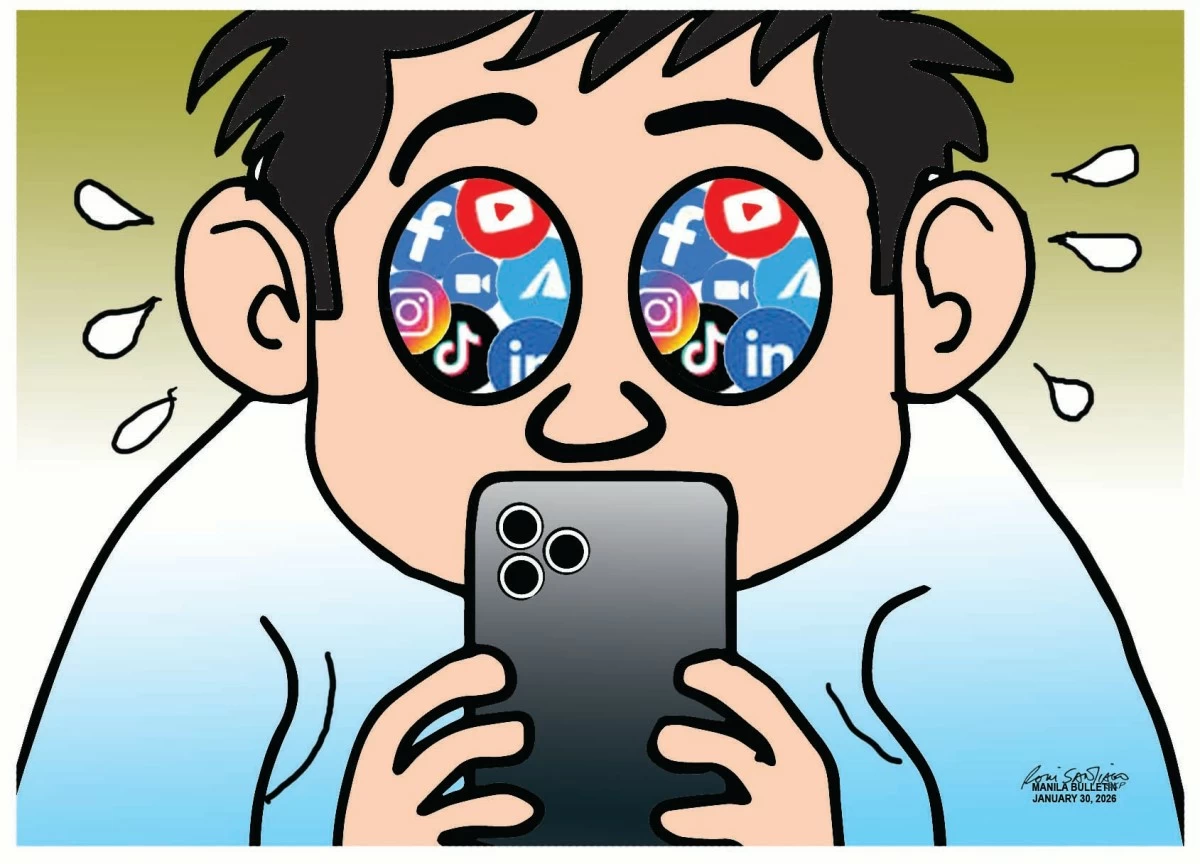
Social media has already woven itself into the fabric of modern life, no doubt about it. It shapes how we learn, how we relate to one another, and how we understand the world. It has given voice to the voiceless, connected families across borders, and sparked movements that changed history. Yet beneath these undeniable benefits lies a worrisome development. The same systems that connect us are also harming us—quietly, persistently, and at times irreversibly.
At the center of this crisis are opaque, profit-driven algorithms that decide what we see, what we feel, and often what we believe. These systems are designed to capture attention, reward emotional extremes, and keep users scrolling for as long as possible. In doing so, they magnify misinformation, normalize cruelty, enable fraud, and deepen social divisions. For children and other vulnerable users, the cost is measured not only in lost privacy, but in damaged mental health, distorted self-worth, and lives altered before they have fully begun.
When a society knows harm is occurring and chooses not to act on it, then this silence becomes complicity. This is why the call for a Social Media Accountability Act—and a meaningful government oversight for that matter—must be taken with utmost seriousness.
Government oversight is not an attack on free expression. It is in fact an affirmation of public responsibility. Democracies have long recognized that markets, left entirely to themselves, do not always protect the common good. We regulate medicine to prevent poisoning and overdose; transportation to prevent tragedy; and finance to prevent exploitation. Social media, though operated by private enterprises but deemed a global public square, should not be the lone exception, especially when its influence reaches into the minds of children and the stability of democratic discourse.
Transparency must be the cornerstone of reform. Platforms should no longer be allowed to hide behind trade secrecy when their algorithms demonstrably shape public behavior and emotion. Independent oversight bodies must be empowered to examine how content is prioritized, how data is harvested, and how risks to mental health, elections, and public safety are assessed and mitigated. Accountability requires visibility.
Equally urgent is the protection of the young. Children are not merely “users;” they are developing human beings. Policies must enforce strict limits on data collection from minors, prohibit targeted advertising to them, and require platform designs that prioritize well-being over addiction. The endless scroll, the dopamine-driven notifications, and the silent comparison culture have exacted a toll that can no longer be dismissed as collateral damage.
Oversight must also confront the harms that flourish daily online. Rampant cyberbullying that pushes victims into despair; financial scams that prey on trust; data breaches that expose lives; and echo chambers that fracture societies into hostile camps. These are among the risks of an unregulated social media. This is why platforms should act to clear standards for preventing, responding to, and remedying these harms. Repeated failure should carry real consequences, not performative and routine apologies.
Yet regulation alone cannot heal what has been broken. Crucial here is for governments to lead in educating citizens for digital citizenship. Media literacy—understanding algorithms, verifying information, recognizing manipulation—must become a core public skill. Citizens empowered with knowledge are less easily deceived and less likely to harm one another online.
History will judge this moment. Officials today are confronted with a choice: to act with courage and foresight, or to look away while harm continues behind glowing screens. Bear in mind, oversight is not about control, it is about care. In a digital age that increasingly defines our humanity, protecting the public is a moral and legal responsibility.
.mb-article-details { position: relative; } .mb-article-details .article-body-preview, .mb-article-details .article-body-summary{ font-size: 17px; line-height: 30px; font-family: "Libre Caslon Text", serif; color: #000; } .mb-article-details .article-body-preview iframe , .mb-article-details .article-body-summary iframe{ width: 100%; margin: auto; } .read-more-background { background: linear-gradient(180deg, color(display-p3 1.000 1.000 1.000 / 0) 13.75%, color(display-p3 1.000 1.000 1.000 / 0.8) 30.79%, color(display-p3 1.000 1.000 1.000) 72.5%); position: absolute; height: 200px; width: 100%; bottom: 0; display: flex; justify-content: center; align-items: center; padding: 0; } .read-more-background a{ color: #000; } .read-more-btn { padding: 17px 45px; font-family: Inter; font-weight: 700; font-size: 18px; line-height: 16px; text-align: center; vertical-align: middle; border: 1px solid black; background-color: white; } .hidden { display: none; }
function initializeAllSwipers() { // Get all hidden inputs with cms_article_id document.querySelectorAll('[id^="cms_article_id_"]').forEach(function (input) { const cmsArticleId = input.value; const articleSelector = '#article-' + cmsArticleId + ' .body_images'; const swiperElement = document.querySelector(articleSelector); if (swiperElement && !swiperElement.classList.contains('swiper-initialized')) { new Swiper(articleSelector, { loop: true, pagination: false, navigation: { nextEl: '#article-' + cmsArticleId + ' .swiper-button-next', prevEl: '#article-' + cmsArticleId + ' .swiper-button-prev', }, }); } }); } setTimeout(initializeAllSwipers, 3000); function showArticleBody(button) { const article = button.closest("article"); const summary = article.querySelector(".article-body-summary"); const body = article.querySelector(".article-body-preview"); const readMoreSection = article.querySelector(".read-more-background"); // Hide summary and read-more section summary.style.display = "none"; readMoreSection.style.display = "none"; // Show the full article body body.classList.remove("hidden"); } document.addEventListener("DOMContentLoaded", () => { let loadCount = 0; // Track how many times articles are loaded const offset = [1, 2, 3, 4, 5, 6, 7, 8, 9, 10]; // Offset values const currentUrl = window.location.pathname.substring(1); let isLoading = false; // Prevent multiple calls if (!currentUrl) { console.log("Current URL is invalid."); return; } const sentinel = document.getElementById("load-more-sentinel"); if (!sentinel) { console.log("Sentinel element not found."); return; } function isSentinelVisible() { const rect = sentinel.getBoundingClientRect(); return ( rect.top < window.innerHeight && rect.bottom >= 0 ); } function onScroll() { console.log('scroll event'); if (isLoading) return; if (isSentinelVisible()) { if (loadCount >= offset.length) { console.log("Maximum load attempts reached."); window.removeEventListener("scroll", onScroll); return; } isLoading = true; const currentOffset = offset[loadCount]; window.loadMoreItems().then((data) => { console.log(data); console.log(this); loadCount++; }).catch(error => { console.error("Error loading more items:", error); }).finally(() => { isLoading = false; }); } } window.addEventListener("scroll", onScroll); }); // Mutation Observer for Newly Loaded Articles const observer = new MutationObserver(() => { console.log("length: ", articles.length); const articles = document.querySelectorAll(".articles-observe"); if (articles.length > 0) { observeArticles(articles); } }); observer.observe(document.body, { childList: true, subtree: true }); let oberservationCount = 0; // Intersection Observer for Updating URL function observeArticles(articles) { const intersectionObserver = new IntersectionObserver( (entries) => { entries.forEach((entry) => { if (entry.isIntersecting) { const newUrl = entry.target.getAttribute("data-url"); if (newUrl && newUrl !== window.location.pathname) { history.pushState(null, null, newUrl); // Extract metadata const section = entry.target.querySelector('.section-info a:first-of-type')?.textContent?.trim() || ''; const author = entry.target.querySelector('.author-section a')?.textContent?.trim() || ''; const title = entry.target.querySelector('h1, h2, h3, .article-title')?.textContent?.trim() || document.title; // Parse URL for Chartbeat path format const parsedUrl = new URL(newUrl, window.location.origin); const cleanUrl = parsedUrl.host + parsedUrl.pathname; // Update Chartbeat configuration if (typeof window._sf_async_config !== 'undefined') { window._sf_async_config.path = cleanUrl; window._sf_async_config.sections = section; window._sf_async_config.authors = author; } // Track virtual page view with Chartbeat if (typeof pSUPERFLY !== 'undefined' && typeof pSUPERFLY.virtualPage === 'function') { pSUPERFLY.virtualPage(cleanUrl, { title: title, sections: section, authors: author }); } // Optional: Update document title if (title && title !== document.title) { document.title = title; } console.log('Chartbeat virtual page tracked:', { url: cleanUrl, section: section, author: author, title: title }); } } }); }, { threshold: 0.1 } ); articles.forEach(article => { console.log(oberservationCount++); intersectionObserver.observe(article) }); }
ADVERTISEMENT
.most-popular .layout-ratio{ padding-bottom: 79.13%; } @media (min-width: 768px) and (max-width: 1024px) { .widget-title { font-size: 15px !important; } }

{{ articles_filter_1561_widget.title }}

.most-popular .layout-ratio{ padding-bottom: 79.13%; } @media (min-width: 768px) and (max-width: 1024px) { .widget-title { font-size: 15px !important; } }

{{ articles_filter_1562_widget.title }}

.most-popular .layout-ratio{ padding-bottom: 79.13%; } @media (min-width: 768px) and (max-width: 1024px) { .widget-title { font-size: 15px !important; } }

{{ articles_filter_1563_widget.title }}

{{ articles_filter_1564_widget.title }}

Sign up by email to receive news.