






Manila Bulletin
 Sports
Basketball
Day 1 to Year 50: Celebrating PBA golden anniversary through MB's pages
Sports
Basketball
Day 1 to Year 50: Celebrating PBA golden anniversary through MB's pages
Sports
Basketball
Day 1 to Year 50: Celebrating PBA golden anniversary through MB's pages
Day 1 to Year 50: Celebrating PBA golden anniversary through MB's pages
Published Jan 30, 2026 06:55 pm


At A Glance
- As Philippine basketball evolved—from backyard courts to sold-out arenas—the PBA stood at the center, and Manila Bulletin was there to tell every chapter.
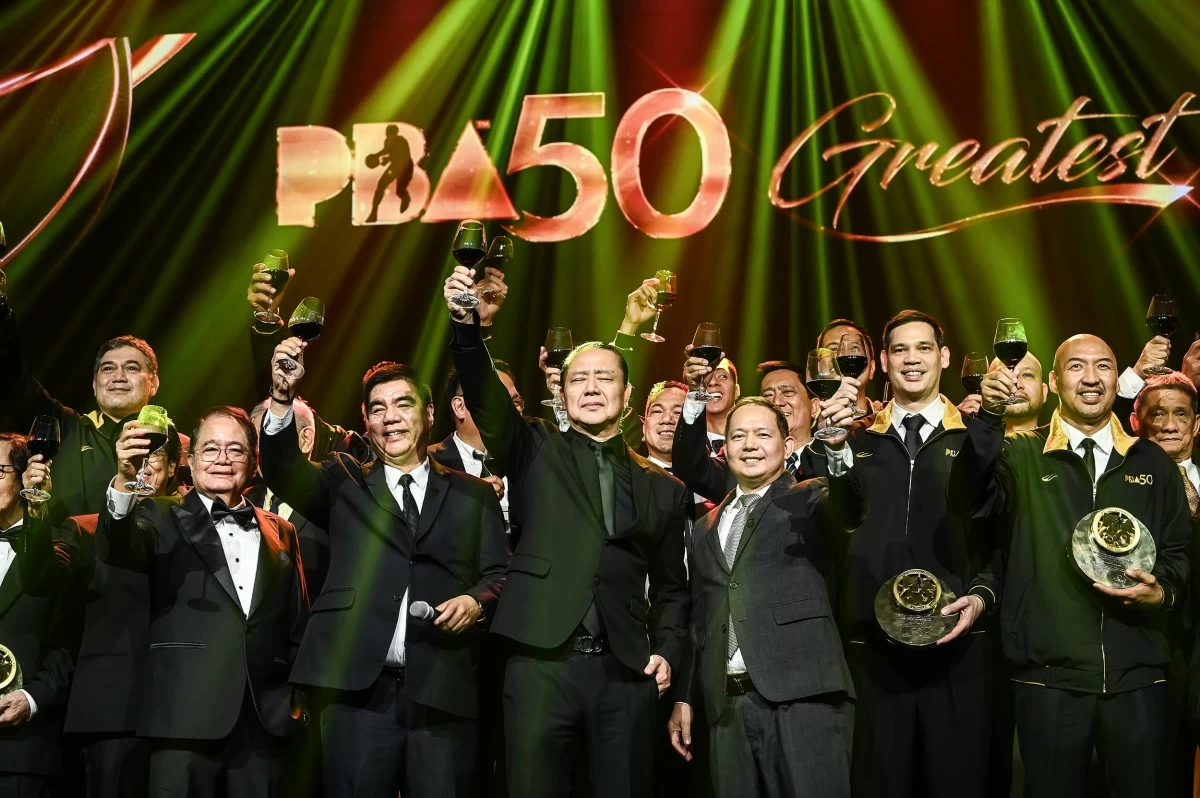
PBA officials offer a toast during the league's 50th anniversary celebration. (PBA Images)
As Philippine basketball evolved—from backyard courts to sold-out arenas—the PBA stood at the center, and Manila Bulletin was there to tell every chapter.
From the first basket during the league’s inception in 1975, to its first three-pointer in 1980, and to its latest innovation with the four-point shot in 2024, the 126-year-old newspaper chronicled every stage of the league’s rise and how it helped shape Philippine basketball as a whole.
Then known as Bulletin Today, the newspaper covered the birth of Asia’s first play-for-pay league—a bold move that showed not only Filipinos, but also other countries in the continent, the viability of professional basketball as a career.
The league would eventually blaze the trail for professional basketball leagues across Asia.
The humble beginnings
As Bulletin Today reporter Danny Santillan described it in the April 10, 1975 issue, it was a simple yet symbolic start to a league that would endure for the next 50 years and become not only a pillar of Philippine sports, but also an economic and cultural force in the country.
“A brief opening ceremony unfurled before action on the hardcourt, under a professional setup this time, and brought the nine competing teams led by their skippers and muses marching before a highly appreciative crowd,” Santillan wrote.
The night ended with Joy Dionisio’s first basket becoming a footnote to Mariwasa-Noritake’s 101-98 victory over Concepcion Carrier in the first-ever PBA game.
The league’s first five years were all about finding its footing. It played the rawest version of the sport—no three-point line, no penalty situations, and no shot-clock violations—before gradually integrating new rules and technologies.
"Before, if you get the ball and you were up by one, you just need to dribble until the clock expires. You can even dribble the ball for 30 minutes. Now, we have 30 seconds," recalled PBA commissioner Willie Marcial.
"No three-pointers, no penalties for the number of fouls. That was the game before. Today, we even have our four-pointers," he added.
The start of evolution
Bulletin Today also bore witness to the sport’s steady growth. When the NBA introduced the three-point line, the PBA followed suit a year later. Robert Jaworski, then playing for Toyota, was the first to nail the PBA three-point shot.
“Toyota backed up its advantage in teamwork with sharp outside shooting by Robert Jaworski last night to roll back Crispa Walk Tall, 112-107, in the openers of the PBA first conference at the Araneta Coliseum,” wrote Bulletin Today’s Bert Eljera.
From there, legends were forged on the PBA hardcourt. Allan Caidic set the record for most three-pointers in a single game with 17—a mark that still stands today. Years later, Marcio Lassiter would emerge as the league’s all-time three-point king, surpassing Caidic and previous record-holder Jimmy Alapag.
Jaworski’s charisma and Ginebra’s Never-Say-Die spirit turned the franchise into the league’s most beloved team.
Ramon Fernandez and Alvin Patrimonio separated themselves from the rest with four MVP awards each in the league’s first three decades, before June Mar Fajardo shattered that standard with a record nine MVPs.
PBA adapts as it evolves
Through the years, the basketball landscape—locally and globally—continued to change, and the PBA remained at the forefront, even daring to innovate beyond what purists traditionally embraced.
As the game shifted from post-up, big-man-centric play in the 1980s and 1990s, to the run-and-gun style of the 2000s and 2010s, and eventually to today’s pace-and-space basketball, the league did not shy away from change. It adapted.
And this writer of Manila Bulletin was fortunate enough to write about the first official four-point shot in the PBA—and in the world.
“You have to adjust to it. It’s a big play. Four-pointers can put you back in the game. We were only up by four points. They could have hit one and given it a chance. It’s fun playing with them,” Meralco’s Chris Banchero, who scored the first four-pointer, said in an Aug. 19, 2024 report.
Now celebrating its 50th year, the league would not have become what it is today without the journalists who chronicled every athlete, team, and game that needed to be told.
The way fans follow the PBA has changed—from newspapers, to radio and television, and now to the internet and social media—but every story, from every era, helped fuel the league’s growth.
As Marcial put it: “PBA was able to withstand plenty of challenges because of the fans, because of their comments and opinions that we fully embraced and attended to. Especially from the media, the PBA would not reach 50 years without them being our outlets."