






 Business
Trade & Industry
Asian export growth seen slowing in early 2026—Oxford Economics
Business
Trade & Industry
Asian export growth seen slowing in early 2026—Oxford Economics
Asian export growth seen slowing in early 2026—Oxford Economics


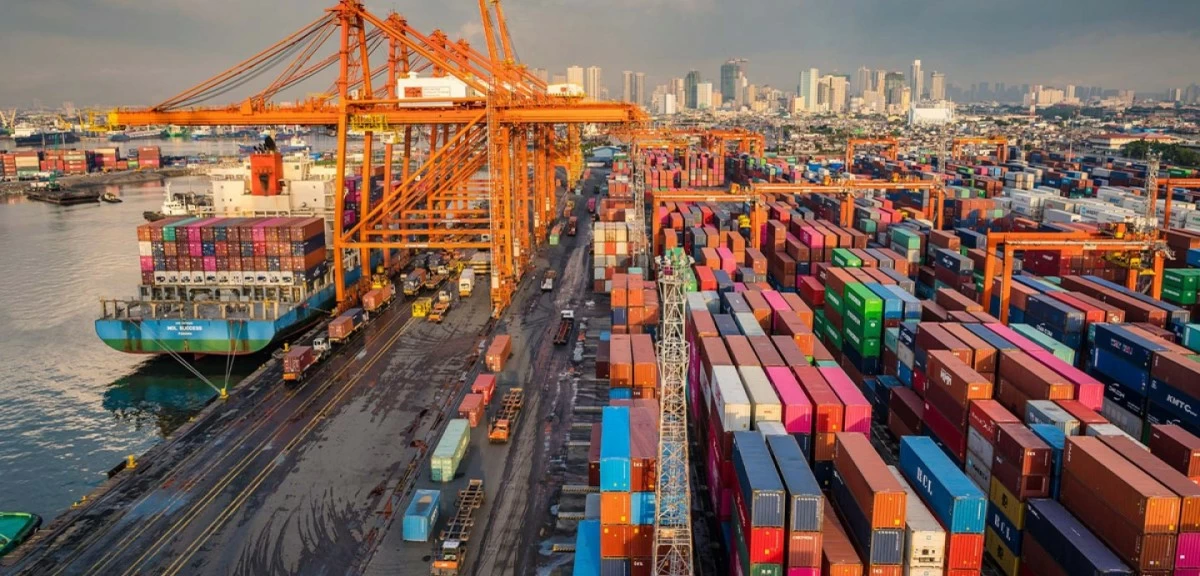
Despite the Philippines’ record-high export performance in 2025, Asian exports growth is expected to slow in early 2026 after showing signs of easing in December, according to London-based think tank Oxford Economics.
“We expect export momentum to moderate but remain firm,” Oxford Economics senior economist Sheana Yue said on Thursday, Jan. 29, adding that “Asian trade is likely to diverge this year, broadly along advanced and emerging market (EM) lines.”
While near-term resilience may continue into the start of the year, Oxford Economics noted that headwinds from United States (US) tariffs and weaker global demand for goods are likely to gradually weigh on growth.
“Last year’s resilience could persist into the first quarter thanks to enduring US consumer demand, a fiscal-led boost in China, and continued strength in AI [artificial intelligence] demand,” the think tank said. “But growing headwinds are likely to emerge as Asian exporters feel the full impact of US tariffs after delays, which will coincide with normalizing AI-related US import gains after last year’s surge.”
“Across 2025, real exports grew 10.3 percent, up from 2024’s 8.8 percent. This reflects sustained price cuts by exporters seeking to maintain competitiveness amid higher US tariffs across most trading partners,” it added.
The latest preliminary data from the Philippine Statistics Authority (PSA) showed that the Philippines’ export sector capped a record-breaking 2025 by reclaiming the US as its primary trade partner, overcoming tariff challenges to achieve the highest annual shipment volume in more than three decades.
According to the PSA, total goods exports surged 23.3 percent year-on-year in December 2025 to $6.99 billion. The year-end rally pushed total annual exports to $84.41 billion, up from $73.27 billion in 2024.
Philippine exports to the US reached $1.1 billion last December, up 14.3 percent year-on-year and accounting for 15.7 percent of the country’s total exports for the month. Full-year 2025 shipments to the US totaled $13.44 billion, up 10.6 percent year-on-year and cornering a 15.9-percent share of overall export sales.
For the full year, Philippine exports reached their highest sales since 1991, while imports hit their highest level since 2022. Total trade in 2025 amounted to $217.98 billion, rising from $200.87 billion in 2024.
Oxford Economics highlighted that advanced Asian exporters are experiencing weaker demand outside the technology sector, alongside a slowdown in AI-related orders following last year’s surge.
However, the think tank noted that electronics orders driven by capacity expansion continue to provide some support.
“Export growth last year was driven primarily by machinery and electronics, reflecting front-loaded orders ahead of potential US tariff actions and a structural upswing in AI-related demand,” it said.
For the Philippines, manufactured goods led exports in December 2025, totaling $5.59 billion and accounting for 79.9 percent of total shipments. This was followed by agro-based products at $732.09 million (10.5 percent of total) and mineral products at $514.85 million.
Oxford Economics further noted that Asia, as a major global electronics production hub, saw exports in the sector rise 22 percent in 2025. Industries facing higher US tariffs, such as metals and autos, were largely unaffected overall due to the region’s limited direct exposure to the US market—except in Japan and South Korea, where exporters responded by cutting prices.
Emerging Asian economies are expected to continue benefiting from industrial activity linked to China as supply chains reorder and intra-Asian trade strengthens, the think tank said.
Conversely, it said advanced Asian economies, including Taiwan, South Korea, and Japan, are facing broad non-tech demand weakness, while AI-related electronics orders are expected to moderate from last year’s surge, constrained more by production capacity than inventory levels.
For the Philippines, China remained the top source of imported goods in December last year, with shipments valued at $2.98 billion, up 13.6 percent year-on-year accounting for 28.4 percent of total imports for the month. For the full year, imports from China rose 16.4 percent to reach $38.22 billion, making it the country’s top import source since 2013, with a 28.6-percent share in 2025.
“Our industry economists expect only a modest cooling in the AI cycle this year. As such, AI-related exports should remain a key stabilizer in Asia, cushioning the broader moderation in export momentum,” Oxford Economics said.