






Manila Bulletin
 Business
The Stock Market
PSEi suffers deepest retreat in months on disappointing GDP data
Business
The Stock Market
PSEi suffers deepest retreat in months on disappointing GDP data
Business
The Stock Market
PSEi suffers deepest retreat in months on disappointing GDP data
PSEi suffers deepest retreat in months on disappointing GDP data
Published Jan 29, 2026 05:03 pm


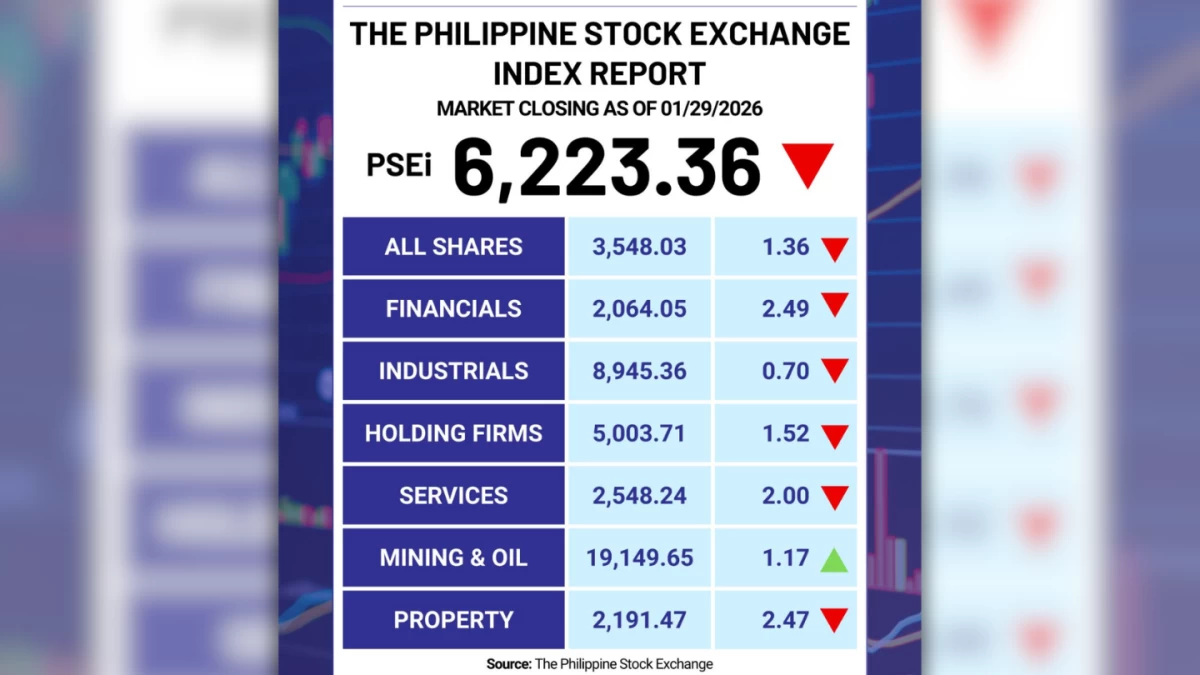
Philippine stocks suffered their steepest decline in months, tracking a selloff that erased more than two percent of the benchmark index’s value after government data showed economic growth stumbled to a near five-year low.
The disappointing gross domestic product (GDP) figures triggered a broad retreat across most sectors as investors reassessed the country’s recovery trajectory amid high interest rates and sluggish state spending.
The Philippine Stock Exchange Index dropped 132.42 points, or 2.08 percent, to finish at 6,223.36 on Thursday, Jan. 29. While mining companies found a foothold on the back of rising bullion prices, the rally was insufficient to offset heavy losses in heavyweight banking and property stocks.
Market turnover was active, with 1.34 billion shares valued at ₱7.55 billion changing hands. Decliners dominated the session, outnumbering gainers 124 to 75, while 56 issues remained unchanged.
The selloff intensified after the Philippine Statistics Authority reported that the economy expanded by just three percent in the fourth quarter of 2025, a deceleration from the 3.9 percent growth recorded in the preceding three-month period. For the full year, GDP growth averaged 4.4 percent.
Luis Limlingan, managing director at Regina Capital Development Corp., noted that the PSEi ended lower amid strong, broad-based selling pressure after the figures failed to meet market consensus.
He added that the softer growth data raised immediate concerns over the near-term economic outlook, prompting a shift toward risk-off positioning.
The equity market also faced headwinds from a weakening local currency as Japhet Tantiangco, research manager at Philstocks Financial, said the market was weighed down by the depreciation of the peso following the United States Federal Reserve’s decision to maintain its current policy rates.
Michael Ricafort, chief economist at Rizal Commercial Banking Corp., meanwhile, characterized the three percent fourth-quarter growth as the slowest pace since the first quarter of 2021.
Excluding the pandemic-induced contraction of 2020, the full-year performance represents the weakest expansion for the Philippines since 2011.
Ricafort attributed the slowdown to a combination of internal and external pressures, ranging from reduced government infrastructure spending amid heightened scrutiny of flood-control projects to adverse weather and geopolitical risks that have dampened global trade.