







Mayon Volcano effusive eruption enters 19th day
Published Jan 26, 2026 10:51 am


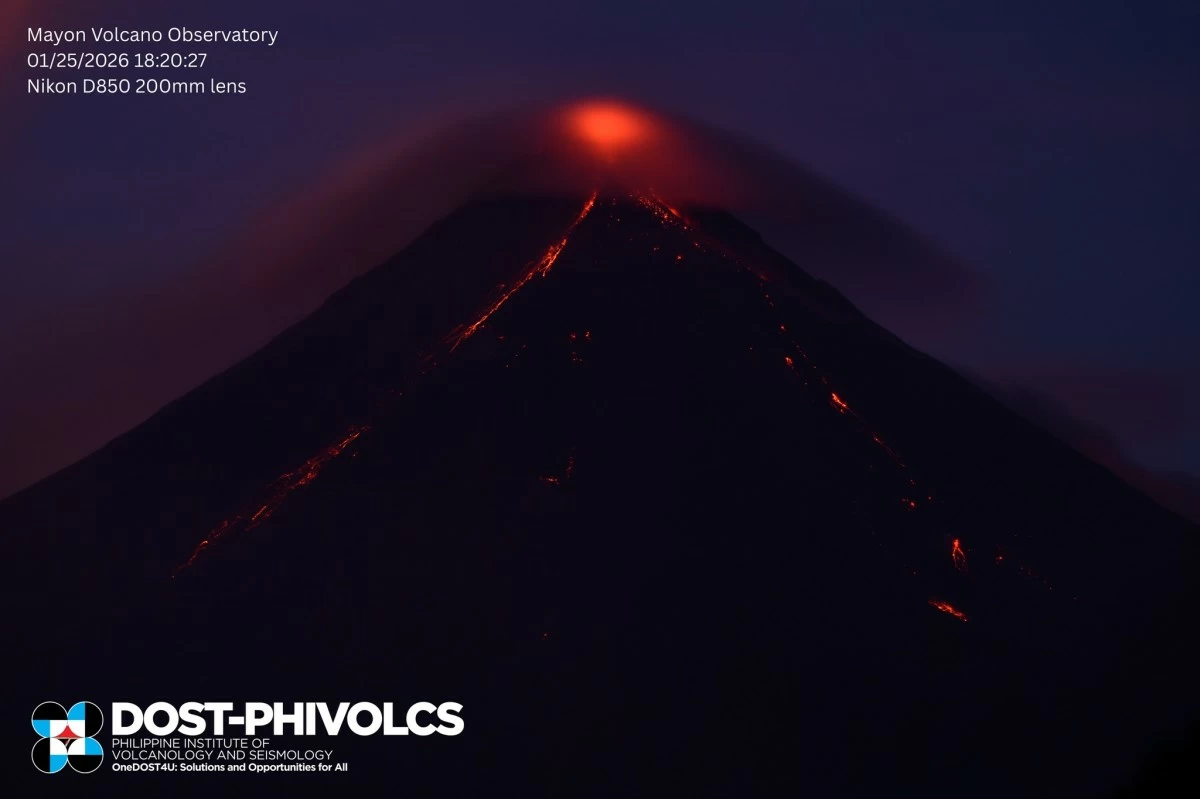
Mayon Volcano’s effusive eruption continues for the 19th consecutive day. A notable crater glow, caused by superheated volcanic gas emitted from the summit, was captured from the Mayon Volcano Observatory between 6:20 p.m. and 6:22 p.m. on January 25, 2026. (Philippine Institute of Volcanology and Seismology)
Communities near Mayon Volcano are advised to remain on alert as the volcano enters its 19th day of effusive eruption, the Philippine Institute of Volcanology and Seismology (Phivolcs) said.
Monitoring from 12 a.m. on Jan. 25 to 12 a.m. on Jan. 26 showed continuous lava effusion with episodic minor strombolian activity, a type of eruption involving small but explosive bursts of lava from the summit.
In 24 hours, Mayon recorded 229 rockfall events, 45 pyroclastic density currents, 13 volcanic earthquakes, and one ongoing tremor.
Phivolcs said a fair crater glow was visible to the naked eye.
Sulfur dioxide emissions also remained high at 1,221 tons, and a 700-meter volcanic plume drifted in multiple directions.
Mayon remains under Alert Level 3, indicating intensified magmatic unrest and the potential for hazardous eruptions.
Phivolcs reminded residents that entry into the six-kilometer permanent danger zone is strictly prohibited, while those in the extended danger zone should exercise heightened vigilance.
The agency also warned that even light ashfall may pose health risks, reduce visibility on roads, and prevent aircraft from flying near the volcano.
Volcanic hazards include rockfalls, landslides or avalanches, lava flows, ballistic fragments, lava fountaining, moderate-sized explosions, pyroclastic density currents, and lahars during heavy or prolonged rainfall.