ADVERTISEMENT

When water fails, everything follows

Published Jan 23, 2026 12:05 am  |  Updated Jan 22, 2026 06:13 pm
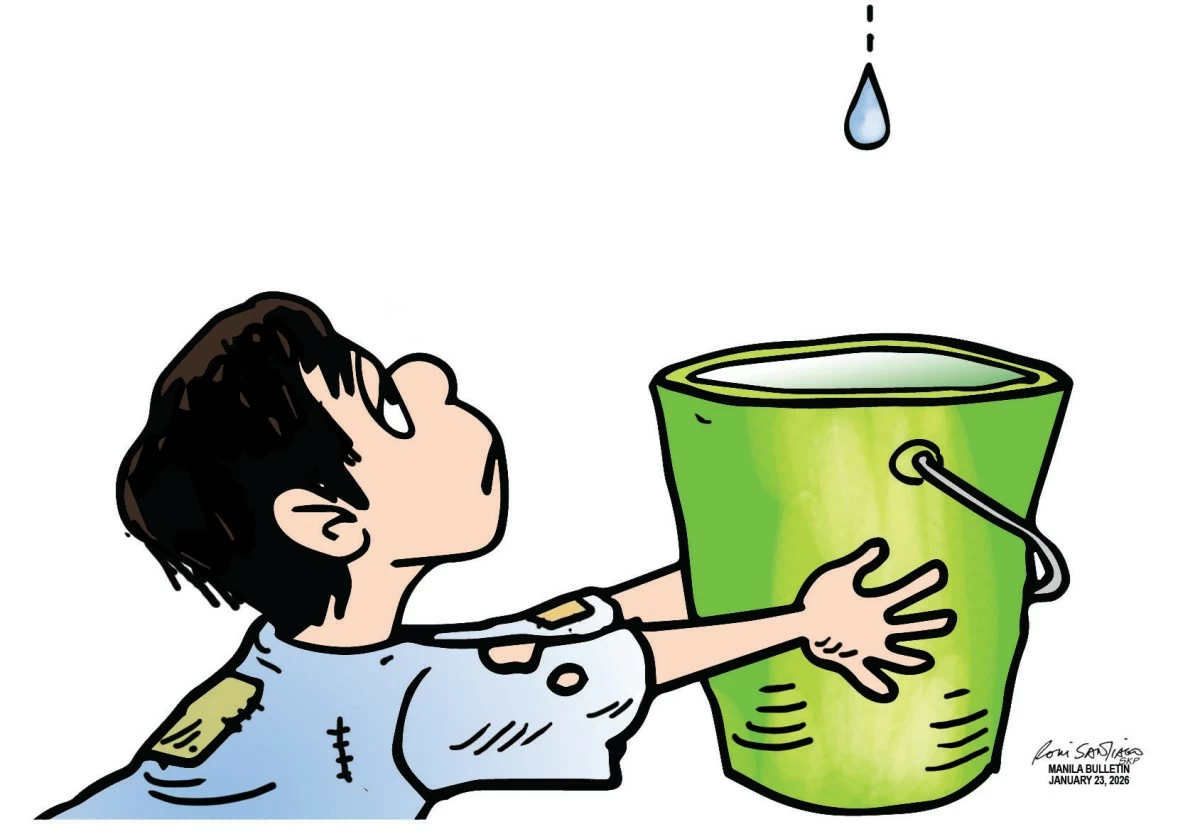
Water insecurity remains a big concern and must be considered a present national emergency. As global reports reveal billions without safe water and sanitation, about 40 million Filipinos are without access to fresh water and an estimated 55 million lacking clean, potable supply, a development that will have far-reaching social, economic, and moral consequences.
Water is life, yet policy appears to have treated it as an afterthought.
The Philippine government must begin by recognizing water security as a central pillar of national security. This means moving beyond fragmented programs and short-term fixes toward a coherent, long-range water strategy anchored in science, equity, and accountability. Watersheds must be protected as critical infrastructure. Decades of deforestation, mining, and unregulated land conversion have degraded the natural systems that store and filter water. Enforcing environmental laws, restoring forests, and protecting aquifers are not anti-development moves; they are prerequisites for sustainable growth.
Second, the country must fix how water is governed. Too many agencies with overlapping mandates have resulted in paralysis rather than progress. A strong, empowered lead institution—whether through reform or consolidation—should coordinate planning, regulate extraction, manage data, and enforce standards nationwide. Accurate, transparent water data must guide decisions: who uses water, how much is available, and where risks are rising. You cannot manage what you do not measure.
Third, infrastructure investment must prioritize people, not politics. Leaking pipes, aging systems, and untreated wastewater waste billions of liters daily while poisoning rivers and coasts. Public funds should be directed toward climate-resilient water systems, especially in rural areas and informal urban communities that are often last in line and first to suffer. Sanitation deserves equal urgency; untreated wastewater is a silent disaster undermining public health and ecosystems alike.
But the government cannot—and should not—do this alone.
The private sector must step up as a partner, not merely a contractor or a concessionaire. Water stewardship should be embedded in business models, particularly for water-intensive industries such as agriculture, manufacturing, and real estate. This means investing in water-efficient technologies, recycling and reuse systems, and transparent reporting of water footprints. Public-private partnerships can help expand and modernize water services, but they must be governed by clear rules that protect affordability, quality, and universal access. The government’s partnership with concessionaires in Metro Manila have improved water services several notches higher. But there’s much that needs to be done to enable more people to have access to safe water. Water is a human right, not just a revenue stream.
Financial institutions also have a role. Capital should flow toward sustainable water projects, not activities that degrade watersheds and pollute waterways. Environmental risk must be treated as financial risk—because it is.
Finally, every Filipino and resident has a stake and a responsibility. Water conservation should not be treated as symbolic. Small daily choices add up when multiplied by millions. Fixing leaks, reducing waste, segregating trash to prevent waterway pollution, and supporting local conservation efforts matter. Equally important is civic engagement: demanding accountability from leaders, opposing destructive projects, and supporting policies that protect shared water resources.
The water crisis is not only about scarcity; it is about our choices. Who gets water, at what cost, and at whose expense? If current trends continue, water insecurity will deepen inequality, fuel conflict, and undermine development gains. But if addressed with urgency and courage, water can become a unifying national project—one that secures health, dignity, and opportunity for generations.
When water fails, everything follows. The choice to act is still ours. Let’s act now before it’s too late.
ADVERTISEMENT
.most-popular .layout-ratio{ padding-bottom: 79.13%; } @media (min-width: 768px) and (max-width: 1024px) { .widget-title { font-size: 15px !important; } }

{{ articles_filter_1561_widget.title }}

.most-popular .layout-ratio{ padding-bottom: 79.13%; } @media (min-width: 768px) and (max-width: 1024px) { .widget-title { font-size: 15px !important; } }

{{ articles_filter_1562_widget.title }}

.most-popular .layout-ratio{ padding-bottom: 79.13%; } @media (min-width: 768px) and (max-width: 1024px) { .widget-title { font-size: 15px !important; } }

{{ articles_filter_1563_widget.title }}

{{ articles_filter_1564_widget.title }}

.mb-article-details { position: relative; } .mb-article-details .article-body-preview, .mb-article-details .article-body-summary{ font-size: 17px; line-height: 30px; font-family: "Libre Caslon Text", serif; color: #000; } .mb-article-details .article-body-preview iframe , .mb-article-details .article-body-summary iframe{ width: 100%; margin: auto; } .read-more-background { background: linear-gradient(180deg, color(display-p3 1.000 1.000 1.000 / 0) 13.75%, color(display-p3 1.000 1.000 1.000 / 0.8) 30.79%, color(display-p3 1.000 1.000 1.000) 72.5%); position: absolute; height: 200px; width: 100%; bottom: 0; display: flex; justify-content: center; align-items: center; padding: 0; } .read-more-background a{ color: #000; } .read-more-btn { padding: 17px 45px; font-family: Inter; font-weight: 700; font-size: 18px; line-height: 16px; text-align: center; vertical-align: middle; border: 1px solid black; background-color: white; } .hidden { display: none; }
function initializeAllSwipers() { // Get all hidden inputs with cms_article_id document.querySelectorAll('[id^="cms_article_id_"]').forEach(function (input) { const cmsArticleId = input.value; const articleSelector = '#article-' + cmsArticleId + ' .body_images'; const swiperElement = document.querySelector(articleSelector); if (swiperElement && !swiperElement.classList.contains('swiper-initialized')) { new Swiper(articleSelector, { loop: true, pagination: false, navigation: { nextEl: '#article-' + cmsArticleId + ' .swiper-button-next', prevEl: '#article-' + cmsArticleId + ' .swiper-button-prev', }, }); } }); } setTimeout(initializeAllSwipers, 3000); const intersectionObserver = new IntersectionObserver( (entries) => { entries.forEach((entry) => { if (entry.isIntersecting) { const newUrl = entry.target.getAttribute("data-url"); if (newUrl) { history.pushState(null, null, newUrl); let article = entry.target; // Extract metadata const author = article.querySelector('.author-section').textContent.replace('By', '').trim(); const section = article.querySelector('.section-info ').textContent.replace(' ', ' '); const title = article.querySelector('.article-title h1').textContent; // Parse URL for Chartbeat path format const parsedUrl = new URL(newUrl, window.location.origin); const cleanUrl = parsedUrl.host + parsedUrl.pathname; // Update Chartbeat configuration if (typeof window._sf_async_config !== 'undefined') { window._sf_async_config.path = cleanUrl; window._sf_async_config.sections = section; window._sf_async_config.authors = author; } // Track virtual page view with Chartbeat if (typeof pSUPERFLY !== 'undefined' && typeof pSUPERFLY.virtualPage === 'function') { try { pSUPERFLY.virtualPage({ path: cleanUrl, title: title, sections: section, authors: author }); } catch (error) { console.error('ping error', error); } } // Optional: Update document title if (title && title !== document.title) { document.title = title; } } } }); }, { threshold: 0.1 } ); function showArticleBody(button) { const article = button.closest("article"); const summary = article.querySelector(".article-body-summary"); const body = article.querySelector(".article-body-preview"); const readMoreSection = article.querySelector(".read-more-background"); // Hide summary and read-more section summary.style.display = "none"; readMoreSection.style.display = "none"; // Show the full article body body.classList.remove("hidden"); } document.addEventListener("DOMContentLoaded", () => { let loadCount = 0; // Track how many times articles are loaded const offset = [1, 2, 3, 4, 5, 6, 7, 8, 9, 10]; // Offset values const currentUrl = window.location.pathname.substring(1); let isLoading = false; // Prevent multiple calls if (!currentUrl) { console.log("Current URL is invalid."); return; } const sentinel = document.getElementById("load-more-sentinel"); if (!sentinel) { console.log("Sentinel element not found."); return; } function isSentinelVisible() { const rect = sentinel.getBoundingClientRect(); return ( rect.top < window.innerHeight && rect.bottom >= 0 ); } function onScroll() { if (isLoading) return; if (isSentinelVisible()) { if (loadCount >= offset.length) { console.log("Maximum load attempts reached."); window.removeEventListener("scroll", onScroll); return; } isLoading = true; const currentOffset = offset[loadCount]; window.loadMoreItems().then(() => { let article = document.querySelector('#widget_1690 > div:nth-last-of-type(2) article'); intersectionObserver.observe(article) loadCount++; }).catch(error => { console.error("Error loading more items:", error); }).finally(() => { isLoading = false; }); } } window.addEventListener("scroll", onScroll); });

Sign up by email to receive news.