







Analysts warn that Iran crisis carries potential nuclear risks
Published Jan 20, 2026 02:06 pm


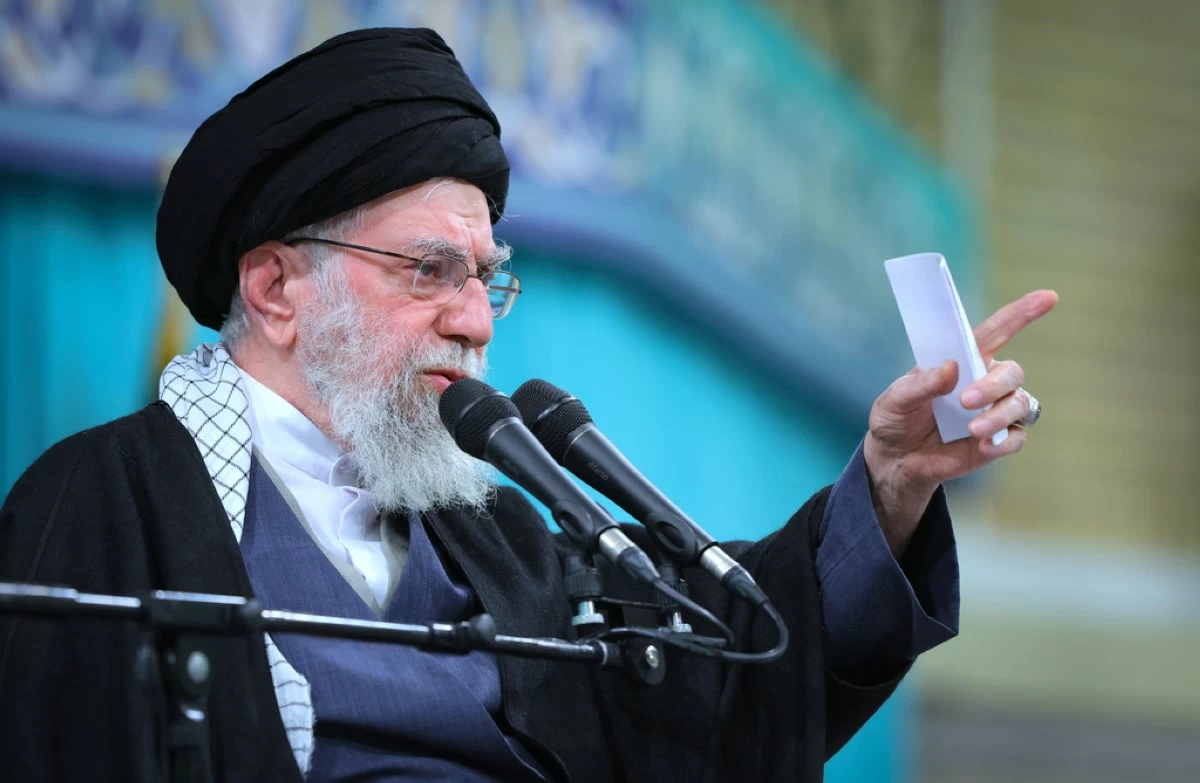
In this photo released by an official website of the office of the Iranian supreme leader, Supreme Leader Ayatollah Ali Khamenei speaks in a meeting, in Tehran, Iran, Saturday, Jan. 17, 2026. (Office of the Iranian Supreme Leader via AP)
VIENNA (AP) — In the wake of spiraling tensions between the United States and Iran over Tehran’s violent crackdown on protests, analysts warn that the internal upheaval affecting the Iranian theocracy could carry nuclear proliferation risks.
While in recent days U.S. President Donald Trump seemed to have backed away from a military strike on Iran, he called Saturday for an end to Supreme Leader Ayatollah Ali Khamenei’s nearly 40-year reign in Iran. Trump’s comments came in response to Khamenei branding Trump a “criminal” for supporting protesters in Iran, and blamed demonstrators for causing thousands of deaths.
Meanwhile, a U.S. aircraft carrier, which days earlier had been in the South China Sea, passed Singapore overnight to enter the Strait of Malacca — putting it on a route that could bring it to the Middle East.
With those dangers, analysts warn Iran's nuclear material could be at risk as well.
Nuclear material could fall into the wrong hands
David Albright, a former nuclear weapons inspector in Iraq and founder of the nonprofit Institute for Science and International Security in Washington, said that in a scenario of internal chaos in Iran, the government could "lose the ability to protect its nuclear assets.”
He said that Iran’s highly enriched uranium stockpile “would be the most worrisome,” adding that there is a possibility that someone could steal some of this material.
There are historical precedents for such a scenario.
Following the collapse of the Soviet Union in 1991, highly enriched uranium and plutonium suitable for building nuclear bombs went missing due to eroded security and weakened protection of these assets.
So far, Iran has maintained control of its sites, even after the U.S. bombed them in the 12-day war in June that Israel launched against the Islamic Republic.
Iran maintains a stockpile of 440.9 kilograms (972 pounds) of uranium enriched up to 60% purity — a short, technical step away from weapons-grade levels of 90%, according to the International Atomic Energy Agency, the Vienna-based U.N. nuclear watchdog.
The agency said in a report last November that it has not been able to verify the status and location of this highly enriched uranium stockpile since the war in June.
The agency said in November that therefore it had lost “continuity of knowledge in relation to the previously declared inventories of nuclear material in Iran” at facilities affected by the war.
A diplomat close to the IAEA confirmed Monday that the agency had still not received any information from Iran on the status or whereabouts of the highly enriched uranium stockpile. The diplomat spoke on condition of anonymity in line with diplomatic protocol.
Albright said that Iran’s stockpile of highly enriched uranium would fit in around 18 to 20 cylinders that are designed for transport, weighing around 50 kilograms (110 pounds) each when full. “Two people can easily carry it,” he said of each container.
Kelsey Davenport, director for nonproliferation policy at the Washington-based Arms Control Association, said that there is a risk that the stockpile “could be diverted either to a covert program or stolen by a faction of the government or the military that wanted to retain the option of weaponization.”
She said that this risk increases as the Iranian government feels threatened or gets destabilized.
Some of the nuclear material could get smuggled out of Iran or sold to non-state actors in the event of internal chaos or potential government collapse, Davenport said.
“The risk is real but it is difficult to assess, given the unknowns regarding the status of the materials and the whereabouts,” she stressed.
Possibility of Iran building a nuclear bomb
Both Davenport and Albright pointed out that there is also a theoretical possibility of making nuclear bombs with Iran's 60% enriched uranium. Tehran has insisted for years its program is peaceful.
However, a weapon made directly from 60% enriched uranium rather than the usual 90% purity requires more nuclear material, which makes it “much bigger and bulkier and probably not well suited to delivery” on a missile, said Eric Brewer, a former U.S. intelligence analyst and now deputy vice president at the Nuclear Threat Initiative.
He added that such a device could still be “blown up in the desert,” for example.
Brewer said that the possibility that the current government in Iran goes down that road should not be “totally dismissed,” but he underlined that most information suggests that the highly enriched uranium “remains buried in a tunnel as a result of the U.S. strikes and is probably not easily accessible to the regime; at least not with some major risk of detection and another strike by the U.S. or Israel."
He added that recent events "have also shown that the Supreme Leader has a very high bar for any decision to weaponize.”
Nuclear power reactor could be a target
In the case of internal chaos, Iran’s nuclear power reactor in Bushehr — Iran’s only commercial nuclear power plant some 750 kilometers (465 miles) south of Tehran — could also get sabotaged or targeted with the aim of causing havoc or making a political point, Albright said. Bushehr is fueled by uranium produced in Russia, not Iran.
So far, there has been no sign of Iran losing command and control of its security forces.
Albright pointed to the attack by the African National Congress’s armed wing on South Africa’s Koeberg Nuclear Power Station near Cape Town, as the country went through increased anti-apartheid resistance in 1982. The act of sabotage caused significant damage but resulted in no nuclear fallout.
“If the Bushehr reactor has a major accident, the winds would carry the fallout within 12 to 15 hours to the United Arab Emirates, Saudi Arabia and Oman,” Albright said.