







From the land of literary awards
Published Jan 19, 2026 08:15 am


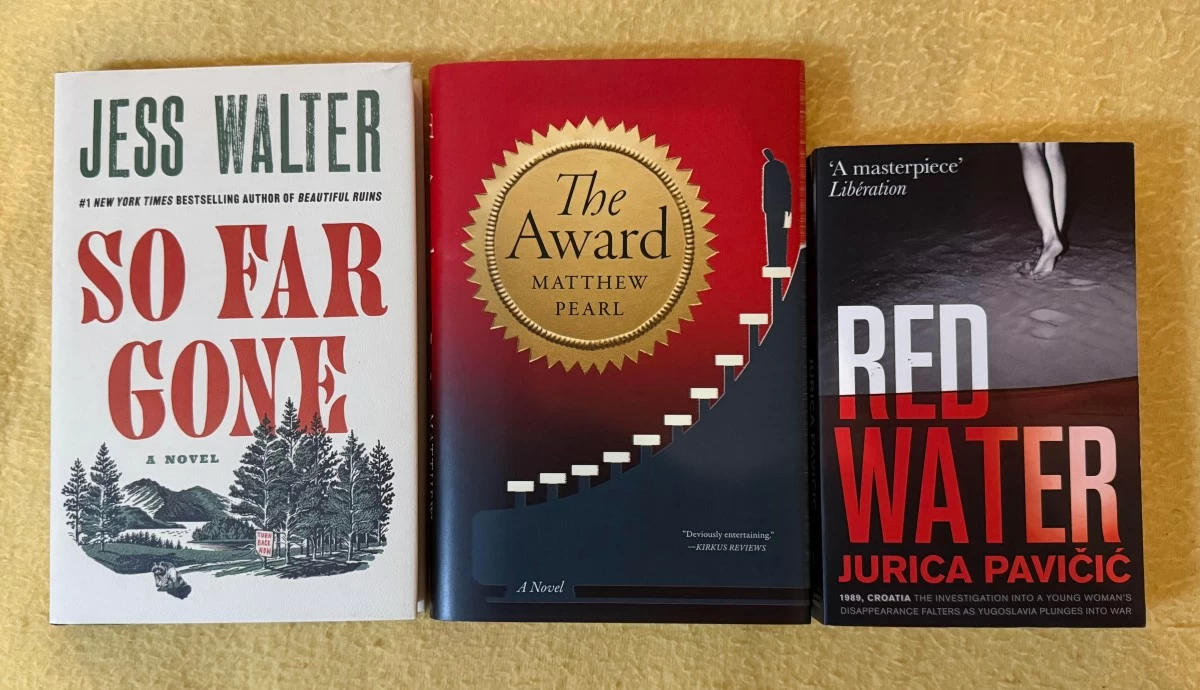
These three novels come from award-winning authors or utilize literary awards to set up an intriguing premise. Happy hours of reading!
"So Far Gone" by Jess Walter
Walter may be best known for his Beautiful Ruins, but he won the Edgar Award for Citizen Vince. In this latest, he has an intriguing premise and a wonderful protagonist. After punching his bigoted son-in-law Shane in the face, retired journalist Rhys Kinnick goes off the grid and lives in a remote cabin in the woods, with hungry raccoons his most constant companions. A failed husband to Celia, and a failed father to Bethany, he lives in the forest with no internet or mobile phone. One day, his two grandchildren, Leah and Asher, show up, accompanied by a neighbor who was left a letter from Bethany. With Bethany missing and Shane mixed up with a cultish paramilitary Church in Idaho, Bethany was hoping Rhys would look after the children. But in Spokane, the two children are taken forcibly from his hands by cohorts of Shane.
Rhys now faces the predicament of having to reenter society, to track down his missing daughter Bethany, and retrieve the two grandchildren that were entrusted to him. It’s redemption time of a different order, and Rhys has to prove he’s still worthy of being called father and grandfather. Coming to his aid are an ex-girlfriend, a bipolar retired detective, and his only friend from the nearby Indian reservation, who are his confederates in this rescue operation. With shafts of humor and a lot of touching human pathos, Walter offers up a narrative that packs a lot of surprises, can suddenly turn violent, and teaches us lessons about family, humility, pride, and knowing how to find your way back. But when it is as ‘so far gone’ as Rhys has travelled, it’s not an easy task to retrace your steps and prove yourself. There’s a lot of humanity in the narrative, and it’s a story that leaves a satisfying echo.
"The Award" by Matthew Pearl
We’re first introduced to young couple David Trent and fiancée Bonnie as they’re house-hunting in Cambridge, Massachusetts. Brought by a realtor to a converted attic they can ill afford, aspiring novelist David is enchanted by the information that living in the main house is "Very Famous" author Silas Hale. While David daydreams of some close friendship developing and mentoring coming into fruition, the truth is that Silas is haughty, disdainful, and looks down on the likes of David. Author of previous novels such as "The Dante Club," "The Poe Shadow," and "The Last Dickens," it’s interesting to see Pearl move away from novels that reference and honor great writers from the past to something that’s more playful, contemporary, and satirical in nature. The title refers to literary awards, and how they can change the life of a writer… or not. How they’re aspired for, and what some will resort to, just to gain them.
The plot picks up when David receives an email saying his book, Crises, has won the Boston Literary Society’s Best First Novel - an honor that Hale had himself received early in his career. Feted by his friends, and suddenly invited by Hale to his year-end party of literary luminaries, the complications arise when the administrator of the Awards meets with David, and explains that the book "Crisis," written by a Valentina Maldonado, is the true winner of the Best First Novel, and there was a clerical mistake made. Buying time, spurred by the fear of embarrassment and losing all that he feels is within reach, there are certain decisions David makes, with consequences that we can’t imagine. At first, a satire of thwarted literary ambition and of hubris, this novel descends into something much darker and more disturbing. There are macabre extremes and sharp depictions of human foibles. It’s writers acting badly, and being alarmingly "human."
"Red Water" by Jurica Pavicić
A multi-awarded Crime Fiction novel in Europe, this work of Pavicić won the Ksaver Sandor Gjalski Prize in Croatia, and won three prizes in France, including the Grand Prix de la Littérature Policière. Set in the Dalmatian coast in 1989, when there was still Yugoslavia, the narrative has at its center the mysterious disappearance of Silva, a precocious high school student who turned heads in the seaside village of Misto. There’s Mate, her twin brother, and her parents, Jakov and Vesna. When the police come around with insinuations of Silva having dealt drugs and heroin, their dream is shattered, and they’re left questioning if they ever knew their sister and/or daughter. And of course, still worried over where she is. This is about making the historical personal, and as seen from the perspective of one family, for this is the precise time Yugoslavia was disintegrating as a nation.
The investigation falters as Yugoslavia plunges into war, and let’s recall how six distinct countries now exist because of that Yugoslavia's dismemberment. It’s only Mate, spurred by his mother, who remains stubborn and searches for Silva amidst the fall of communism and the five years of armed conflict that ensued. Written in a style that could be described as European noir, the narrative encompasses close to thirty years of Eastern European history and conflict, and how this journey for discovery and resolution finds its own course of reckoning for the village. More than a police procedural, this engrossing novel is the story of how a community deals with its destiny, and how the people at the center of the incident will each form their own course of action, and facing head on the facts on hand. Beyond Silva’s nuclear family, other narrative voices include the lead investigator, Silva's boyfriend, and his protective mother. The awards this novel garnered are well-deserved.