ADVERTISEMENT

Fishers protest 'fake' Manila Bay rehab, seek accountability over ongoing reclamation

Published Jan 19, 2026 02:14 pm
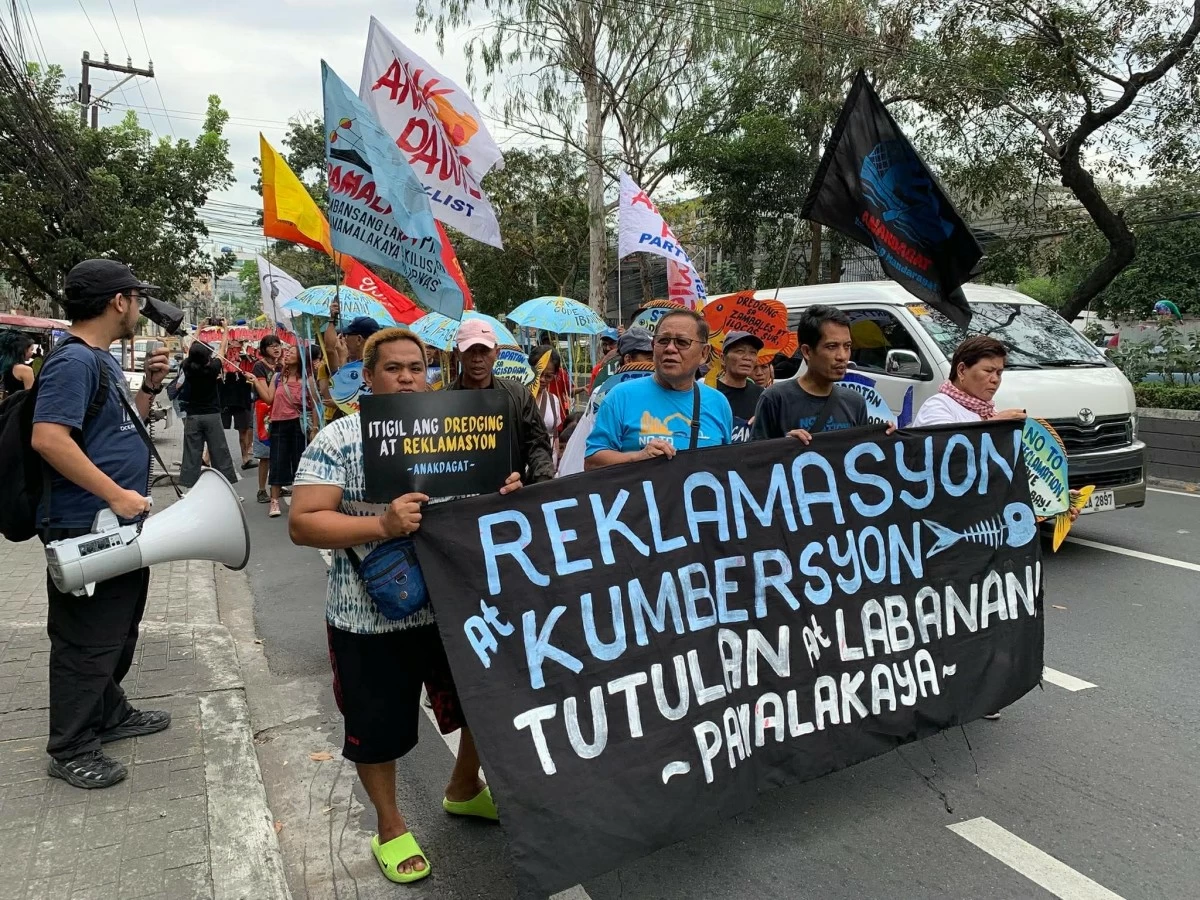
(PAMALAKAYA PHOTO)
(PAMALAKAYA PHOTO)
Fishers on Monday, Jan. 19, accused the government of carrying out a “fake rehabilitation” of Manila Bay, saying large-scale reclamation and dredging projects continue to destroy marine ecosystems and livelihoods.
To press their claim, members of the progressive fisherfolk group Pambansang Lakas ng Kilusang Mamamalakaya ng Pilipinas (Pamalakaya) staged a protest at the Department of Environment and Natural Resources (DENR), demanding accountability from government agencies and corporations behind what they described as destructive coastal conversion projects across the bay.
The group said the protest marked the seventh year of what it called a rehabilitation program that has instead legitimized reclamation and dredging activities, worsened flooding in Metro Manila, and deprived thousands of small-scale fishers of their primary source of livelihood.
Pamalakaya criticized President Marcos’ 2023 order suspending reclamation projects, calling it “mere lip service” as operations allegedly continue in several parts of Manila Bay.
In Navotas City, the group said fisherfolk and coastal residents reported ongoing “dump-and-fill” activities believed to be part of the 650-hectare Navotas Coastal Bay Reclamation Project.
Meanwhile, fisherfolk in Cavite reported the continued presence of massive dredging vessels off the coasts of Bacoor City and Cavite City, warning that the operations could cause irreversible damage to fisheries and marine biodiversity.
“Dapat managot ang mga korporasyong sangkot sa malawakang pagkasira ng kalikasan at pagkawala ng kabuhayan ng mga mangingisda (Corporations involved in the widespread destruction of the environment and the loss of fisherfolk livelihoods must be held accountable),” Pamalakaya Chairperson Fernando Hicap said in a statement.
“Higit sa lahat, dapat panagutin si Marcos Jr. sa pagpayag nitong ibuyangyang at wasakin ang aming mga pangisdaan para sa malalaking negosyo (Above all, Marcos Jr. must be held responsible for allowing our fishing grounds to be exposed and destroyed for big business),” he added.
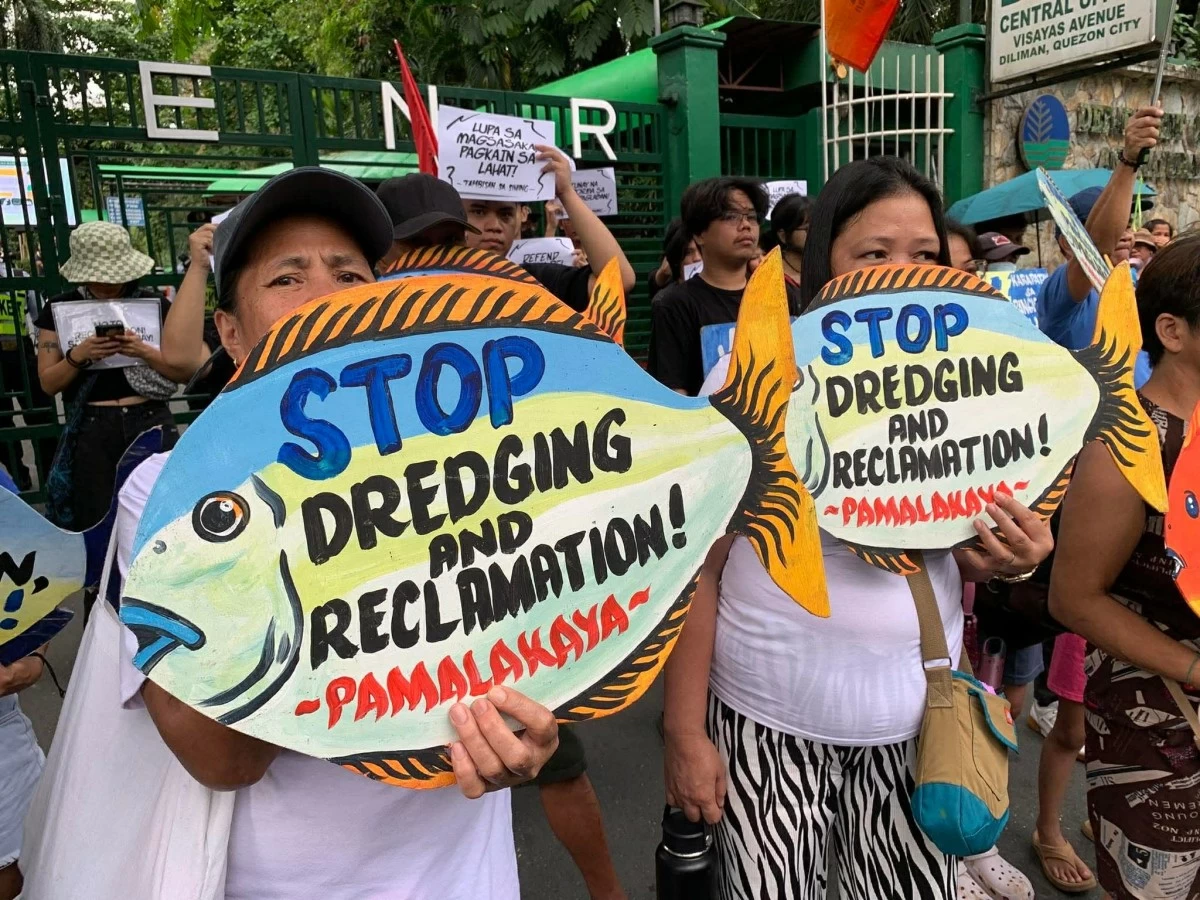
(PAMALAKAYA PHOTO)
(PAMALAKAYA PHOTO)
Earlier, a broad coalition of church groups, environmental advocates, fisherfolk organizations—including Pamalakaya—along with youth and civil society groups formally appealed to President Marcos to stop proposed reclamation projects in Manila Bay, citing risks of increased flooding, environmental disasters, and threats to human life.
In a petition received by the Office of the President on Dec. 23, 2025, the groups opposed 10 proposed reclamation projects planned between Rizal Park and the Cultural Center of the Philippines, warning that these would “irreversibly exacerbate flooding in the City of Manila and neighboring cities” and “inevitably destroy Manila Bay as the only marine biodiversity and a cultural gem in the country’s capital.”
Drawing from scientific studies, the petitioners warned that reclamation would weaken natural flood defenses by eliminating wetlands and mudflats.
The petition also cited findings of Filipino scientist Dr. Kelvin Rodolfo that coastal Metro Manila is subsiding “about 30 times faster” than natural rates due to excessive groundwater extraction, a problem that could worsen with reclamation.
Citing marine scientists, the groups further warned that reclamation and dredging could disrupt Manila Bay’s natural water circulation, trap pollutants, worsen water quality, trigger harmful algal blooms, and pose public health risks.
They stressed that Manila Bay remains biologically alive, citing a study that documented “51 coral genera and 167 fish species” that continue to support fisheries and marine biodiversity.
As of press time, the DENR has yet to respond to the claims raised by the group.

Related Tags

PAMALAKAYA DREDGING RECLAMATION FAKE REHAB DENR
ADVERTISEMENT
.most-popular .layout-ratio{ padding-bottom: 79.13%; } @media (min-width: 768px) and (max-width: 1024px) { .widget-title { font-size: 15px !important; } }

{{ articles_filter_1561_widget.title }}

.most-popular .layout-ratio{ padding-bottom: 79.13%; } @media (min-width: 768px) and (max-width: 1024px) { .widget-title { font-size: 15px !important; } }

{{ articles_filter_1562_widget.title }}

.most-popular .layout-ratio{ padding-bottom: 79.13%; } @media (min-width: 768px) and (max-width: 1024px) { .widget-title { font-size: 15px !important; } }

{{ articles_filter_1563_widget.title }}

{{ articles_filter_1564_widget.title }}

.mb-article-details { position: relative; } .mb-article-details .article-body-preview, .mb-article-details .article-body-summary{ font-size: 17px; line-height: 30px; font-family: "Libre Caslon Text", serif; color: #000; } .mb-article-details .article-body-preview iframe , .mb-article-details .article-body-summary iframe{ width: 100%; margin: auto; } .read-more-background { background: linear-gradient(180deg, color(display-p3 1.000 1.000 1.000 / 0) 13.75%, color(display-p3 1.000 1.000 1.000 / 0.8) 30.79%, color(display-p3 1.000 1.000 1.000) 72.5%); position: absolute; height: 200px; width: 100%; bottom: 0; display: flex; justify-content: center; align-items: center; padding: 0; } .read-more-background a{ color: #000; } .read-more-btn { padding: 17px 45px; font-family: Inter; font-weight: 700; font-size: 18px; line-height: 16px; text-align: center; vertical-align: middle; border: 1px solid black; background-color: white; } .hidden { display: none; }
function initializeAllSwipers() { // Get all hidden inputs with cms_article_id document.querySelectorAll('[id^="cms_article_id_"]').forEach(function (input) { const cmsArticleId = input.value; const articleSelector = '#article-' + cmsArticleId + ' .body_images'; const swiperElement = document.querySelector(articleSelector); if (swiperElement && !swiperElement.classList.contains('swiper-initialized')) { new Swiper(articleSelector, { loop: true, pagination: false, navigation: { nextEl: '#article-' + cmsArticleId + ' .swiper-button-next', prevEl: '#article-' + cmsArticleId + ' .swiper-button-prev', }, }); } }); } setTimeout(initializeAllSwipers, 3000); const intersectionObserver = new IntersectionObserver( (entries) => { entries.forEach((entry) => { if (entry.isIntersecting) { const newUrl = entry.target.getAttribute("data-url"); if (newUrl) { history.pushState(null, null, newUrl); let article = entry.target; // Extract metadata const author = article.querySelector('.author-section').textContent.replace('By', '').trim(); const section = article.querySelector('.section-info ').textContent.replace(' ', ' '); const title = article.querySelector('.article-title h1').textContent; // Parse URL for Chartbeat path format const parsedUrl = new URL(newUrl, window.location.origin); const cleanUrl = parsedUrl.host + parsedUrl.pathname; // Update Chartbeat configuration if (typeof window._sf_async_config !== 'undefined') { window._sf_async_config.path = cleanUrl; window._sf_async_config.sections = section; window._sf_async_config.authors = author; } // Track virtual page view with Chartbeat if (typeof pSUPERFLY !== 'undefined' && typeof pSUPERFLY.virtualPage === 'function') { try { pSUPERFLY.virtualPage({ path: cleanUrl, title: title, sections: section, authors: author }); } catch (error) { console.error('ping error', error); } } // Optional: Update document title if (title && title !== document.title) { document.title = title; } } } }); }, { threshold: 0.1 } ); function showArticleBody(button) { const article = button.closest("article"); const summary = article.querySelector(".article-body-summary"); const body = article.querySelector(".article-body-preview"); const readMoreSection = article.querySelector(".read-more-background"); // Hide summary and read-more section summary.style.display = "none"; readMoreSection.style.display = "none"; // Show the full article body body.classList.remove("hidden"); } document.addEventListener("DOMContentLoaded", () => { let loadCount = 0; // Track how many times articles are loaded const offset = [1, 2, 3, 4, 5, 6, 7, 8, 9, 10]; // Offset values const currentUrl = window.location.pathname.substring(1); let isLoading = false; // Prevent multiple calls if (!currentUrl) { console.log("Current URL is invalid."); return; } const sentinel = document.getElementById("load-more-sentinel"); if (!sentinel) { console.log("Sentinel element not found."); return; } function isSentinelVisible() { const rect = sentinel.getBoundingClientRect(); return ( rect.top < window.innerHeight && rect.bottom >= 0 ); } function onScroll() { if (isLoading) return; if (isSentinelVisible()) { if (loadCount >= offset.length) { console.log("Maximum load attempts reached."); window.removeEventListener("scroll", onScroll); return; } isLoading = true; const currentOffset = offset[loadCount]; window.loadMoreItems().then(() => { let article = document.querySelector('#widget_1690 > div:nth-last-of-type(2) article'); intersectionObserver.observe(article) loadCount++; }).catch(error => { console.error("Error loading more items:", error); }).finally(() => { isLoading = false; }); } } window.addEventListener("scroll", onScroll); });

Sign up by email to receive news.