







Tarriela won't apologize to China over Xi caricatures
Understanding China's wolf warrior diplomacy in the Philippines
Published Jan 18, 2026 01:07 pm


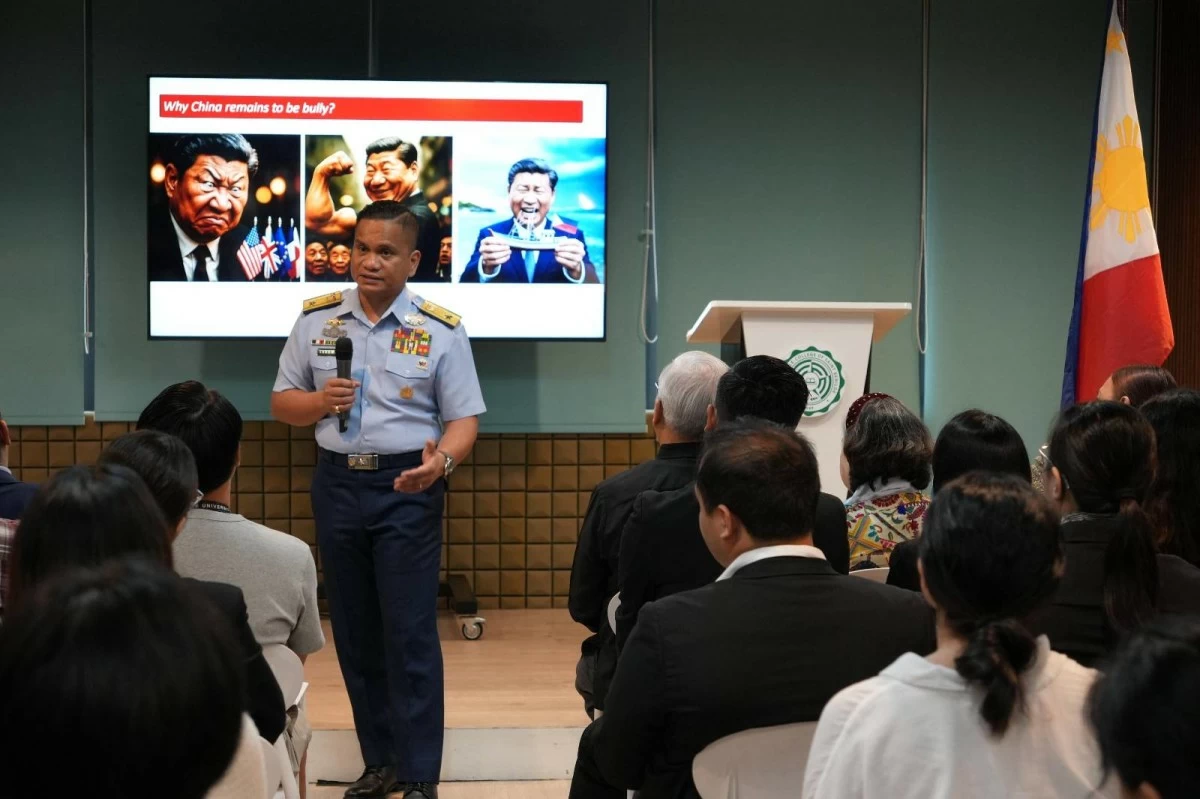
(Photo: PCG spokesperson for WPS Commodore Jay Tarriela / Facebook)
Philippine Coast Guard (PCG) spokesperson for West Philippine Sea (WPS) Commodore Jay Tarriela said he will not apologize to the Chinese government over caricatures that Beijing claimed depicted Chinese President Xi Jinping, insisting there is no authority for China to demand an explanation from him.
“There’s no authority for the Chinese Embassy to ask us to explain,” Tarriela said during a media forum in Quezon City on Saturday, Jan. 17.
“Secondly, why would I apologize? Because of the caricature? I didn’t even mention that it was President Xi Jinping. They were the ones who named it,” he added.
Tarriela said the Chinese Embassy’s protest was an attempt to silence him amid his repeated public disclosures on Chinese activities in the WPS.
“The intention of the Chinese Embassy is to justify their call to silence me. For about a week now, we have been exchanging statements on social media. They always downplay the incidents and amplify their lies and misinformation about the West Philippine Sea and the 2016 Arbitral Award,” he said.
The Chinese Embassy earlier lodged a diplomatic protest against Tarriela, citing social media posts that included caricature slides depicting Xi.
The embassy accused the PCG official of disrespect and demanded an explanation.
However, Tarriela said he was confused by the protest. “When I read the statement of the Chinese Embassy, I was also confused. What exactly are they complaining about? Everything that I posted on social media, especially the [WPS] incidents, or just the caricature?”
He added that the PCG has no obligation to respond to such protests.
“I think the Philippine Coast Guard does not have any obligation to respond to any diplomatic protest. Diplomatic relations are not our concern,” he stated.
Wolf warrior diplomacy
Political analyst Renato De Castro, a professor at De La Salle University’s International Studies Department, said the protest against Tarriela fits China’s so-called “wolf warrior diplomacy.”
He described it as an aggressive and crude style of foreign engagement that expanded under President Xi Jinping.
“They are very rude and very crude,” De Castro said. He said China uses this approach to attack individuals who symbolize policies it wants to undermine.
“Commodore Jay Tarriela is a symbol of the transparency initiative. If you attack the symbol, then you are attacking the very initiative,” he explained.
He said China’s messaging is aimed not only at officials but at shaping public opinion through propaganda and malign influence.
De Castro also criticized what he called the limits of traditional diplomacy being utilized by the Department of Foreign Affairs (DFA).
He said the DFA is trained for state-to-state engagement and not for confronting public-facing attacks.
“Wolf warrior diplomacy talks directly to society. That is why public diplomacy is important,” he said.
For Tarriela, the answer remains unchanged as he asserted that he would continue speaking out against China’s illegal, coercive, aggressive, and deceptive actions in the WPS.
“There is no need for me to apologize to the Chinese Embassy,” he said.
Chinese presence in WPS
As this developed, Tarriela released the PCG’s year-long monitoring data showing a sharp increase in Chinese maritime activity in Philippine waters.
From January to December, the PCG tracked more than 800 Chinese maritime militia vessels, along with China Coast Guard (CCG) and People’s Liberation Army-Navy (PLA-N) ships, operating across the Kalayaan Island Group (KIG).
In November alone, the number of monitored Chinese maritime militia vessels reached 818.
Tarriela said this was the highest deployment recorded and that the vessels “swarmed illegally our exclusive economic zone.”
In Bajo de Masinloc, the PCG also recorded spikes in Chinese maritime militia deployment last April and CCG presence in October.
Tarriela said CCG vessels were no longer confined to the shoal of Bajo de Masinloc.
“Last year, we monitored that these China Coast Guard vessels came as close as 30 nautical miles off the coast of Pangasinan,” he said. Similar deployments were documented near Zambales, Mindoro, and even the Ilocos region.
Satellite data also showed changes in Filipino fishing patterns. In 2024, many Filipino fishing boats were still operating near Bajo de Masinloc but in 2025, the boats were more dispersed and pushed farther away.
Tarriela said this was due to the forward deployment of CCG vessels closer to Philippine coastal provinces.
In response, the PCG increased patrol days in 2025 compared to 2024. Tarriela said this was made possible by stronger logistical support from the national government, which helped maintain the operational readiness of PCG ships and aircraft.
The PCG also monitored 23 CCG vessels that were newly documented in 2025. Tarriela said this showed China was increasing both the number and types of assets deployed in the WPS.
The PCG also tracked 46 Chinese research vessels that illegally conducted marine scientific research inside the Philippine exclusive economic zone, and Tarriela said some of the vessels launched underwater drones.
These operations were monitored not only in the WPS but also in northern waters and along the eastern seaboard.
Seven Chinese research vessels were also monitored conducting geological and seismic surveys along the eastern seaboard, including areas near the Philippine Rise. Tarriela said China has no legal authority to conduct such activities there.
“This is a good example of such a lie,” Tarriela said, referring to China’s claim that its ships were merely passing through. “We were able to document that they deployed an underwater drone to conduct marine scientific research within our own exclusive economic zone.”