

ADVERTISEMENT

Jirah Libanza explores damage and renewal in 'Bosom'

Published Jan 17, 2026 07:19 am

At A Glance

  • Jirah's exhibit was a masterclass in the impasto technique, where she layered thick oil paint to create tactile, emotive surfaces.
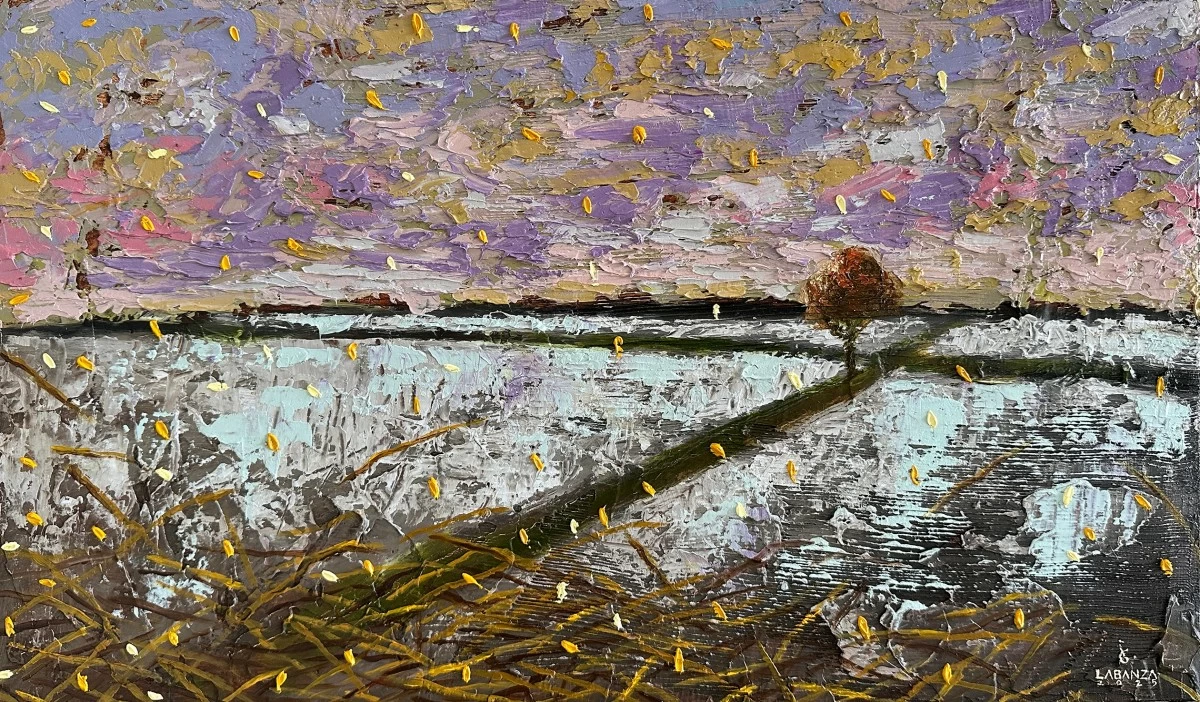
'FROM AFAR' oil on canvas, 13 x 22 inches, 2025
To understand the textured canvases of Jirah Labanza is to understand the soil of Dingle, Iloilo. In her latest exhibit, “Bosom,” the Grand Prize winner of the Philippine Art Awards returned to the fragments of the countryside that shaped her. By blending thick impastos of oil with her signature uhot (rice straw), Jirah didn’t just paint landscapes; she sculpted the very earth of her heritage. The exhibit served as a reminder that for this architect-turned-artist, the "bosom" is both a place of prayer and a reflection of the charred fields that eventually become the soil for healing.
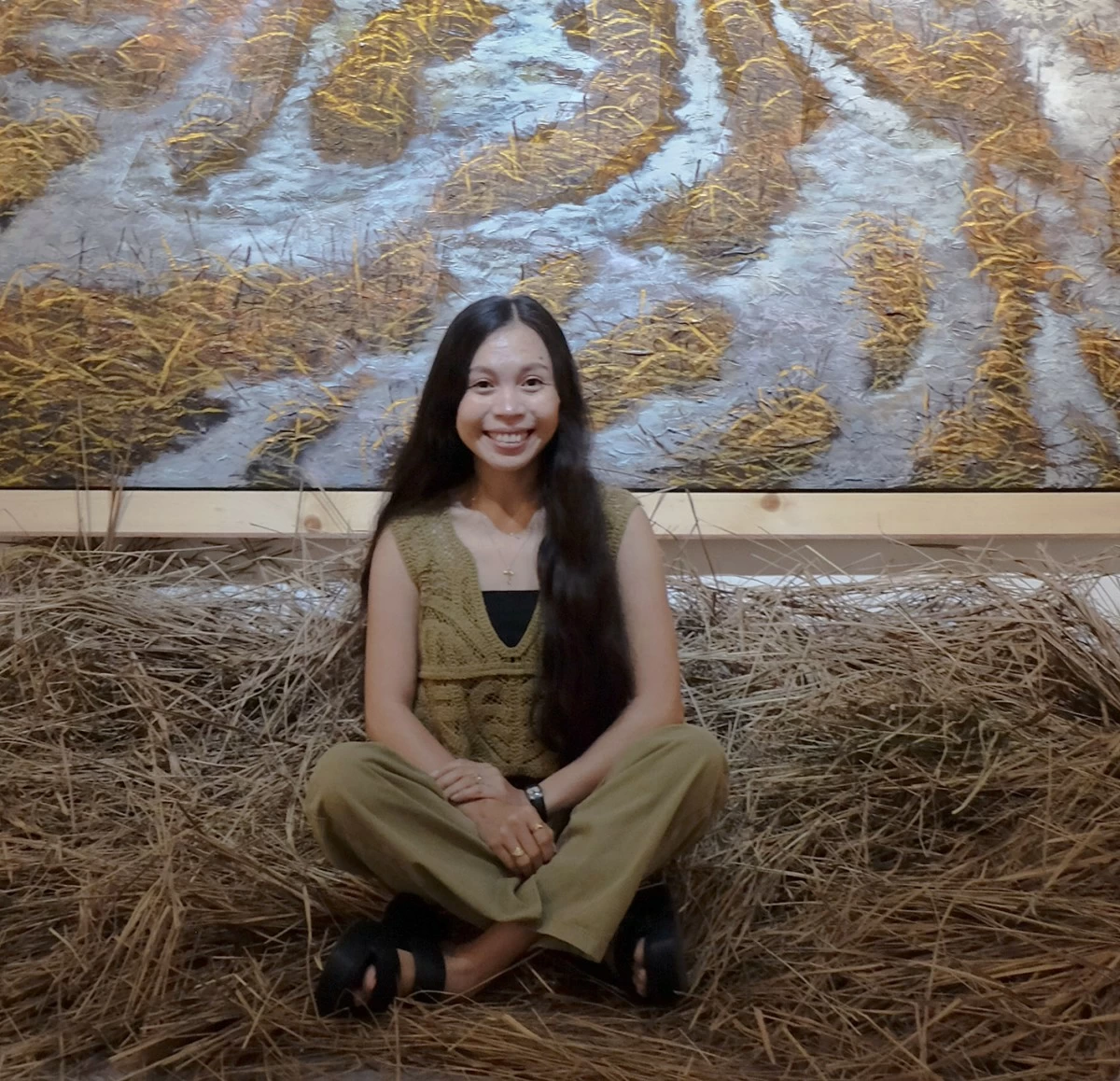
MEET THE ARTIST Jirah Lavanza
The architecture of texture
Born in 1995 in Dingle, Iloilo, Jirah’s path to the canvas was shaped by the structured world of architecture, having graduated from Iloilo Science and Technology University (ISATU). Her soul, however, clearly belongs to the untamed landscapes of her youth. As the daughter of a teacher and a farmer, she successfully fused these worlds: the discipline of design and the raw, unyielding fortitude of the land.
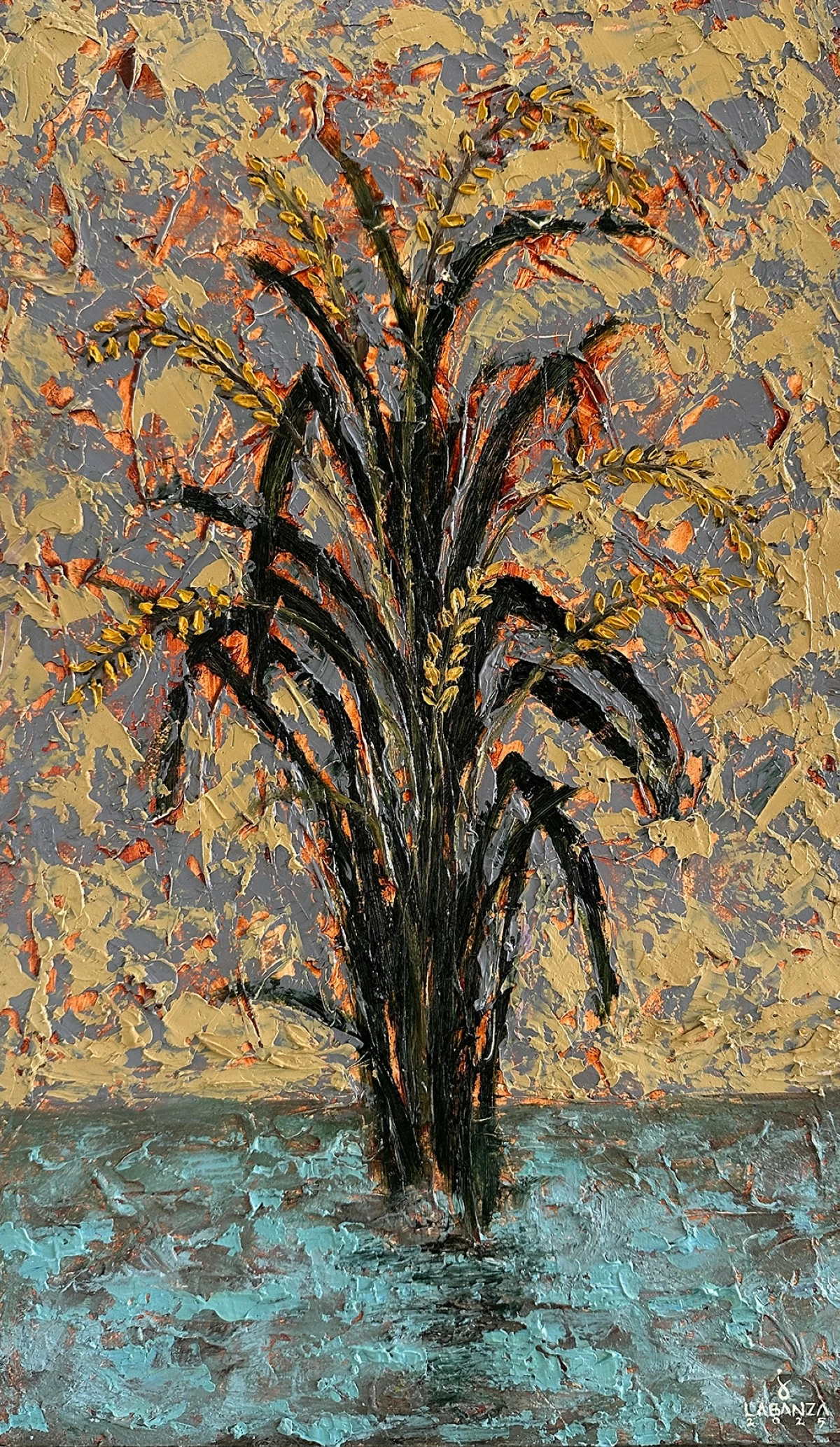
'SEED' oil on canvas, 20 x 12 inches, 2025
Jirah is no stranger to the national spotlight. A member of the Sigahum Artist Group and Hubon Ilonggo, she made history as the Grand Prize Winner of the Philippine Art Awards 2022-2023. Her expertise was further cemented as a multi-year finalist in the Metrobank Art and Design Excellence (MADE) competitions.
A signature of uhot and impasto
Jirah’s exhibit was a masterclass in the impasto technique, where she layered thick oil paint to create tactile, emotive surfaces. Her work is immediately recognizable by the inclusion of uhot (rice straw) motifs, a symbolic nod to her heritage and a tool for self-healing through art.
In “Bosom,” Jirah’s palette shifted toward the monochromatic and the somber, yet remained punctuated by radiant bursts of light.
The collection felt less like a series of paintings and more like a geography of the heart.
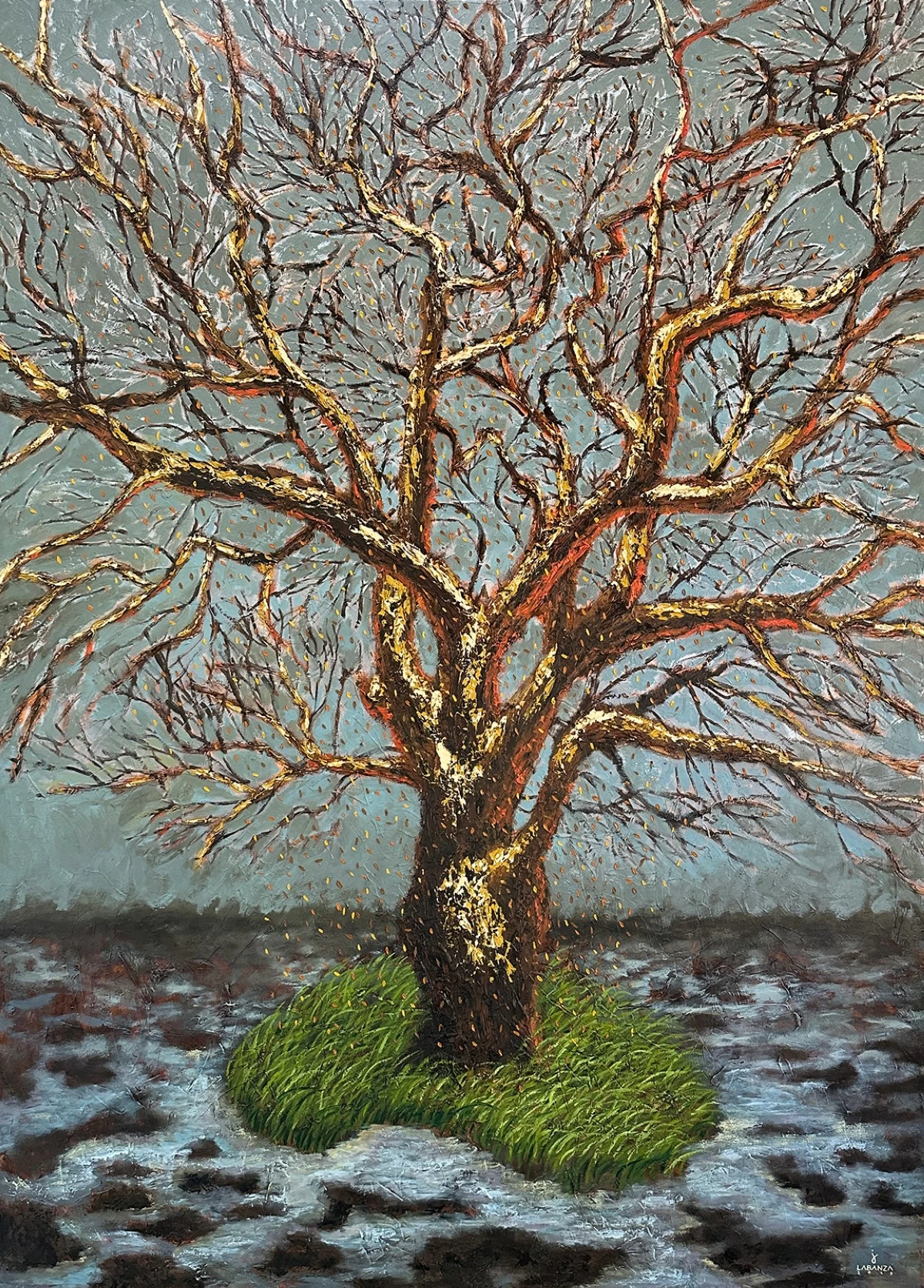
'A ROOTED SOLACE' oil on canvas, 72 x 52 inches, 2025
“A Rooted Solace” is a towering piece dominated by space. A skeletal yet golden-lit tree stood atop a lone patch of green, surrounded by a dark, churned earth. It was a perfect metaphor for endurance, showing that even in charred fields of hardship, life finds a way to anchor itself.
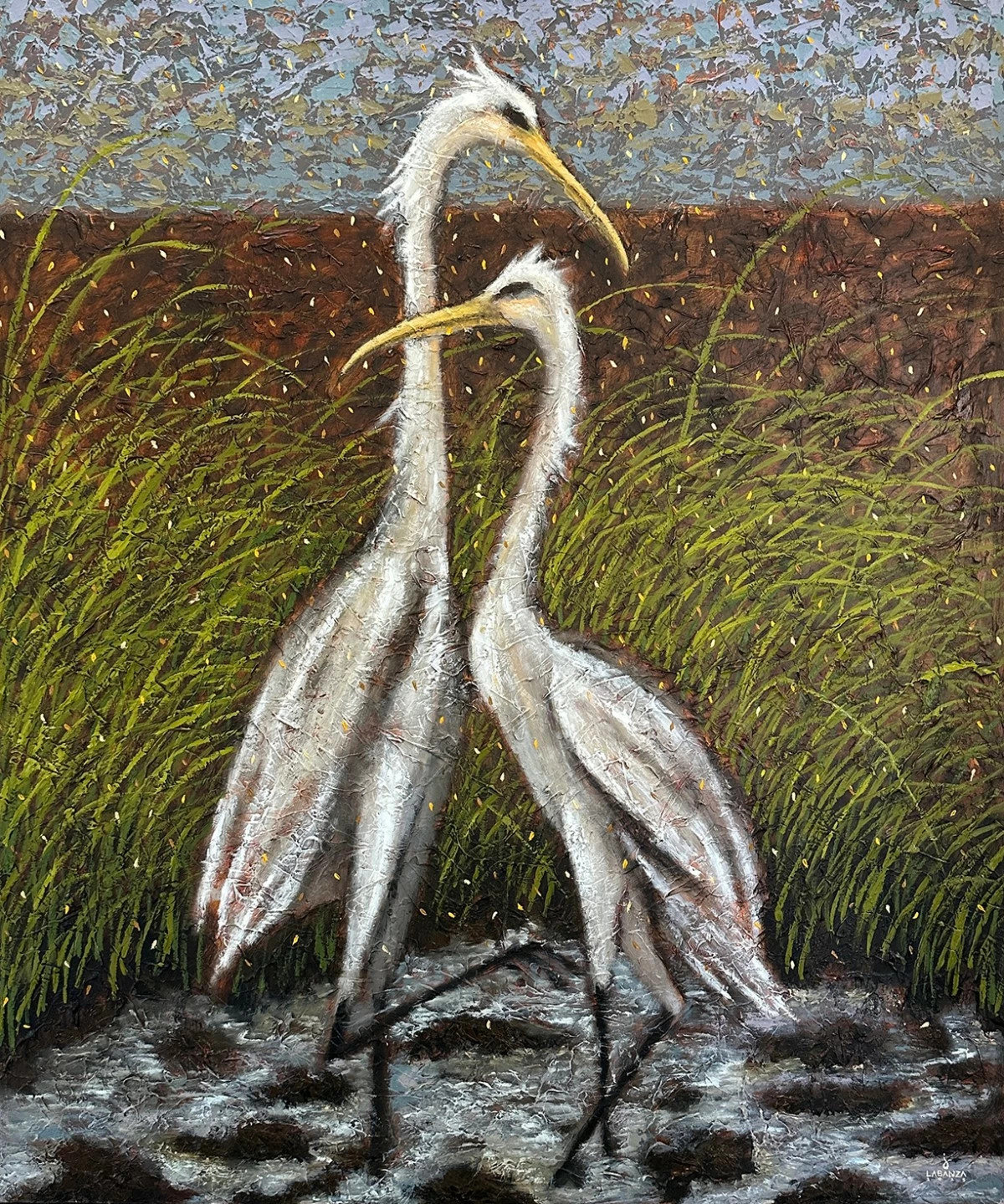
'WHILE WINGS, STILL WATERS' oil on canvas, 49 x 41 inches, 2025
In “White Wings, Still Waters,” the frantic energy of Jirah’s texture met a surprising stillness. Two heroes leaned into one another, their forms emerging from a chaotic background of reeds and water. It captured the tender pulse of faith that the exhibit promised, highlighting a moment of shared sanctuary.
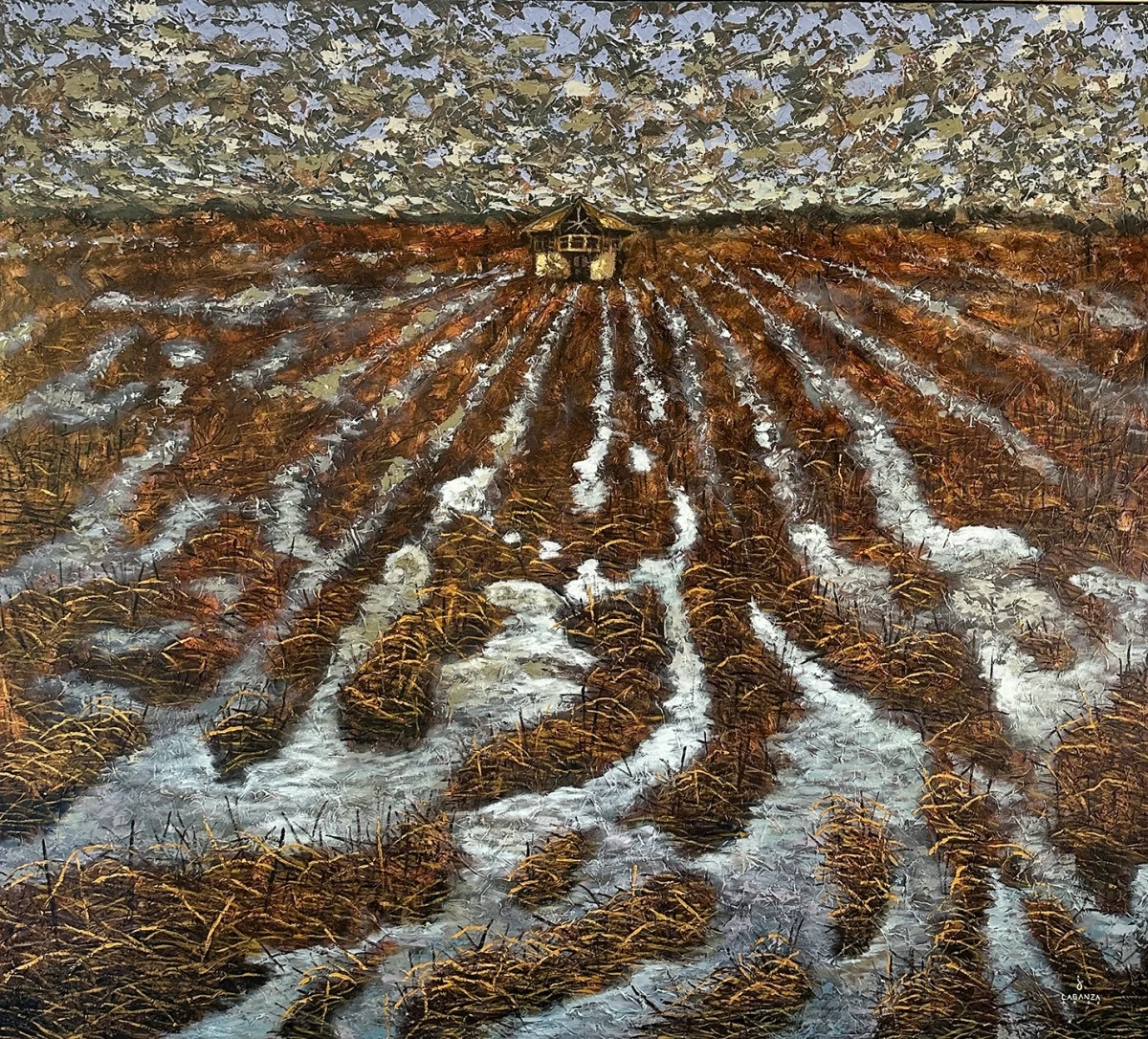
'FOR WHERE YOUR TREASURE IS, THERE YOUR HEART WILL BE ALSO' oil on canvas, 72 x 80 inches, 2025
Perhaps the most personal piece, “For Where Your Treasure Is, There Your Heart Will Be Also,” is a large-scale landscape that features a small farm hut at the horizon of a flooded field. The perspective lines pulled the viewer deep into the muck and water, honoring her father’s labor while transforming a humble rice field into a sacred space.
A sanctuary of grace
What made “Bosom” stand out was its lack of pretension. Jirah did not just paint landscapes; she painted faith as a physical presence. The exhibit successfully navigated the cycle of damage and renewal, proving that the most fragile parts of our history can become our greatest strengths.
While the exhibit has concluded, the echoes of Jirah’s textured fields remain. She has firmly established herself as an artist who doesn’t just observe the land. She listens to it, acknowledging the divine in the ordinary with every stroke of her palette knife.
“Bosom” ran from Nov. 12 to Dec. 2, 2025, at Art Verite Gallery, Serendra, Bonifacio Global City, Taguig.

Related Tags

Arts and Culture Artist At Work
ADVERTISEMENT
.most-popular .layout-ratio{ padding-bottom: 79.13%; } @media (min-width: 768px) and (max-width: 1024px) { .widget-title { font-size: 15px !important; } }

{{ articles_filter_1561_widget.title }}

.most-popular .layout-ratio{ padding-bottom: 79.13%; } @media (min-width: 768px) and (max-width: 1024px) { .widget-title { font-size: 15px !important; } }

{{ articles_filter_1562_widget.title }}

.most-popular .layout-ratio{ padding-bottom: 79.13%; } @media (min-width: 768px) and (max-width: 1024px) { .widget-title { font-size: 15px !important; } }

{{ articles_filter_1563_widget.title }}

{{ articles_filter_1564_widget.title }}

.mb-article-details { position: relative; } .mb-article-details .article-body-preview, .mb-article-details .article-body-summary{ font-size: 17px; line-height: 30px; font-family: "Libre Caslon Text", serif; color: #000; } .mb-article-details .article-body-preview iframe , .mb-article-details .article-body-summary iframe{ width: 100%; margin: auto; } .read-more-background { background: linear-gradient(180deg, color(display-p3 1.000 1.000 1.000 / 0) 13.75%, color(display-p3 1.000 1.000 1.000 / 0.8) 30.79%, color(display-p3 1.000 1.000 1.000) 72.5%); position: absolute; height: 200px; width: 100%; bottom: 0; display: flex; justify-content: center; align-items: center; padding: 0; } .read-more-background a{ color: #000; } .read-more-btn { padding: 17px 45px; font-family: Inter; font-weight: 700; font-size: 18px; line-height: 16px; text-align: center; vertical-align: middle; border: 1px solid black; background-color: white; } .hidden { display: none; }
function initializeAllSwipers() { // Get all hidden inputs with cms_article_id document.querySelectorAll('[id^="cms_article_id_"]').forEach(function (input) { const cmsArticleId = input.value; const articleSelector = '#article-' + cmsArticleId + ' .body_images'; const swiperElement = document.querySelector(articleSelector); if (swiperElement && !swiperElement.classList.contains('swiper-initialized')) { new Swiper(articleSelector, { loop: true, pagination: false, navigation: { nextEl: '#article-' + cmsArticleId + ' .swiper-button-next', prevEl: '#article-' + cmsArticleId + ' .swiper-button-prev', }, }); } }); } setTimeout(initializeAllSwipers, 3000); const intersectionObserver = new IntersectionObserver( (entries) => { entries.forEach((entry) => { if (entry.isIntersecting) { const newUrl = entry.target.getAttribute("data-url"); if (newUrl) { history.pushState(null, null, newUrl); let article = entry.target; // Extract metadata const author = article.querySelector('.author-section').textContent.replace('By', '').trim(); const section = article.querySelector('.section-info ').textContent.replace(' ', ' '); const title = article.querySelector('.article-title h1').textContent; // Parse URL for Chartbeat path format const parsedUrl = new URL(newUrl, window.location.origin); const cleanUrl = parsedUrl.host + parsedUrl.pathname; // Update Chartbeat configuration if (typeof window._sf_async_config !== 'undefined') { window._sf_async_config.path = cleanUrl; window._sf_async_config.sections = section; window._sf_async_config.authors = author; } // Track virtual page view with Chartbeat if (typeof pSUPERFLY !== 'undefined' && typeof pSUPERFLY.virtualPage === 'function') { try { pSUPERFLY.virtualPage({ path: cleanUrl, title: title, sections: section, authors: author }); } catch (error) { console.error('ping error', error); } } // Optional: Update document title if (title && title !== document.title) { document.title = title; } } } }); }, { threshold: 0.1 } ); function showArticleBody(button) { const article = button.closest("article"); const summary = article.querySelector(".article-body-summary"); const body = article.querySelector(".article-body-preview"); const readMoreSection = article.querySelector(".read-more-background"); // Hide summary and read-more section summary.style.display = "none"; readMoreSection.style.display = "none"; // Show the full article body body.classList.remove("hidden"); } document.addEventListener("DOMContentLoaded", () => { let loadCount = 0; // Track how many times articles are loaded const offset = [1, 2, 3, 4, 5, 6, 7, 8, 9, 10]; // Offset values const currentUrl = window.location.pathname.substring(1); let isLoading = false; // Prevent multiple calls if (!currentUrl) { console.log("Current URL is invalid."); return; } const sentinel = document.getElementById("load-more-sentinel"); if (!sentinel) { console.log("Sentinel element not found."); return; } function isSentinelVisible() { const rect = sentinel.getBoundingClientRect(); return ( rect.top < window.innerHeight && rect.bottom >= 0 ); } function onScroll() { if (isLoading) return; if (isSentinelVisible()) { if (loadCount >= offset.length) { console.log("Maximum load attempts reached."); window.removeEventListener("scroll", onScroll); return; } isLoading = true; const currentOffset = offset[loadCount]; window.loadMoreItems().then(() => { let article = document.querySelector('#widget_1690 > div:nth-last-of-type(2) article'); intersectionObserver.observe(article) loadCount++; }).catch(error => { console.error("Error loading more items:", error); }).finally(() => { isLoading = false; }); } } window.addEventListener("scroll", onScroll); });

Sign up by email to receive news.