






Manila Bulletin
 Philippines
National
DND welcomes widening defense ties with UAE, Japan in back-to-back agreements
Philippines
National
DND welcomes widening defense ties with UAE, Japan in back-to-back agreements
Philippines
National
DND welcomes widening defense ties with UAE, Japan in back-to-back agreements
DND welcomes widening defense ties with UAE, Japan in back-to-back agreements
Word war erupts between Tarriela, Chinese Embassy
Published Jan 16, 2026 12:59 pm
|
Updated Jan 16, 2026 01:46 pm


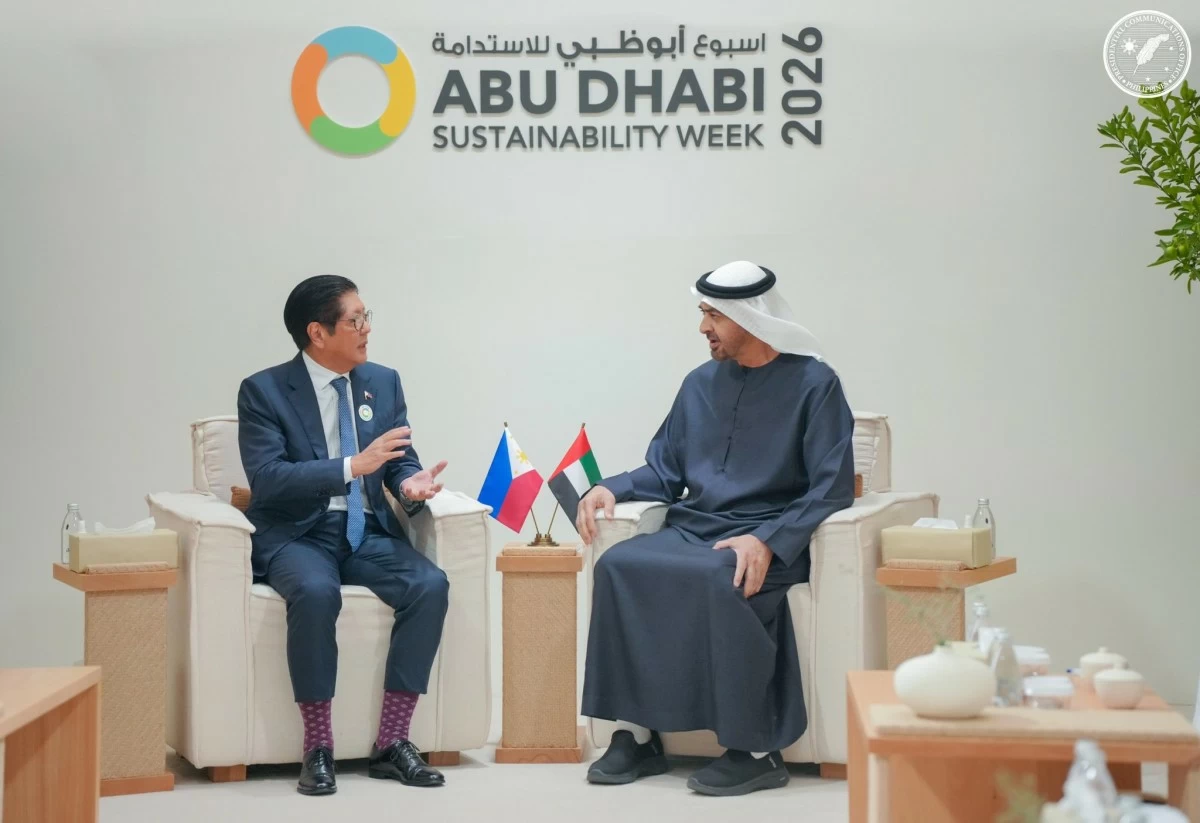
President Ferdinand R. Marcos Jr. (left) meets United Arab Emirates President His Highness Sheikh Mohamed bin Zayed Al Nahyan, Ruler of Abu Dhabi, on the sidelines of Abu Dhabi Sustainability Week as part of a working visit to the UAE from Jan. 12 to 14, 2025. (Photo: Presidential Communications Office)
The Department of National Defense (DND) was elated with the expansion of the country’s defense partnerships with the United Arab Emirates (UAE) and Japan involving two separate agreements aimed at strengthening security cooperation beyond traditional allies amid China’s sustained aggression in the West Philippine Sea (WPS) that has sparked a new word war between officials from Manila and Beijing.
President Ferdinand R. Marcos Jr. witnessed the signing of a Memorandum of Understanding on Defense Cooperation between the Philippines and the UAE during his working visit to Abu Dhabi from January 12 to 14, DND spokesperson Asst. Sec. Arsenio Andolong said.
The MOU seeks to deepen cooperation on advanced defense technologies including the use of unmanned aerial systems (UAS), electronic warfare, and naval systems “in line with the capability development and modernization of the Armed Forces of the Philippines (AFP).”
The agreement is also expected to strengthen defense and military relations through education and training. It covers intelligence and security sharing, anti-terrorism efforts, maritime security, and peacekeeping operations.
Andolong said the MOU is anchored on the “already robust people-to-people ties between the Philippines and the UAE.” It described the agreement as the country’s first formal defense pact with a Gulf state.
“Being the first formal defense agreement of the Philippines with a Gulf country, the MOU with the UAE is a testament to the Philippines' commitment to forging stronger partnerships to address matters of mutual interest,” he shared.
Andolong said the DND will continue to work with like-minded partners in pursuit of regional and global peace, stability, and prosperity.
PH-Japan ties
Meanwhile, the Philippines also entered into another defense arrangement with Japan through the signing of the Acquisition and Cross-Servicing Agreement or ACSA in Manila on Jan. 15.
The agreement was signed by Japanese Foreign Minister Motegi Toshimitsu and Department of Foreign Affairs (DFA) Secretary Maria Theresa Lazaro.
According to the Japanese Embassy in the Philippines, the ACSA establishes a framework for the settlement procedures for the reciprocal provision of supplies and services between the AFP and the Japan Self-Defense Forces (JSDF).
It added that the pact will promote closer cooperation and enable both sides to contribute more actively to the peace and security of the international community.
For the DND, the agreement is meant to improve interoperability and operational readiness between the two forces, and aims to make cooperation more efficient, particularly during emergencies that require rapid coordination.
“The Agreement is intended to enhance military interoperability and readiness, and to enable the more efficient conduct of joint exercises, humanitarian assistance and disaster relief (HADR) operations, peacekeeping activities, and other mutually agreed engagements,” Andolong said.
“The ACSA complements existing bilateral defense arrangements and contributes to deeper practical cooperation between the two countries,” he added.
Both sides also exchanged notes on Japan’s Official Security Assistance for Japanese Fiscal Year 2025, which, the DND said, would support the modernization and capacity-building efforts of the Philippine defense sector.
“This assistance includes infrastructure support under Japan's OSA framework, reinforcing the Philippines' ability to enhance maritime security and operational effectiveness,” Andolong bared.
The DND said the signing took place as the two countries commemorate the 70th anniversary of the normalization of diplomatic relations, “highlighting the steady evolution of Philippines-Japan relations and their shared resolve to further deepen cooperation in the years ahead.”
Both Manila and Tokyo underscored that the signing of the ACSA and the OSA for FY 2025 reflects their “shared commitment to strengthening defense cooperation, promoting regional peace and stability, and upholding a rules-based international order”.
“The agreements also demonstrate the growing level of strategic trust between the Philippines and Japan as longstanding partners,” Andolong said.
Word war
As this developed, a diplomatic row flared after the Chinese Embassy in Manila accused a Philippine Coast Guard (PCG) spokesperson of attacking and smearing Chinese leaders amid heated tensions in the WPS.
The embassy, through newly appointed Chinese Ambassador to the Philippines Jing Quan, demanded clarification from the Philippine government and questioned why PCG spokesperson for WPS Commodore Jay Tarriela had not been “held accountable” for his actions, which it said “constitute a serious violation of China’s political dignity and a blatant political provocation” and an act that “has crossed the red line.”
In a statement, the Chinese Embassy said it had lodged “solemn representations” with Malacañang, DFA, and the PCG after accusing Tarriela of “hyping up maritime issues,” “misrepresent[ing] facts,” and “inciting confrontation” over the WPS issue.
“As a spokesperson of the Philippine Coast Guard, do his smears and slanders against China and Chinese leader represent the stance of the Philippine government?” the embassy said.
“As a uniformed service member, should he not be subject to the most basic standards of discipline and ethics? Why is he able to act so recklessly without being held accountable?” it added.
However, Tarriela rejected the embassy’s claims and said the demand itself breached international law.
“The Chinese Embassy's statement demanding clarification from the Philippine government on whether my statements represent official policy—and why I have not been ‘held accountable’—is not only a clear violation of the Vienna Convention on Diplomatic Relations but also an attempt to deflect from the core issue,” he said.
He pointed to Article 41(1) of the Vienna Convention and stressed that “diplomatic missions must not interfere in the internal affairs of the host state.”
He said the embassy was “engaging in precisely the interference it is obliged to avoid.”
“This is not legitimate diplomacy. It is an effort to intimidate and suppress truthful reporting on matters of Philippine sovereignty,” he added, noting that China's “repeated aggressive and illegal actions” in the WPS are what the embassy should focus on and put a stop.
“These are not ‘smears’ or ‘slanders.’ These are factual accounts backed by video evidence, photographs, official Philippine Coast Guard reports, and third-party observations—including satellite imagery and statements from other nations,” he stressed.