







Witnessing the holy grail of destinations
A visit to Jordan's ancient city of Petra
Published Jan 15, 2026 04:16 pm


At A Glance
- 'Indiana Jones and the Last Crusade' was filmed in Petra, with Al-Khazneh serving as the secret temple housing the Holy Grail.
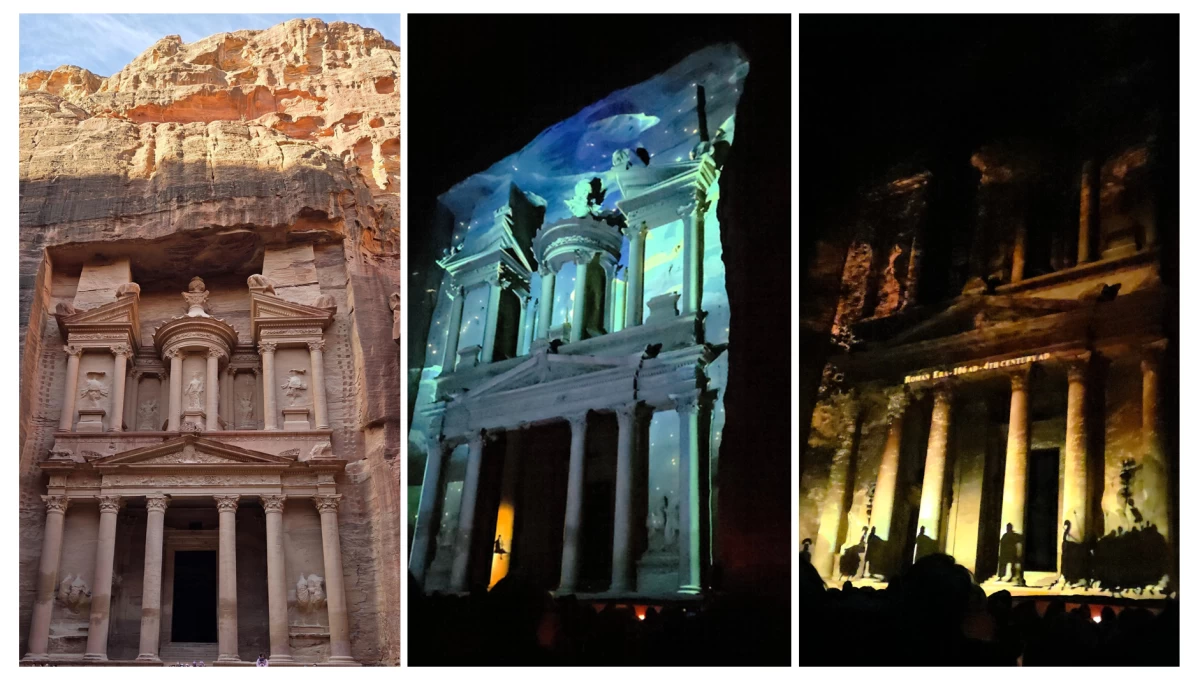
HISTORICAL WONDER Al-Khazneh during the day and its changing, lit-up façade at Petra by night.
Our journey in Jordan continued with four full days of exploration left. Our hotel rooms in Dana had huge picture windows overlooking the beautiful canyons of the bioreserve, and we were able to watch the sun set even as the weather got worse. We went to bed to the sound of howling winds at gale speeds of up to 70 kph following a sumptuous dinner capped off by locally grown organic tea in steaming mugs. We set out from Dana on a foggy morning with a very cold temperature of 3°C and light rain. The weather in Jordan changed constantly, and shortly after we left, the fog burned away, and the sun shone brightly.
Journeying from Dana to Petra took about two hours. We drove on the King’s Highway, a centuries-old road that connects the main cities of Jordan and winds through the desert. Disused rail tracks still dot the landscape from a time when Jordan was connected to Syria and all the way to Türkiye by train, but these were gradually abandoned for more cost-efficient trucks hauling cargo ranging from fruits to fertilizer. On the outskirts of Petra is Little Petra, a smaller collection of ancient buildings carved into the rockface, along with water channels and cisterns made by the Nabateans. We hiked and climbed through the narrow canyon with a local Bedouin guide who explained the ingenuity of the Nabateans in using the landscape to collect rainwater, which was so precious in the desert. We were amazed by the advanced engineering and the planning it took to put this together, and Little Petra served as a good preview for the main attraction nearby.
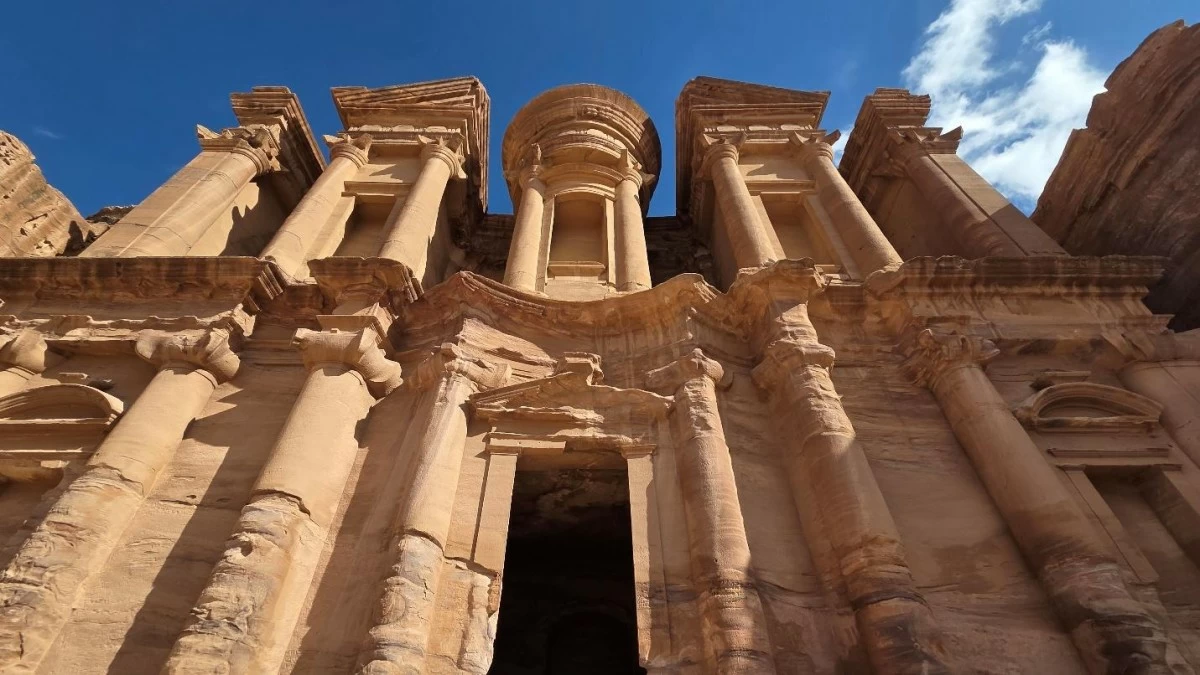
MAJESTIC SIGHT The Monastery at Petra.
We pulled into the modern city of Petra in the early afternoon and had a late lunch. Our driver asked if we were interested in purchasing tickets for the newly revamped “Petra by Night” optional activity after sunset, which was a light and sound show held at the Treasury (Al-Khazneh), the most famous building inside old Petra. Having seen similar shows in the monuments of Egypt, we decided to go ahead and watch. After dinner, we entered the main visitor entrance and walked a two-kilometer path lit by candles under a full moon and the stars. The weather was cool and dry, so it was quite pleasant as we entered the Siq, a long canyon that leads up to Al-Khazneh. The Siq abruptly opens into a courtyard fronting the treasury, and emerging from a dimly lit canyon into the imposing structure of a magnificent building hewn into the red sandstone is breathtaking. We were ushered to prepared mats on the ground and served warm tea to fight the chill. Then the show started with the mesmerizing sounds of traditional Bedouin music in the desert night.
Petra by Night uses a custom-made projection system that illuminates the façade of Al-Khazneh in different colors and uses animation to tell the story of the monument throughout the ages. The projection transformed the façade as it was seen in ancient times up to the modern age and was set to an English narration that succinctly explained the history of the Nabatean Empire.
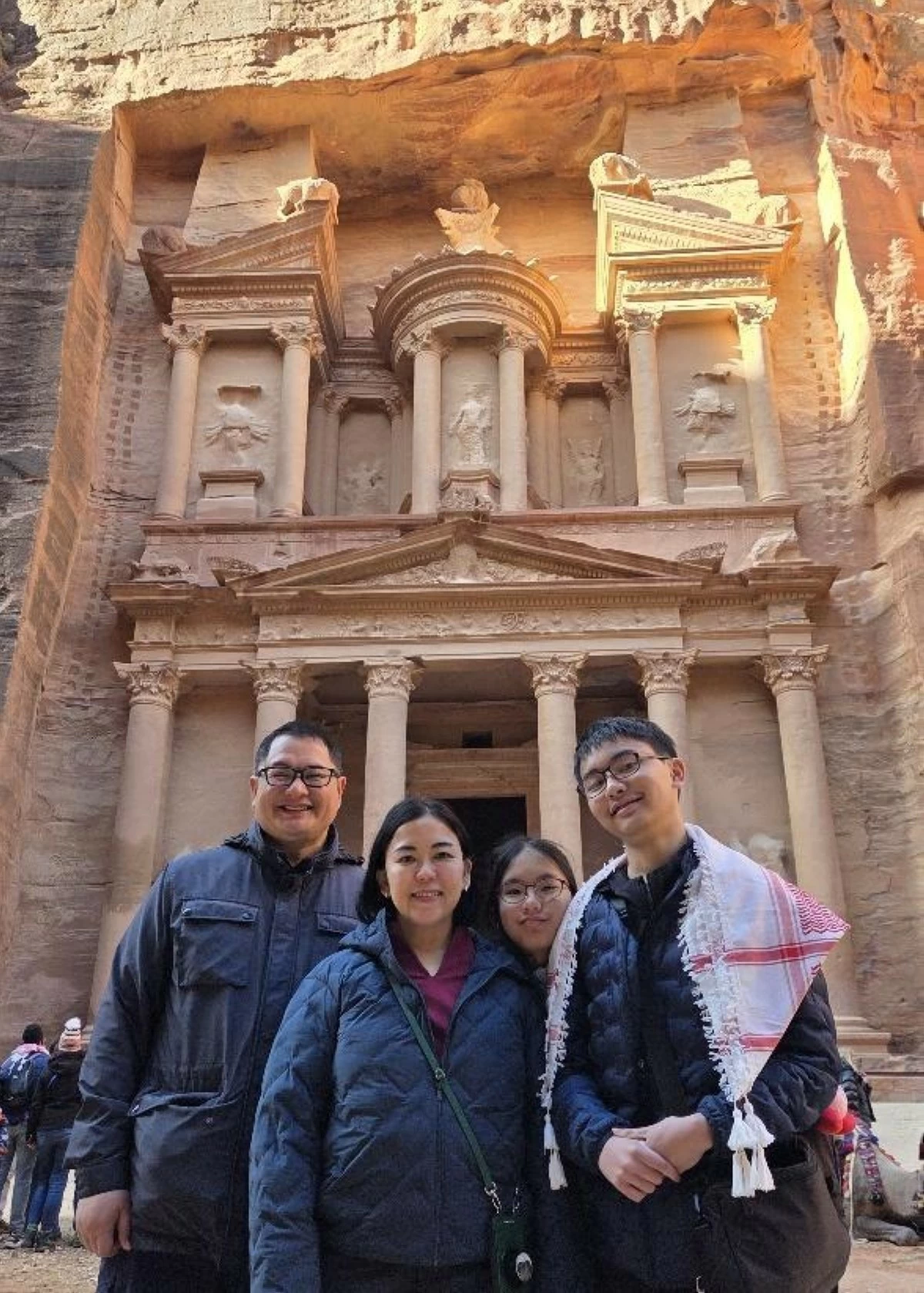
ALL SMILES The author and his family at Al-Khazneh, Petra.
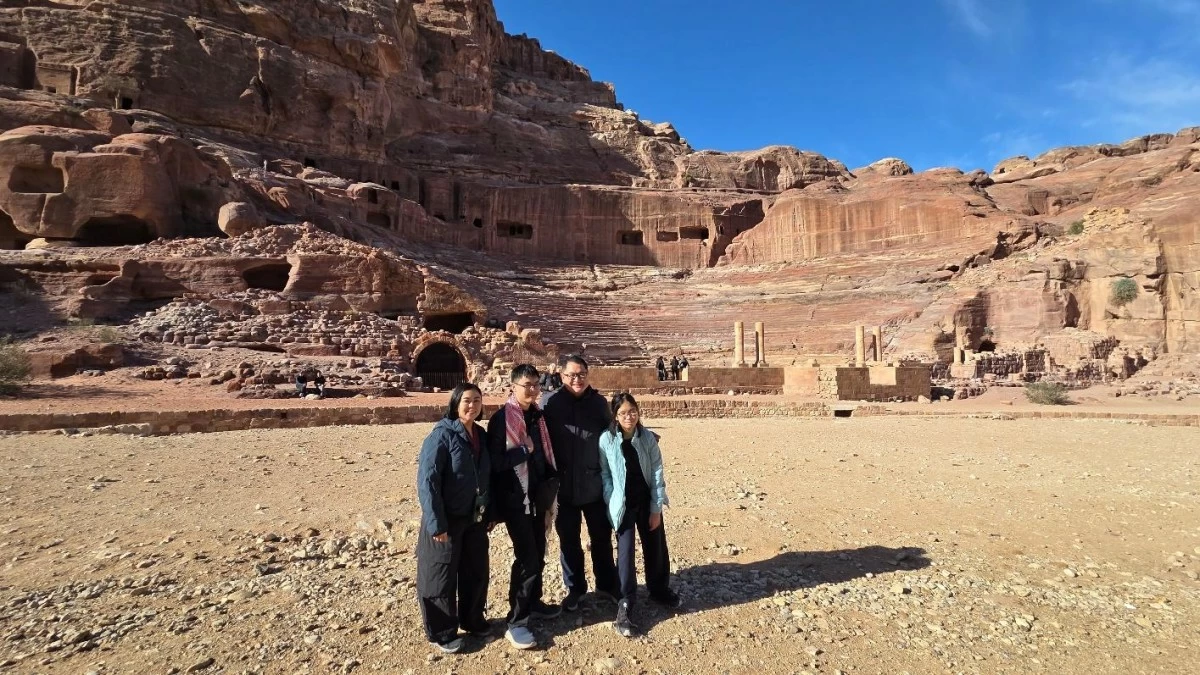
RESPECT THE CULTURE A Greco-Roman amphitheater cut into the rock at Petra.
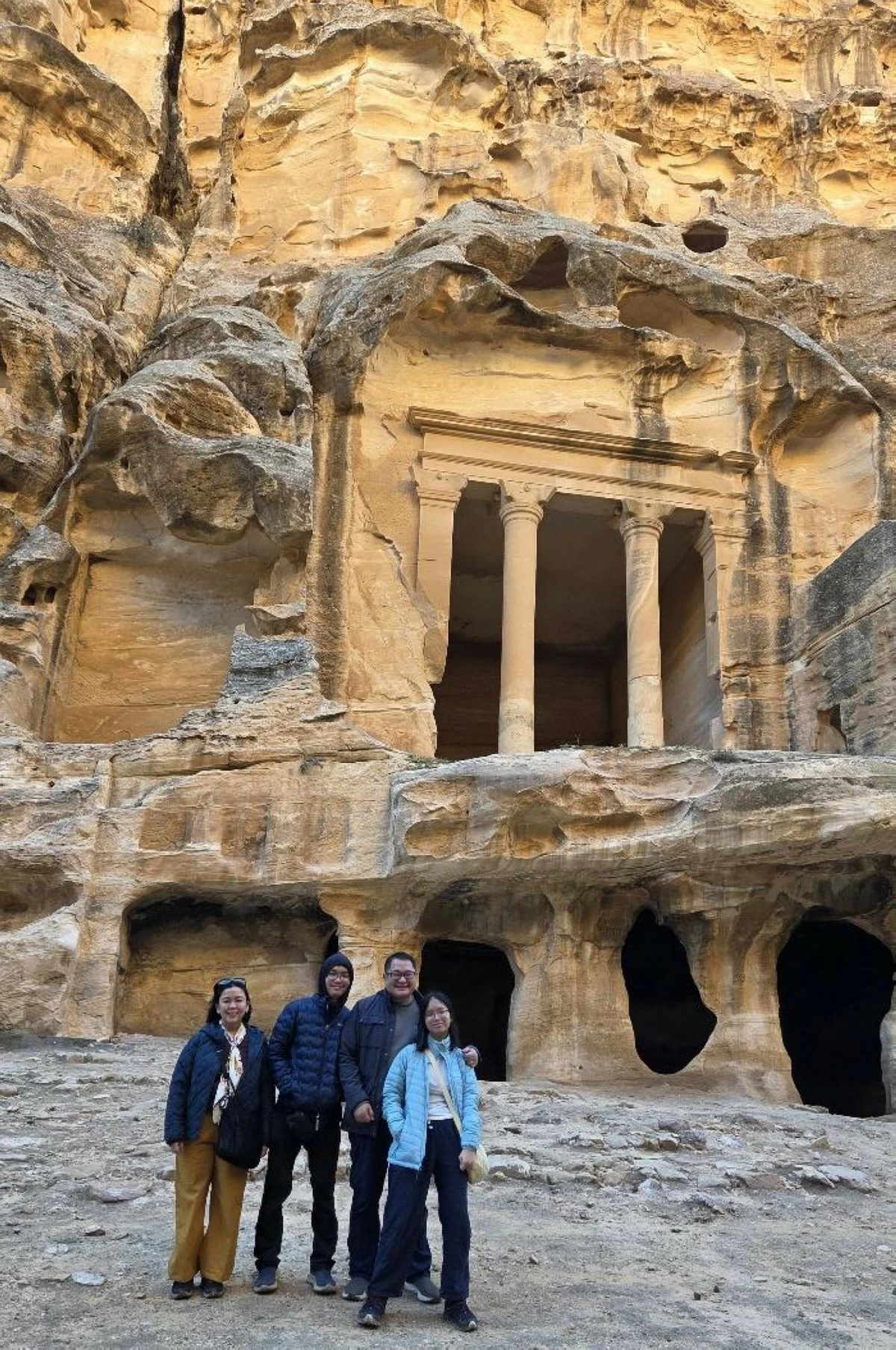
MINI VERSION Little Petra is a smaller-scale building and has a cistern below it for water storage.
The next day, we got up bright and early for the main tour of Petra. Our guide was a local Bedouin who had an impressive knowledge of the history of the Nabateans. He pointed out that the most impressive structures in Petra, including Al-Khazneh, are actually tombs. The architecture shows a mixture of Egyptian and Greco-Roman features since the Nabateans actively traded with them, along with their own unique designs and highly advanced hydrological engineering. A typical tomb has a staircase motif above it, symbolizing the transition from earth to heaven. I couldn’t help hearing Led Zepellin’s “Stairway to Heaven” song in my head. As we walked further through the valley, called Wadi Musa or Valley of Moses, since the spring he created by striking the rock is reportedly nearby. Our guide pointed out water channels cunningly carved into the wall of the canyon, some of which still had remnants of clay pipes that directed the water to reservoirs. Since Petra is halfway between a high elevation and a lower one, it is prone to flash floods, and waterflow had to be controlled. After it was rediscovered, archaeologists had a hard time controlling the flooding in Petra until they discovered a bypass tunnel carved into the rock by the Nabateans, which they then restored, thus safely diverting the water rushing through.
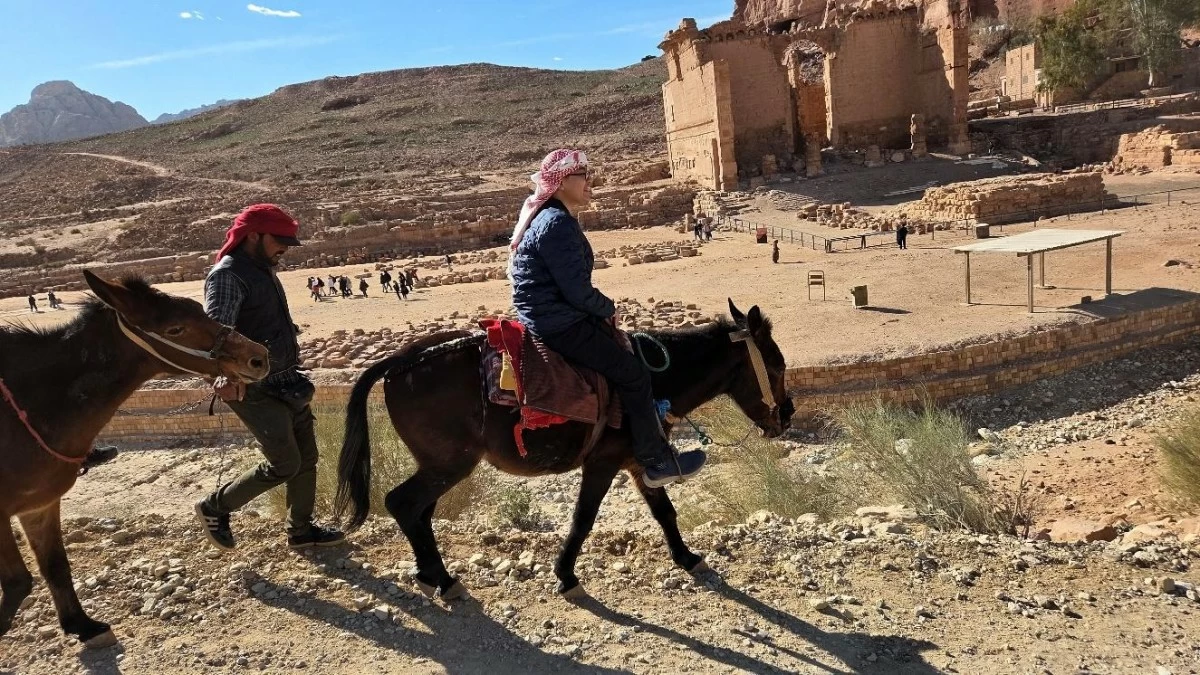
WILD RIDE You can visit the monastery at Petra by riding a mule.
Having walked through the Siq during the day, we could appreciate the different colors of the sandstone and other minerals. The most prominent color was red due to the iron content of the rocks, and this is why Petra is also known as the Rose City. Seeing Al-Khazneh bathed by sunlight was an incredible experience. Considering the hundreds of years this colossal building has survived in the rock, it is still pretty well-preserved. Going closer to the structure, it becomes apparent that the floor at ground level is in fact the second floor, and a partial excavation shows the actual first floor below ground. In other words, Al-Khazneh is even bigger than it looks. “Indiana Jones and the Last Crusade” was filmed in Petra, with Al-Khazneh serving as the secret temple housing the Holy Grail. From the Treasury, we walked along the main street of Petra, which had more tombs, temples, and facades, as well as the only ancient amphitheater carved into the rock. We continued our journey toward the Monastery (Al Dayr), which is also an ancient tomb that was repurposed as a monastery by the Byzantines. Climbing more than 800 steps was not something we were going to be able to do in a reasonable amount of time at our fitness level. Luckily, there are donkeys and mules for hire, which got us up the stairs in no time. Al Dayr was impressive, and the back roads that descended to little Petra were picturesque and looked over the Holy Land. In one of the mountain peaks, you could make out a white structure which our guide said was the tomb of Aaron, brother of Moses and high priest of the Israelites. Unfortunately, we did not have enough time to visit it since going up the mountain would have taken an extra day.
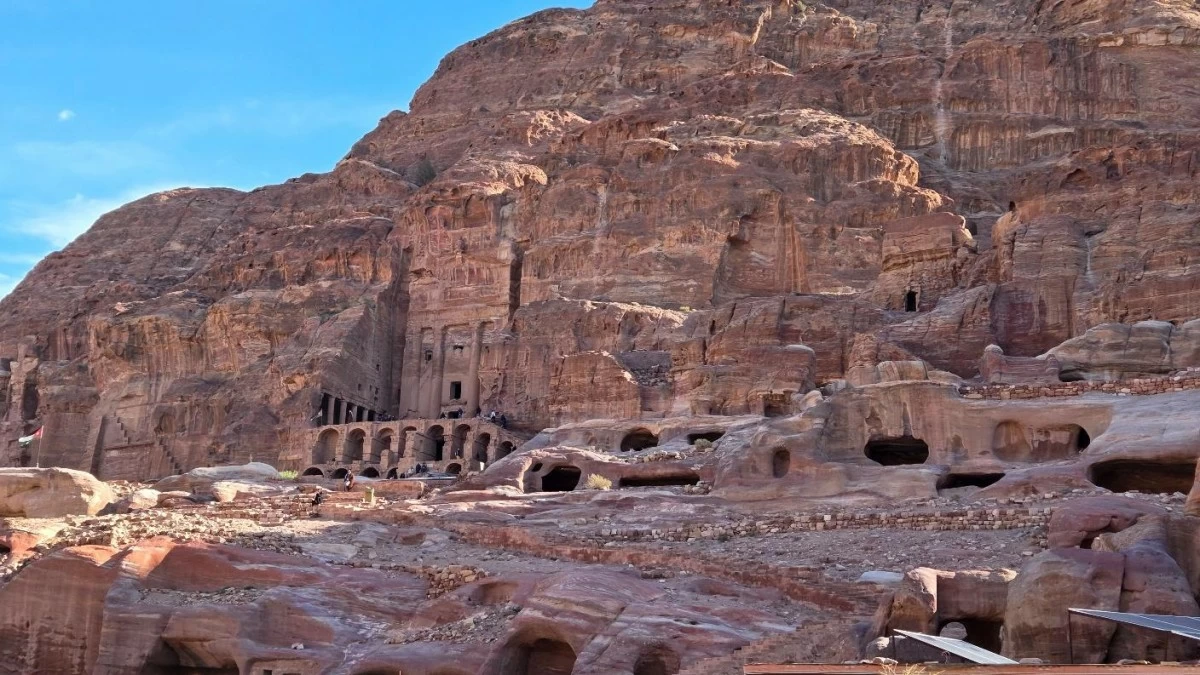
IT’S ROYALTY The Royal Tombs at Petra have staircase facades on the left, marking the place as a tomb.
In almost every place you look in Jordan, there is a story to be told. In my next column, I will write about the conclusion of our journey in the otherworldly landscapes of Wadi Rum, where many movies, including “Star Wars” and “Dune,” were filmed, as well as the deeply spiritual retreat that is the Dead Sea.