






Manila Bulletin
 Technews
Twilio digital patience study shows that Filipinos are among the most patient customers - but it also fades away
Technews
Twilio digital patience study shows that Filipinos are among the most patient customers - but it also fades away
Technews
Twilio digital patience study shows that Filipinos are among the most patient customers - but it also fades away
Twilio digital patience study shows that Filipinos are among the most patient customers - but it also fades away
New research reveals that Filipinos are among the most patient customers, but their patience quickly fades without clear answers, data security, and warmth
Published Jan 15, 2026 12:34 pm


At A Glance

Nicholas Kontopoulos and Mark Anthony Munsayac
In a zoom media conference with Nicholas Kontopoulos - Vice President of Marketing for Asia Pacific and Japan (APJ) at Twilio and Mark Anthony Munsayac, Vice President for Customer Experience at Philippine Airlines, the Filipino’s digital patience was discussed.
Twilio is a customer engagement platform that drives real-time, personalized experiences for today's leading brands and in their study “Decoding Digital Patience: Are Asia Pacific's Digital Users Losing Their Cool?” reveals that Filipino consumers have the second-highest digital patience in the Asia Pacific & Japan (APJ) region, behind only Indonesia.
Filipino consumers exhibit the highest “willing-to-wait” threshold, expecting their issues to be resolved in 27.3 minutes on average, compared to the APJ average of 24.4 minutes. However, they also experience the longest actual waiting times in the region at 31.9 minutes on average.
While Filipinos demonstrate a unique tolerance for delays, this endurance is conditional. Consumers locally want clarity, transparency, and security. While quick service and resolution remain important (41%), Filipino consumers, more than their APJ peers, place even greater emphasis on clear and easily understandable instructions (50%). They also expect data security (41%) and want automated interactions to mirror the warmth and friendliness (37%) they would expect from a real human interaction.

Art by Chino Andin / MB
In the Philippines, human connections still win and this is something that Mark Anthony Munsayac champions as well at Philippine Airlines.
Not all waiting times are treated equally
Across the Philippines, consumers show different levels of patience depending on the type of customer service interaction, with tolerance generally higher for issues seen as urgent or complex. Health-related concerns, for instance, tend to receive more understanding, as Filipinos recognize these situations often require additional care and time to resolve.
In contrast, patience drops sharply when routine, everyday interactions fall short of expectations. Frustration quickly rises in cases such as experiencing telecom service outages (69%) -you know it, we’ve all been there, receiving incorrect or damaged items (68%), disputing a charge or unauthorized transaction (68%), or dealing with delayed or missed retail deliveries (66%).
Filipinos are often regarded as inherently patient, yet repeated delays in simple, day-to-day interactions can rapidly turn that patience into dissatisfaction. When expectations are not met, many consumers choose to take action with: 43% looking for answers themselves, 35% switching to a different channel, and 26% leaving negative reviews.
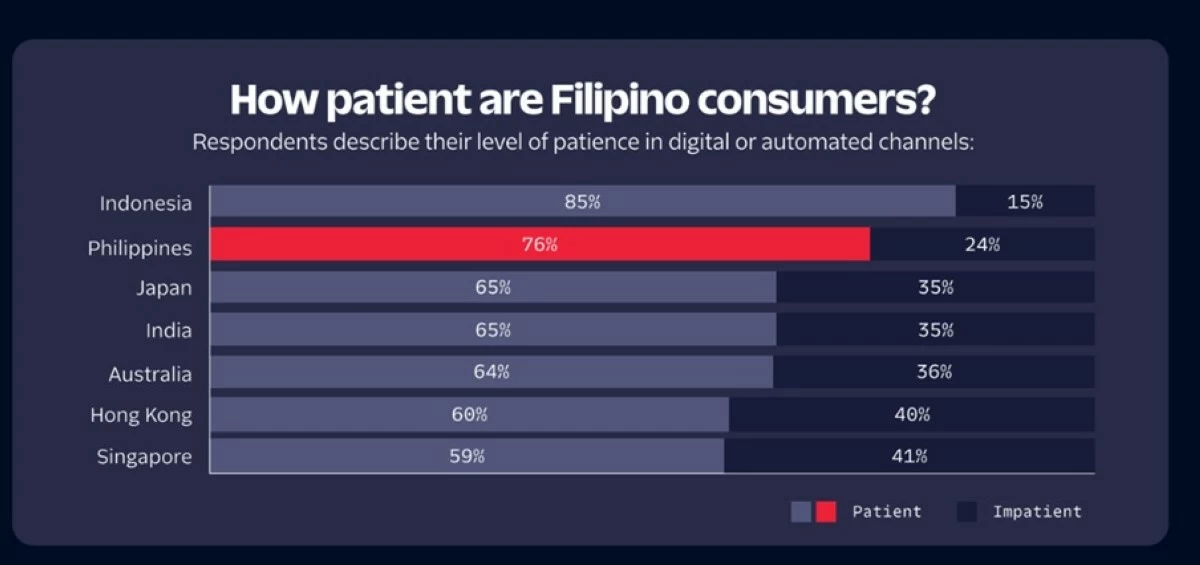
Beyond speed: AI that’s secure, clear, and feels human
Filipino consumers are among the most experienced users of AI-powered customer service in the region, with 81% reporting interaction with these tools. While moderately satisfied with AI,
42% indicate that current AI implementations are testing their patience with frustration driven by scripted responses (46%), generic answers (44%), and unresolved issues (41%).
Consequently, the "human touch" remains a priority. Filipinos report a general preference in starting customer support with a human agent (43%) rather than an automated system (23%). For many, waiting a little longer for a capable human is seen as an investment in a guaranteed solution, rather than wasted time on a “fast” AI interaction that could lead to misunderstandings, rigid scripts, or the frustration of having to start over. At the same time, there is a growing openness to hybrid service models with clear escalation paths with 3 in 4 Filipino consumers expecting a smooth, seamless transfer to a human when needed.
Filipinos prefer being right, rather than being fast.
Filipino patience is a trust signal and a chance for brands to exceed expectations
“Filipino consumers are patient because they start with a deep sense of trust, but this trust is a foundation that brands must either build upon or risk breaking,” said Kontopoulos.
“While brands have an initial head start, capturing long-term loyalty requires meeting Filipinos on their own terms: through clear communication, strong data safeguards, and seamless transitions. Just as important is recognizing high-stakes moments where a person-to-person connection is still expected. When a brand gets this right, they don’t just satisfy a customer. They build credibility that makes it very difficult for competitors to lure them away.”
Filipino consumers’ unique patience profile offers brands a window of opportunity to get the customer experience right. And as this patience gets tested in the AI era, brands should focus on four levers when designing AI interactions: clarity about AI’s role, choice to reach a human where possible, continuity across channels and agents, and care through empathetic, conversational experiences. When done right, these elements help extend digital patience and turn it into a competitive advantage.
The digital age may have brought us faster and instant interactions but Twilio’s study just shows that authentic personalization still goes a long way.