






Manila Bulletin
 Philippines
National
Lava effusion, pyroclastic density currents continue at Mayon; Alert Level 3 remains
Philippines
National
Lava effusion, pyroclastic density currents continue at Mayon; Alert Level 3 remains
Philippines
National
Lava effusion, pyroclastic density currents continue at Mayon; Alert Level 3 remains
Lava effusion, pyroclastic density currents continue at Mayon; Alert Level 3 remains
Published Jan 15, 2026 10:01 am


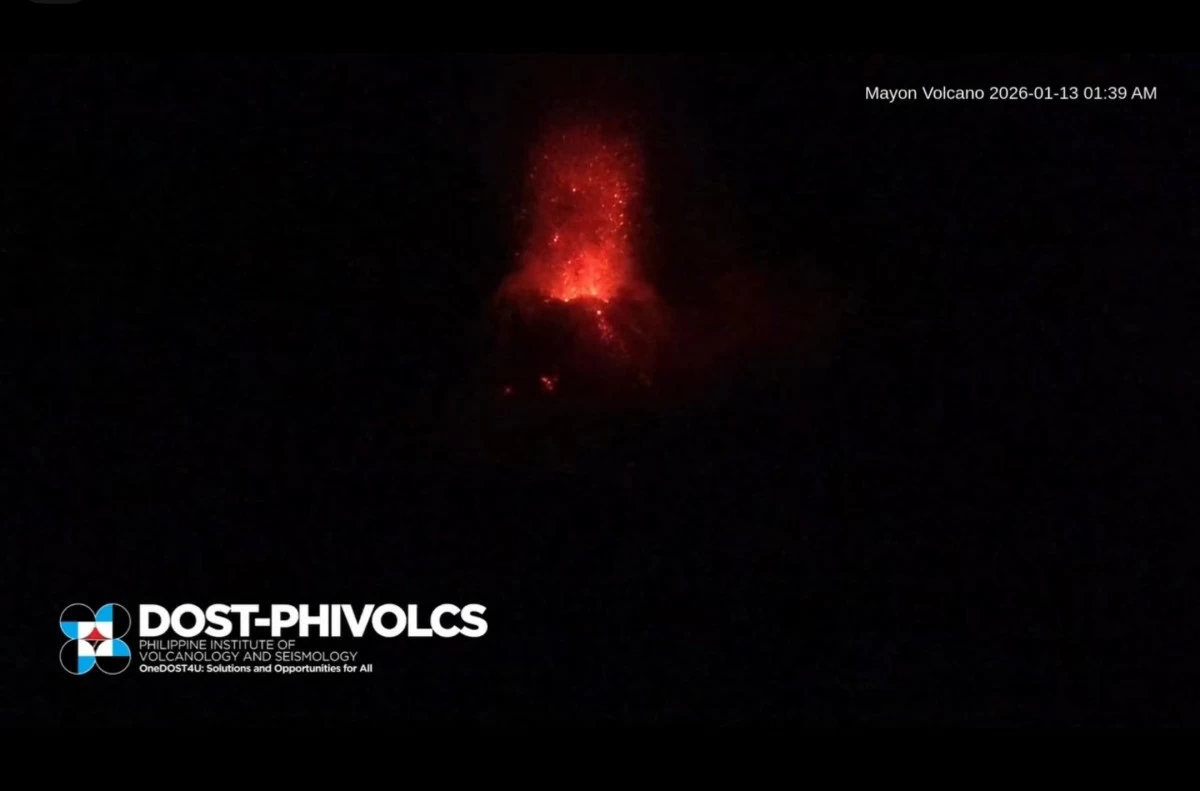
A faint glow and brief lava fountaining are seen at Mayon Volcano’s summit crater during the early hours of Jan. 13, 2026. (Philippine Institute of Volcanology and Seismology/File)
Continued lava dome growth and lava flow effusion were observed at Mayon Volcano from 12 a.m. on Jan. 14 to 12 a.m. on Jan. 15, the Philippine Institute of Volcanology and Seismology (Phivolcs) said.
Phivolcs also recorded a total of 207 rockfall events and 27 pyroclastic density currents, locally known as “uson,” during the 24-hour monitoring period.
Crater glow was described as fair and visible to the naked eye.
Sulfur dioxide emission measured on Jan. 14 reached 987 tons, while volcanic plumes rose up to 800 meters above the summit crater.
The plumes showed moderate emission and drifted west-southwest to southwest.
Based on these parameters, Phivolcs said Alert Level 3 remains hoisted over Mayon Volcano due to intensified magmatic unrest.
The agency reiterated that entry into the six-kilometer-radius permanent danger zone is strictly prohibited, as well as entry without vigilance into the extended danger zone.
Flying aircraft close to the volcano is also not allowed due to possible hazards from ash and other volcanic debris.
Phivolcs warned the public and local authorities of potential hazards while Alert Level 3 remains in effect, including rockfalls, landslides or avalanches, ballistic fragments, lava flows and lava fountaining, pyroclastic density currents, moderate-sized explosions, and lahars during heavy and prolonged rainfall.