

ADVERTISEMENT

'No': DENR rejects PRA's claim that reclamation curbs flooding

Published Jan 14, 2026 03:06 pm
(MB FILE PHOTO)
(MB FILE PHOTO)
Contrary to claims by the Philippine Reclamation Authority (PRA), the Department of Environment and Natural Resources (DENR) on Wednesday, Jan. 14, said reclamation projects do not mitigate flooding and may even worsen it by obstructing the natural flow of floodwaters to Manila Bay.
Raquel Malubag, project management specialist for Knowledge Management of the DENR, said reclamation activities block waterways, making surrounding areas more prone to flooding.
“Personally, it really affects… For example, if lalagyan mo talaga ng lupa, pwedeng mabarahan ‘yung daanan ng tubig. So it’s really prone to flooding. So, no (Personally, it really affects… For example, if you put soil there, the passage of water can be blocked. So it’s really prone to flooding. So, no),” Malubag said during the Manila Bay Reclamation Convergence Conversation forum held in Intramuros, Manila.
Malubag made the statement when asked by the Manila Bulletin whether the DENR agrees with earlier claims by the PRA that reclamation projects help ease flooding.

Malubag (JEL SANTOS/MB PHOTO)
Forum participants—composed of members of church groups, environmental advocates, fisherfolk organizations, youth groups, and civil society organizations—applauded Malubag following her remarks.
Rev. Fr. Ricardo F. Valencia Jr., head of the Ministry on Environment and Disaster Response and the Ecology Ministry of the Roman Catholic Archdiocese of Manila, earlier asked the DENR where it stands amid reclamation proposals—whether the agency is siding with environmental protection or with business interests behind the projects.
Malubag stressed that the DENR’s position is aligned with the rehabilitation of Manila Bay and with the communities working to protect it.
“Of course, we are for the people po kasi we are trying to rehabilitate Manila Bay. How can we rehabilitate the bay if there are so many reclamations ongoing, personal opinion ko (Of course, we are for the people because we are trying to rehabilitate Manila Bay. How can we rehabilitate the bay if there are so many reclamations ongoing, this is my personal opinion),” she said.
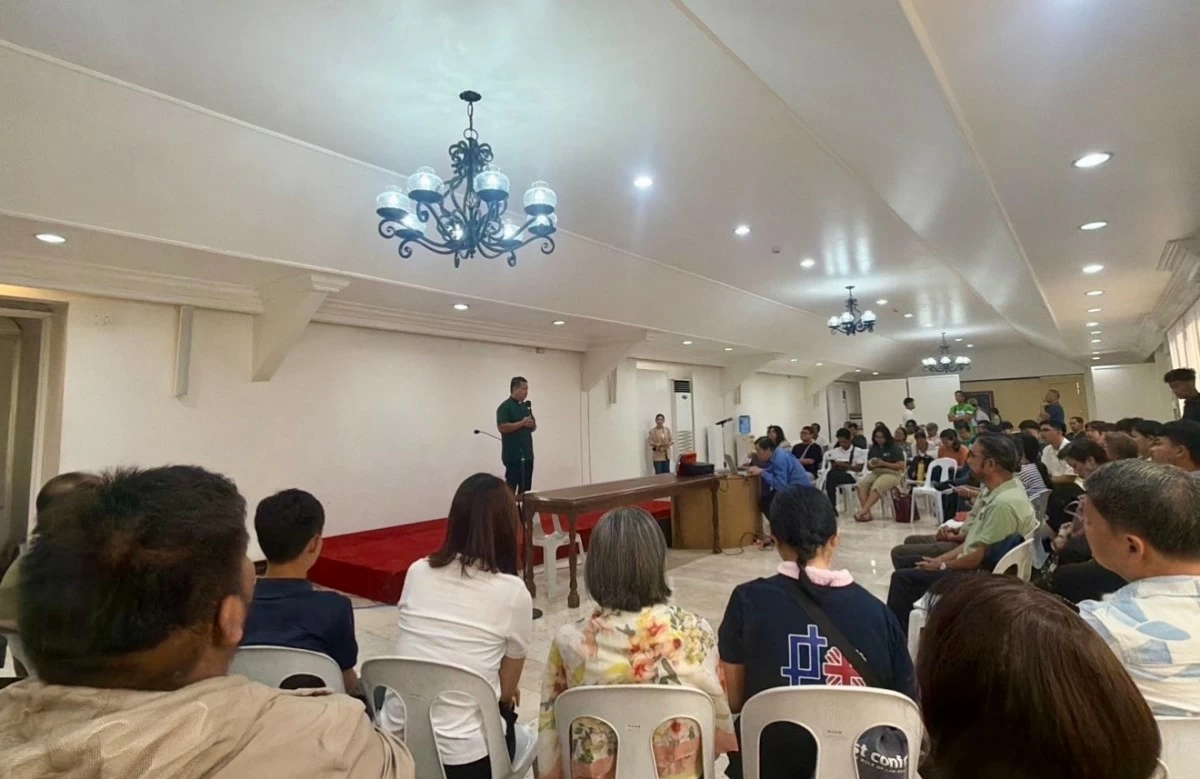
Fr. Valencia (JEL SANTOS/MB PHOTO)
She added that reclamation projects undermine the government’s obligation to restore the bay under the Supreme Court’s Manila Bay ruling.
“Actually, kung may power lang po ang office namin, once we know na may reclamation, dapat ‘no’ agad kasi it will affect the rehabilitation of the bay baka hindi po namin magawa ‘yung utos ni Supreme Court (Actually, if our office only had the power, once we know there is reclamation, it should already be a ‘no’ because it will affect the rehabilitation of the bay and we might not be able to fulfill the order of the Supreme Court),” she said.
On Dec. 18, 2016, the Supreme Court issued a writ of continuing mandamus on Manila Bay (G.R. Nos. 171947-48), ordering 13 government agencies to clean up, rehabilitate, and preserve the bay, and to restore and maintain its waters to Class SB level, making them suitable for swimming, skin-diving, and other contact recreation.
In December last year, DENR Secretary Raphael Lotilla said 19 of the 21 reclamation projects along Manila Bay remain suspended pending the completion of the cumulative impact assessment ordered by President Marcos.
Recently, international marine conservation group Oceana criticized the PRA for asserting that reclamation projects help reduce flooding, calling the claim “reprehensible” and devoid of scientific support.
Oceana Vice President Von Hernandez said the assertion overlooks both empirical evidence and the natural processes governing water flow.
Progressive fisherfolk group Pamalakaya also dismissed the PRA’s claim as “a big lie and deception.”
The PRA had earlier floated the idea that reclamation projects could help address flooding in the country.

Related Tags

DENR PRA FORUM RECLAMATION MANILA BAY FLOODING ENVIRONMENT
ADVERTISEMENT
.most-popular .layout-ratio{ padding-bottom: 79.13%; } @media (min-width: 768px) and (max-width: 1024px) { .widget-title { font-size: 15px !important; } }

{{ articles_filter_1561_widget.title }}

.most-popular .layout-ratio{ padding-bottom: 79.13%; } @media (min-width: 768px) and (max-width: 1024px) { .widget-title { font-size: 15px !important; } }

{{ articles_filter_1562_widget.title }}

.most-popular .layout-ratio{ padding-bottom: 79.13%; } @media (min-width: 768px) and (max-width: 1024px) { .widget-title { font-size: 15px !important; } }

{{ articles_filter_1563_widget.title }}

{{ articles_filter_1564_widget.title }}

.mb-article-details { position: relative; } .mb-article-details .article-body-preview, .mb-article-details .article-body-summary{ font-size: 17px; line-height: 30px; font-family: "Libre Caslon Text", serif; color: #000; } .mb-article-details .article-body-preview iframe , .mb-article-details .article-body-summary iframe{ width: 100%; margin: auto; } .read-more-background { background: linear-gradient(180deg, color(display-p3 1.000 1.000 1.000 / 0) 13.75%, color(display-p3 1.000 1.000 1.000 / 0.8) 30.79%, color(display-p3 1.000 1.000 1.000) 72.5%); position: absolute; height: 200px; width: 100%; bottom: 0; display: flex; justify-content: center; align-items: center; padding: 0; } .read-more-background a{ color: #000; } .read-more-btn { padding: 17px 45px; font-family: Inter; font-weight: 700; font-size: 18px; line-height: 16px; text-align: center; vertical-align: middle; border: 1px solid black; background-color: white; } .hidden { display: none; }
function initializeAllSwipers() { // Get all hidden inputs with cms_article_id document.querySelectorAll('[id^="cms_article_id_"]').forEach(function (input) { const cmsArticleId = input.value; const articleSelector = '#article-' + cmsArticleId + ' .body_images'; const swiperElement = document.querySelector(articleSelector); if (swiperElement && !swiperElement.classList.contains('swiper-initialized')) { new Swiper(articleSelector, { loop: true, pagination: false, navigation: { nextEl: '#article-' + cmsArticleId + ' .swiper-button-next', prevEl: '#article-' + cmsArticleId + ' .swiper-button-prev', }, }); } }); } setTimeout(initializeAllSwipers, 3000); const intersectionObserver = new IntersectionObserver( (entries) => { entries.forEach((entry) => { if (entry.isIntersecting) { const newUrl = entry.target.getAttribute("data-url"); if (newUrl) { history.pushState(null, null, newUrl); let article = entry.target; // Extract metadata const author = article.querySelector('.author-section').textContent.replace('By', '').trim(); const section = article.querySelector('.section-info ').textContent.replace(' ', ' '); const title = article.querySelector('.article-title h1').textContent; // Parse URL for Chartbeat path format const parsedUrl = new URL(newUrl, window.location.origin); const cleanUrl = parsedUrl.host + parsedUrl.pathname; // Update Chartbeat configuration if (typeof window._sf_async_config !== 'undefined') { window._sf_async_config.path = cleanUrl; window._sf_async_config.sections = section; window._sf_async_config.authors = author; } // Track virtual page view with Chartbeat if (typeof pSUPERFLY !== 'undefined' && typeof pSUPERFLY.virtualPage === 'function') { try { pSUPERFLY.virtualPage({ path: cleanUrl, title: title, sections: section, authors: author }); } catch (error) { console.error('ping error', error); } } // Optional: Update document title if (title && title !== document.title) { document.title = title; } } } }); }, { threshold: 0.1 } ); function showArticleBody(button) { const article = button.closest("article"); const summary = article.querySelector(".article-body-summary"); const body = article.querySelector(".article-body-preview"); const readMoreSection = article.querySelector(".read-more-background"); // Hide summary and read-more section summary.style.display = "none"; readMoreSection.style.display = "none"; // Show the full article body body.classList.remove("hidden"); } document.addEventListener("DOMContentLoaded", () => { let loadCount = 0; // Track how many times articles are loaded const offset = [1, 2, 3, 4, 5, 6, 7, 8, 9, 10]; // Offset values const currentUrl = window.location.pathname.substring(1); let isLoading = false; // Prevent multiple calls if (!currentUrl) { console.log("Current URL is invalid."); return; } const sentinel = document.getElementById("load-more-sentinel"); if (!sentinel) { console.log("Sentinel element not found."); return; } function isSentinelVisible() { const rect = sentinel.getBoundingClientRect(); return ( rect.top < window.innerHeight && rect.bottom >= 0 ); } function onScroll() { if (isLoading) return; if (isSentinelVisible()) { if (loadCount >= offset.length) { console.log("Maximum load attempts reached."); window.removeEventListener("scroll", onScroll); return; } isLoading = true; const currentOffset = offset[loadCount]; window.loadMoreItems().then(() => { let article = document.querySelector('#widget_1690 > div:nth-last-of-type(2) article'); intersectionObserver.observe(article) loadCount++; }).catch(error => { console.error("Error loading more items:", error); }).finally(() => { isLoading = false; }); } } window.addEventListener("scroll", onScroll); });

Sign up by email to receive news.