






Manila Bulletin
 Business
Trade & Industry
Philippines sees expanded exports to UAE under free trade deal
Business
Trade & Industry
Philippines sees expanded exports to UAE under free trade deal
Business
Trade & Industry
Philippines sees expanded exports to UAE under free trade deal
Philippines sees expanded exports to UAE under free trade deal
Published Jan 13, 2026 07:54 pm


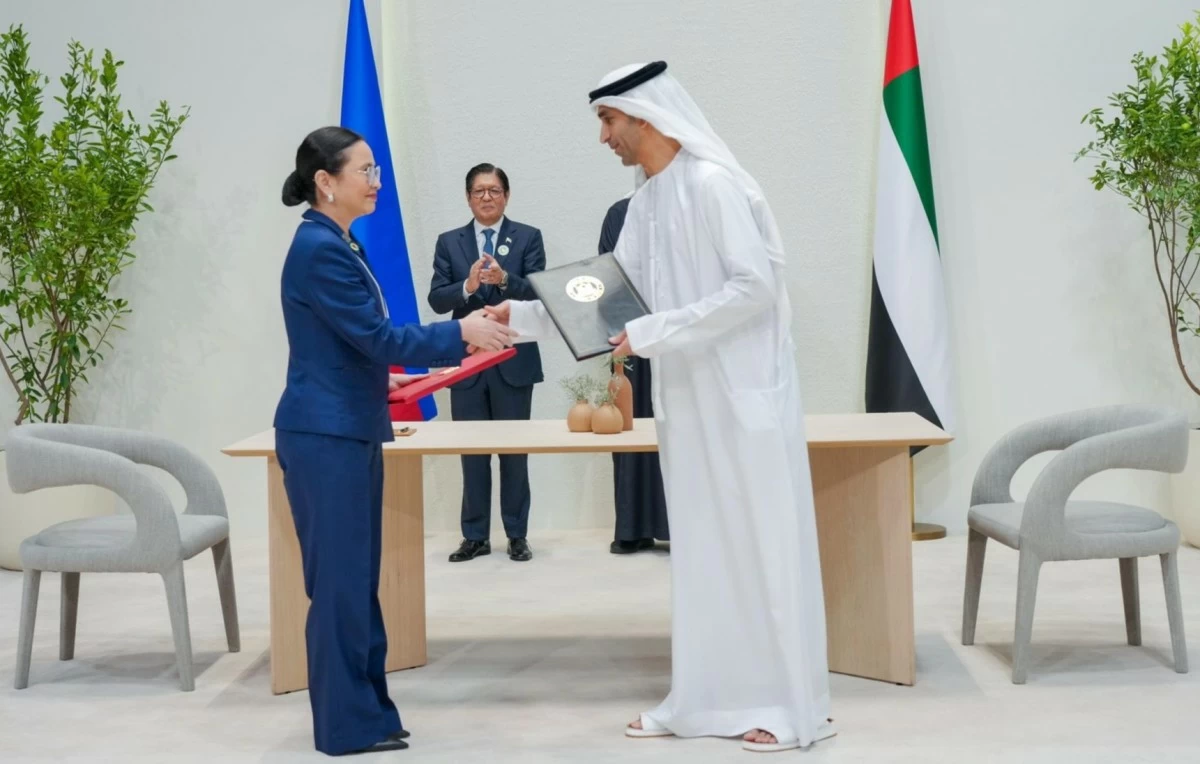
(Left) Department of Trade and Industry Secretary Cristina Roque and UAE Minister of Foreign Trade Thani bin Ahmed Al Zeyoudi (PCO photo)
The Philippines expects a significant increase in the export of key commodities, with around 95 percent of its products receiving preferential treatment under the newly signed comprehensive economic partnership agreement (CEPA) with the United Arab Emirates (UAE).
The country's first free trade agreement (FTA) with a Middle Eastern nation was formalized on Tuesday, Jan. 13 in a signing ceremony in Abu Dhabi, attended by President Ferdinand “Bongbong” Marcos Jr. and UAE President Mohamed bin Zayed Al Nahyan.
The agreement was signed by Department of Trade and Industry (DTI) Secretary Cristina Roque and UAE Minister of Foreign Trade Thani bin Ahmed Al Zeyoudi.
Roque said the CEPA is a major step in the administration’s initiative to use trade and foreign policy as a tool for long-term economic positioning.
“Following President Ferdinand R. Marcos Jr.’s directive, we are using strategic trade deals to move Philippine businesses into higher-value markets and more integrated supply chains,” said Roque.
“In doing so, the CEPA gives our exporters and service providers a stable platform in the Middle East,” she added.
According to the DTI, about 95 percent of the country’s exports to the UAE will enjoy preferential tariff treatment, meaning there will be lower tariffs imposed on local goods.
These products cover personal care and cosmetic items, food products, electronic equipment, automotive and aircraft parts, and textile and apparel products.
The DTI expects reduced tariffs and more seamless trade facilitation to help domestic manufacturers expand exports, which would ramp up production and generate more jobs in the process.
Data from the Philippine Statistics Authority (PSA) showed that the UAE was the country’s 18th largest trading partner in 2024, with total trade between the two countries amounting to $1.83 billion.
The country’s exports to the UAE reached $390.4 million, while imports from the Middle Eastern nation stood at $1.44 billion.
Citing preliminary studies, the government estimates that exports to the UAE would grow by 9.13 percent, or around $2 billion based on 2024 levels.
The CEPA also provides more predictable rules for businesses operating in key service sectors such as professional services, construction, retail, tourism, and information technology and business process management (IT-BPM).
The DTI said this would support the expansion of local service providers in the UAE and foster potential investments by UAE-based firms in the country.
Moreover, the agreement widens cooperation in strategic sectors such as digital trade, MSME, trade and sustainable development, intellectual property rights protection and enforcement, competition and consumer protection, government procurement, and economic and technical cooperation.
With the signing of the CEPA, Roque said it “sends a strong signal that the Philippines is open for deeper, rules-based economic partnerships.”
This year, the government is aiming to sign the CEPA with Chile and the FTA with the European Union (EU).
Currently, the Philippines has FTAs with Japan, South Korea, and the European Free Trade Association (EFTA), as well as regional agreements with the Association of Southeast Asian Nations (ASEAN) and its trade partners, and the Regional Comprehensive Economic Partnership (RCEP).