







Marcos calls for more accessible, fairer climate financing
Published Jan 13, 2026 07:43 pm


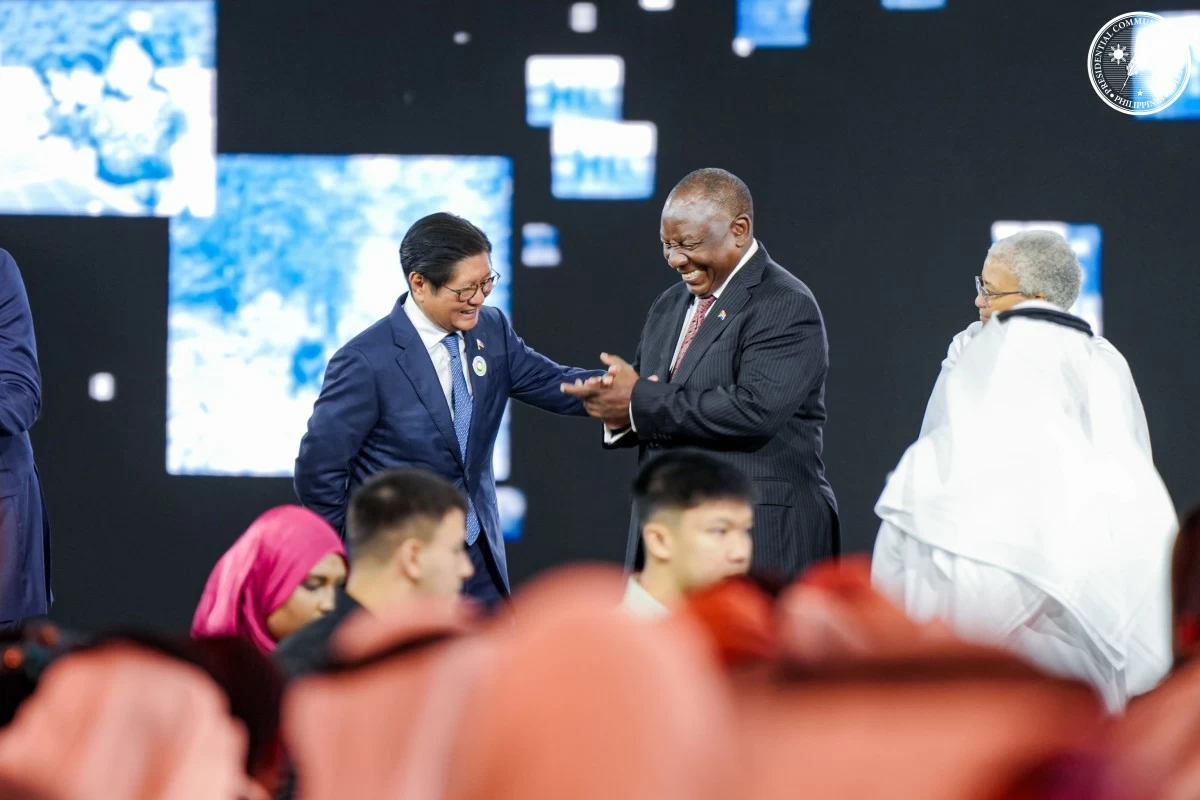
President Ferdinand R. Marcos Jr. on Jan. 13, 2026, participates in the opening ceremony of the Abu Dhabi Sustainability Week (ADSW) 2026 Summit, joining world leaders in discussions on solutions to the most pressing global challenges, including climate change, renewable energy, and sustainable development. (Photo courtesy of PCO)
President Marcos has called on global financial institutions to make climate financing more accessible and fairer.
Malacañang said Marcos "reiterated calls for reforms in global financial institutions to make climate and development financing fairer, more accessible, and more responsive" during his keynote speech at the Abu Dhabi Sustainability Week (ADSW) on Tuesday, Jan. 13.
This, as he noted that the Philippines remains highly vulnerable to climate change, emphasizing the challenges faced by many economies, including rising debt, fiscal constraints, and limited access to development finance.
“Borrowing costs for climate-vulnerable countries exceed growth rates, while debt burdens crowd out investments in health, education, and resilience. This is not simply a matter of finance. It is a matter of equity, stability, and shared responsibility,” Marcos said.
The President also stressed the Philippines’ consistent advocacy for increased climate finance, the effective use of concessional financing, such as Official Development Assistance, and support for disaster risk reduction and management, sustainable transport and infrastructure, and the circular economy.
He cited the country's move to adopt a community-led approach to climate resilience, citing the People’s Survival Fund as a key mechanism supporting vulnerable communities through adaptation projects, climate data, and technology.
“The Philippines views the People’s Survival Fund as complementing the Green Climate Fund, Adaptation Fund, and the Fund for Responding to Loss and Damage—three global mechanisms where we are board members. We are also the proud host to the Fund for Responding to Loss and Damage,” he said.
Marcos also highlighted the need for reform in the global financial architecture, noting discussions during the Fourth International Conference on Financing for Development in Spain, where countries acknowledged that the current system is “no longer fit for purpose,” particularly for climate-vulnerable nations.
In his remark, Marcos thanked the United Arab Emirates (UAE) for convening ADSW, describing it as a vital platform that brings together governments, the private sector, and civil society to align policies, technologies, and investments in support of sustainability.
“The Abu Dhabi Sustainability Week (ADSW) reminds us that sustainability is no longer the concern of any single sector but a shared imperative,” he said, adding that this year’s theme, ‘The Nexus of Next: All Systems Go,’ captures this reality well.
Amid rapid technological, economic, and geopolitical shifts, Marcos also reaffirmed the Philippines’ commitment to achieving the Sustainable Development Goals (SDGs) by strengthening the link between climate action, adaptation, and economic development.
Renewable energy commitment
In his keynote address, Marcos also reaffirmed the Philippines’ commitment to renewable energy expansion, nuclear safety, and science-driven sustainability.
The President cited the signing of the Philippine National Nuclear Energy Safety Act, which establishes the country’s first comprehensive framework for the safe, secure, and peaceful use of nuclear technology.
“This provides a stable and predictable environment for scientists and industries to innovate safely and responsibly. It also signals the Philippines’ readiness to deepen science-driven cooperation with global partners,” he said.
The Chief Executive noted the Philippines’ growing role in science-based solutions, including hosting the world’s first International Atomic Energy Agency (IAEA) High-Level Forum on Nuclear Technology for Controlling Plastic Pollution, which advanced public-private partnerships and innovation for circular and sustainable technologies.
Marcos is on a working visit to the UAE, his second visit in just over a year, to further strengthen bilateral relations between Manila and Abu Dhabi in trade, defense, and sustainable development.