ADVERTISEMENT

Decades of conflict cost thousands of lives, millions displaced—PIDS urges sustained peacebuilding

Published Jan 12, 2026 12:00 am  |  Updated Jan 10, 2026 02:11 pm
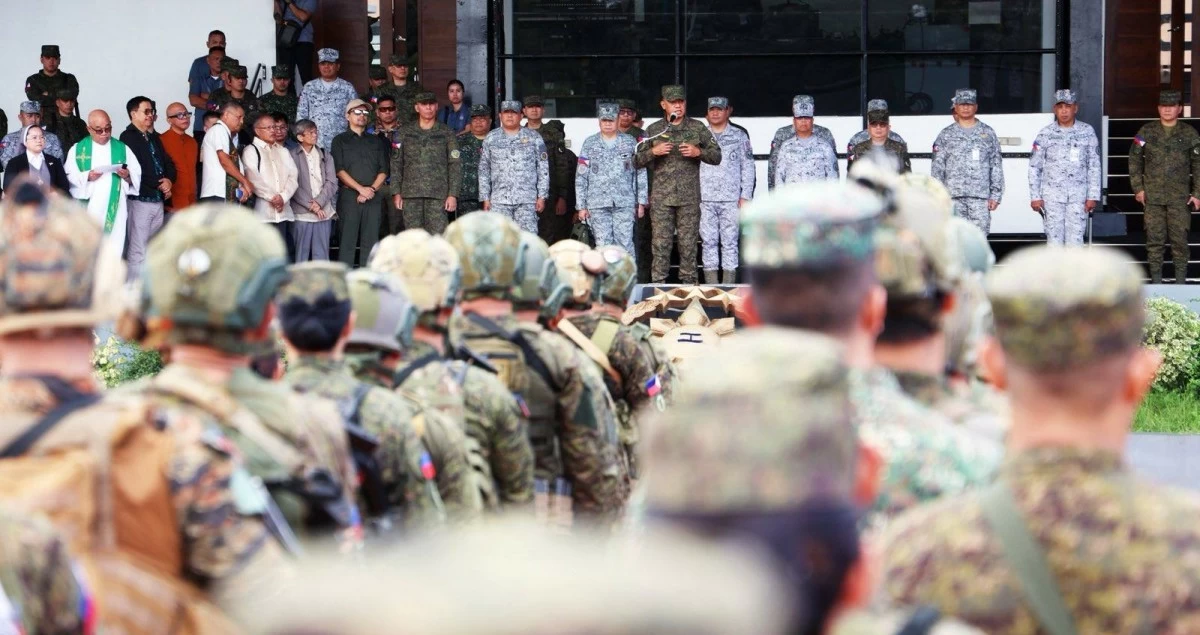
Armed Forces of the Philippines (AFP) Chief of Staff, General Romeo S. Brawner Jr. (middle) addresses the assembled military personnel at Camp Aguinaldo in Quezon City on Nov. 16, 2025. (File photo: AFP)
State-run policy think tank Philippine Institute for Development Studies (PIDS) warned that decades of armed conflict in the country have exacted a heavy toll, including tens of thousands of deaths and millions displaced, and called for more coordinated, sustained, and incentive-aligned peacebuilding efforts.
In a Jan. 7 discussion paper titled “Toward Resolutions and Reconciliations: Understanding the Elements of Peacebuilding in the Philippines,” researchers from PIDS emphasized that peacebuilding works best when economic, political, and security incentives are aligned, and state commitments are seen as credible and long-lasting.
“Peacebuilding success in the Philippines should be assessed not only by the signing of peace agreements but, more fundamentally, by the human and social costs that have been avoided,” PIDS said.
Authored by PIDS senior research fellow Adoracion M. Navarro and research analyst Janina Sofia H. Jacinto, the paper highlighted the heavy toll of decades-long conflicts. These include approximately 40,000 deaths in clashes between Communist Party of the Philippines-New People’s Army (CPP-NPA) and the Armed Forces of the Philippines (AFP), around 150,000 fatalities in central and western Mindanao, and roughly 3.2 million people displaced by violence between 2008 and 2022.
PIDS noted that lasting peace emerges when government efforts—such as confidence-building measures, development programs, ceasefires, legal settlements, and reconciliation initiatives—work together with aligned incentives and credible commitments. It stressed that “steadfast peacebuilding pays off economically.”
To strengthen peacebuilding, PIDS recommended designing interventions around incentive compatibility, ensuring that cooperation brings greater and more predictable benefits than renewed conflict for all parties. The think tank emphasized the need to closely align security measures with socioeconomic programs to enhance the effectiveness of peace initiatives.
The paper also called for the institutionalization and digitalization of monitoring and evaluation systems to track real outcomes—beyond mere outputs—particularly for reintegration programs such as Enhanced Comprehensive Local Integration Program (ECLIP) and barangay-level development projects.
In terms of fiscal accountability, PIDS suggested a special audit by the Commission on Audit (COA) for peacebuilding and reintegration programs to address efficiency gaps across initiatives such as ECLIP, PAyapa at MAsaganang PamayaNAn (PAMANA), and Barangay Development Program (BDP). It also recommended the development of integrated databases and results-based monitoring systems to track beneficiaries across programs over time.
The think tank further called for reconciliation ceremonies highlighting women’s roles to strengthen former armed groups and support community healing. It recommended involving neutral facilitators, including civil society organizations, faith groups, and academics, to enhance trust and transparency in peacebuilding processes.
Addressing the persistent challenges in negotiations with CPP-NPA-National Democratic Front (NDF), PIDS suggested that the Philippines could learn from Thailand’s experience, where the end of communist insurgency was achieved through a mix of military containment, amnesty, and political and socioeconomic inclusion. The report said that a similar approach could guide the remaining peacebuilding work in the country.
Finally, the paper stressed that lasting peace requires tackling the root causes of conflict, particularly in rural and indigenous communities. By fostering local engagement, dialogue with government institutions, and inclusive political participation, conflict transformation strategies could build trust and help resolve the remaining CPP-NPA-NDF conflicts, PIDS said.
ADVERTISEMENT
.most-popular .layout-ratio{ padding-bottom: 79.13%; } @media (min-width: 768px) and (max-width: 1024px) { .widget-title { font-size: 15px !important; } }

{{ articles_filter_1561_widget.title }}

.most-popular .layout-ratio{ padding-bottom: 79.13%; } @media (min-width: 768px) and (max-width: 1024px) { .widget-title { font-size: 15px !important; } }

{{ articles_filter_1562_widget.title }}

.most-popular .layout-ratio{ padding-bottom: 79.13%; } @media (min-width: 768px) and (max-width: 1024px) { .widget-title { font-size: 15px !important; } }

{{ articles_filter_1563_widget.title }}

{{ articles_filter_1564_widget.title }}

.mb-article-details { position: relative; } .mb-article-details .article-body-preview, .mb-article-details .article-body-summary{ font-size: 17px; line-height: 30px; font-family: "Libre Caslon Text", serif; color: #000; } .mb-article-details .article-body-preview iframe , .mb-article-details .article-body-summary iframe{ width: 100%; margin: auto; } .read-more-background { background: linear-gradient(180deg, color(display-p3 1.000 1.000 1.000 / 0) 13.75%, color(display-p3 1.000 1.000 1.000 / 0.8) 30.79%, color(display-p3 1.000 1.000 1.000) 72.5%); position: absolute; height: 200px; width: 100%; bottom: 0; display: flex; justify-content: center; align-items: center; padding: 0; } .read-more-background a{ color: #000; } .read-more-btn { padding: 17px 45px; font-family: Inter; font-weight: 700; font-size: 18px; line-height: 16px; text-align: center; vertical-align: middle; border: 1px solid black; background-color: white; } .hidden { display: none; }
function initializeAllSwipers() { // Get all hidden inputs with cms_article_id document.querySelectorAll('[id^="cms_article_id_"]').forEach(function (input) { const cmsArticleId = input.value; const articleSelector = '#article-' + cmsArticleId + ' .body_images'; const swiperElement = document.querySelector(articleSelector); if (swiperElement && !swiperElement.classList.contains('swiper-initialized')) { new Swiper(articleSelector, { loop: true, pagination: false, navigation: { nextEl: '#article-' + cmsArticleId + ' .swiper-button-next', prevEl: '#article-' + cmsArticleId + ' .swiper-button-prev', }, }); } }); } setTimeout(initializeAllSwipers, 3000); const intersectionObserver = new IntersectionObserver( (entries) => { entries.forEach((entry) => { if (entry.isIntersecting) { const newUrl = entry.target.getAttribute("data-url"); if (newUrl) { history.pushState(null, null, newUrl); let article = entry.target; // Extract metadata const author = article.querySelector('.author-section').textContent.replace('By', '').trim(); const section = article.querySelector('.section-info ').textContent.replace(' ', ' '); const title = article.querySelector('.article-title h1').textContent; // Parse URL for Chartbeat path format const parsedUrl = new URL(newUrl, window.location.origin); const cleanUrl = parsedUrl.host + parsedUrl.pathname; // Update Chartbeat configuration if (typeof window._sf_async_config !== 'undefined') { window._sf_async_config.path = cleanUrl; window._sf_async_config.sections = section; window._sf_async_config.authors = author; } // Track virtual page view with Chartbeat if (typeof pSUPERFLY !== 'undefined' && typeof pSUPERFLY.virtualPage === 'function') { try { pSUPERFLY.virtualPage({ path: cleanUrl, title: title, sections: section, authors: author }); } catch (error) { console.error('ping error', error); } } // Optional: Update document title if (title && title !== document.title) { document.title = title; } } } }); }, { threshold: 0.1 } ); function showArticleBody(button) { const article = button.closest("article"); const summary = article.querySelector(".article-body-summary"); const body = article.querySelector(".article-body-preview"); const readMoreSection = article.querySelector(".read-more-background"); // Hide summary and read-more section summary.style.display = "none"; readMoreSection.style.display = "none"; // Show the full article body body.classList.remove("hidden"); } document.addEventListener("DOMContentLoaded", () => { let loadCount = 0; // Track how many times articles are loaded const offset = [1, 2, 3, 4, 5, 6, 7, 8, 9, 10]; // Offset values const currentUrl = window.location.pathname.substring(1); let isLoading = false; // Prevent multiple calls if (!currentUrl) { console.log("Current URL is invalid."); return; } const sentinel = document.getElementById("load-more-sentinel"); if (!sentinel) { console.log("Sentinel element not found."); return; } function isSentinelVisible() { const rect = sentinel.getBoundingClientRect(); return ( rect.top < window.innerHeight && rect.bottom >= 0 ); } function onScroll() { if (isLoading) return; if (isSentinelVisible()) { if (loadCount >= offset.length) { console.log("Maximum load attempts reached."); window.removeEventListener("scroll", onScroll); return; } isLoading = true; const currentOffset = offset[loadCount]; window.loadMoreItems().then(() => { let article = document.querySelector('#widget_1690 > div:nth-last-of-type(2) article'); intersectionObserver.observe(article) loadCount++; }).catch(error => { console.error("Error loading more items:", error); }).finally(() => { isLoading = false; }); } } window.addEventListener("scroll", onScroll); });

Sign up by email to receive news.