ADVERTISEMENT

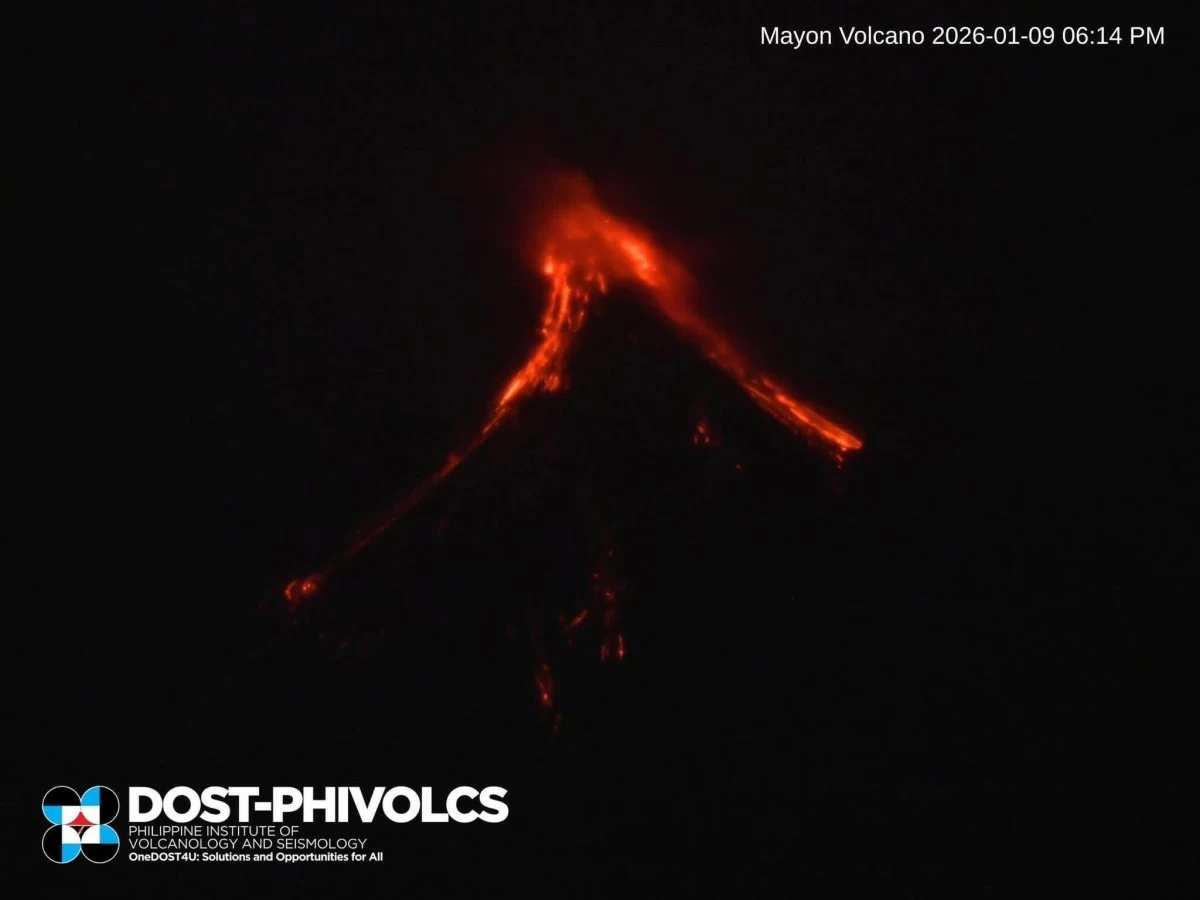
Phivolcs reports spike in seismic energy release at Mayon Volcano

Published Jan 11, 2026 01:54 pm
(PHIVOLCS)
(PHIVOLCS)
A “pronounced increase” in seismic energy release has been recorded at Mayon Volcano after the Philippine Institute of Volcanology and Seismology (Phivolcs) detected elevated real-time seismic amplitude measurement (RSAM) levels at six of its 16 monitoring stations beginning Sunday, Jan. 11.
“This increase was induced by background tremor while no other volcanic earthquakes have been detected, which may be due to prevailing fully open vent conditions as the volcano effusively erupts,” the agency said in its advisory.
According to Phivolcs, monitoring data have not indicated any new rise in ground deformation, even as continuous Global Positioning System measurements, electronic tilt instruments, and electronic distance measurement surveys show non-uniform inflation at Mayon Volcano, mainly affecting its eastern sector since June 2024.
It added that sulfur dioxide emissions have also remained close to background levels, with monitoring data showing an average output of 777 tonnes per day recorded the previous day.
Phivolcs said Mayon Volcano generated 256 rockfall events from 12 a.m. on Jan. 10 to 12 a.m. on Jan. 11, with an additional 41 pyroclastic density currents recorded over the same monitoring period.
The agency noted that RSAM levels had begun to decrease as of advisory time, but cautioned that the episode could still signal new intrusions into the Mayon edifice that may lead to further eruptive activity.
Phivolcs reiterated that Mayon Volcano remains under Alert Level 3 as the eruption of a summit lava dome continues, generating new lava flows as well as collapse-fed rockfalls and pyroclastic density currents, locally known as “uson,” on the volcano’s southern and eastern upper slopes.
“The public should refrain from entering the six-kilometer radius Permanent Danger Zone due to the danger of pyroclastic density currents, lava flows, rockfalls, and other volcanic hazards,” the agency stressed.
Phivolcs added that residents within the eight-kilometer danger zone should remain prepared for evacuation should monitoring parameters suddenly escalate and the volcano’s alert status be raised to Alert Level 4.
“Increased vigilance against lahars and sediment-laden streamflows along channels draining the edifice is also advised in the event that intense rains occur over the summit area,” it said.
Meanwhile, Phivolcs urged civil aviation authorities to advise pilots to avoid flying close to the volcano’s summit, warning that ash from any sudden eruption could pose hazards to aircraft.

Related Tags

SEISMIC ENERGY SPIKE PHIVOLCS MAYON VOLCANO
ADVERTISEMENT
.most-popular .layout-ratio{ padding-bottom: 79.13%; } @media (min-width: 768px) and (max-width: 1024px) { .widget-title { font-size: 15px !important; } }

{{ articles_filter_1561_widget.title }}

.most-popular .layout-ratio{ padding-bottom: 79.13%; } @media (min-width: 768px) and (max-width: 1024px) { .widget-title { font-size: 15px !important; } }

{{ articles_filter_1562_widget.title }}

.most-popular .layout-ratio{ padding-bottom: 79.13%; } @media (min-width: 768px) and (max-width: 1024px) { .widget-title { font-size: 15px !important; } }

{{ articles_filter_1563_widget.title }}

{{ articles_filter_1564_widget.title }}

.mb-article-details { position: relative; } .mb-article-details .article-body-preview, .mb-article-details .article-body-summary{ font-size: 17px; line-height: 30px; font-family: "Libre Caslon Text", serif; color: #000; } .mb-article-details .article-body-preview iframe , .mb-article-details .article-body-summary iframe{ width: 100%; margin: auto; } .read-more-background { background: linear-gradient(180deg, color(display-p3 1.000 1.000 1.000 / 0) 13.75%, color(display-p3 1.000 1.000 1.000 / 0.8) 30.79%, color(display-p3 1.000 1.000 1.000) 72.5%); position: absolute; height: 200px; width: 100%; bottom: 0; display: flex; justify-content: center; align-items: center; padding: 0; } .read-more-background a{ color: #000; } .read-more-btn { padding: 17px 45px; font-family: Inter; font-weight: 700; font-size: 18px; line-height: 16px; text-align: center; vertical-align: middle; border: 1px solid black; background-color: white; } .hidden { display: none; }
function initializeAllSwipers() { // Get all hidden inputs with cms_article_id document.querySelectorAll('[id^="cms_article_id_"]').forEach(function (input) { const cmsArticleId = input.value; const articleSelector = '#article-' + cmsArticleId + ' .body_images'; const swiperElement = document.querySelector(articleSelector); if (swiperElement && !swiperElement.classList.contains('swiper-initialized')) { new Swiper(articleSelector, { loop: true, pagination: false, navigation: { nextEl: '#article-' + cmsArticleId + ' .swiper-button-next', prevEl: '#article-' + cmsArticleId + ' .swiper-button-prev', }, }); } }); } setTimeout(initializeAllSwipers, 3000); const intersectionObserver = new IntersectionObserver( (entries) => { entries.forEach((entry) => { if (entry.isIntersecting) { const newUrl = entry.target.getAttribute("data-url"); if (newUrl) { history.pushState(null, null, newUrl); let article = entry.target; // Extract metadata const author = article.querySelector('.author-section').textContent.replace('By', '').trim(); const section = article.querySelector('.section-info ').textContent.replace(' ', ' '); const title = article.querySelector('.article-title h1').textContent; // Parse URL for Chartbeat path format const parsedUrl = new URL(newUrl, window.location.origin); const cleanUrl = parsedUrl.host + parsedUrl.pathname; // Update Chartbeat configuration if (typeof window._sf_async_config !== 'undefined') { window._sf_async_config.path = cleanUrl; window._sf_async_config.sections = section; window._sf_async_config.authors = author; } // Track virtual page view with Chartbeat if (typeof pSUPERFLY !== 'undefined' && typeof pSUPERFLY.virtualPage === 'function') { try { pSUPERFLY.virtualPage({ path: cleanUrl, title: title, sections: section, authors: author }); } catch (error) { console.error('ping error', error); } } // Optional: Update document title if (title && title !== document.title) { document.title = title; } } } }); }, { threshold: 0.1 } ); function showArticleBody(button) { const article = button.closest("article"); const summary = article.querySelector(".article-body-summary"); const body = article.querySelector(".article-body-preview"); const readMoreSection = article.querySelector(".read-more-background"); // Hide summary and read-more section summary.style.display = "none"; readMoreSection.style.display = "none"; // Show the full article body body.classList.remove("hidden"); } document.addEventListener("DOMContentLoaded", () => { let loadCount = 0; // Track how many times articles are loaded const offset = [1, 2, 3, 4, 5, 6, 7, 8, 9, 10]; // Offset values const currentUrl = window.location.pathname.substring(1); let isLoading = false; // Prevent multiple calls if (!currentUrl) { console.log("Current URL is invalid."); return; } const sentinel = document.getElementById("load-more-sentinel"); if (!sentinel) { console.log("Sentinel element not found."); return; } function isSentinelVisible() { const rect = sentinel.getBoundingClientRect(); return ( rect.top < window.innerHeight && rect.bottom >= 0 ); } function onScroll() { if (isLoading) return; if (isSentinelVisible()) { if (loadCount >= offset.length) { console.log("Maximum load attempts reached."); window.removeEventListener("scroll", onScroll); return; } isLoading = true; const currentOffset = offset[loadCount]; window.loadMoreItems().then(() => { let article = document.querySelector('#widget_1690 > div:nth-last-of-type(2) article'); intersectionObserver.observe(article) loadCount++; }).catch(error => { console.error("Error loading more items:", error); }).finally(() => { isLoading = false; }); } } window.addEventListener("scroll", onScroll); });

Sign up by email to receive news.