







Making K to 12 work: Turning reform into real employability
Published Jan 10, 2026 12:05 am


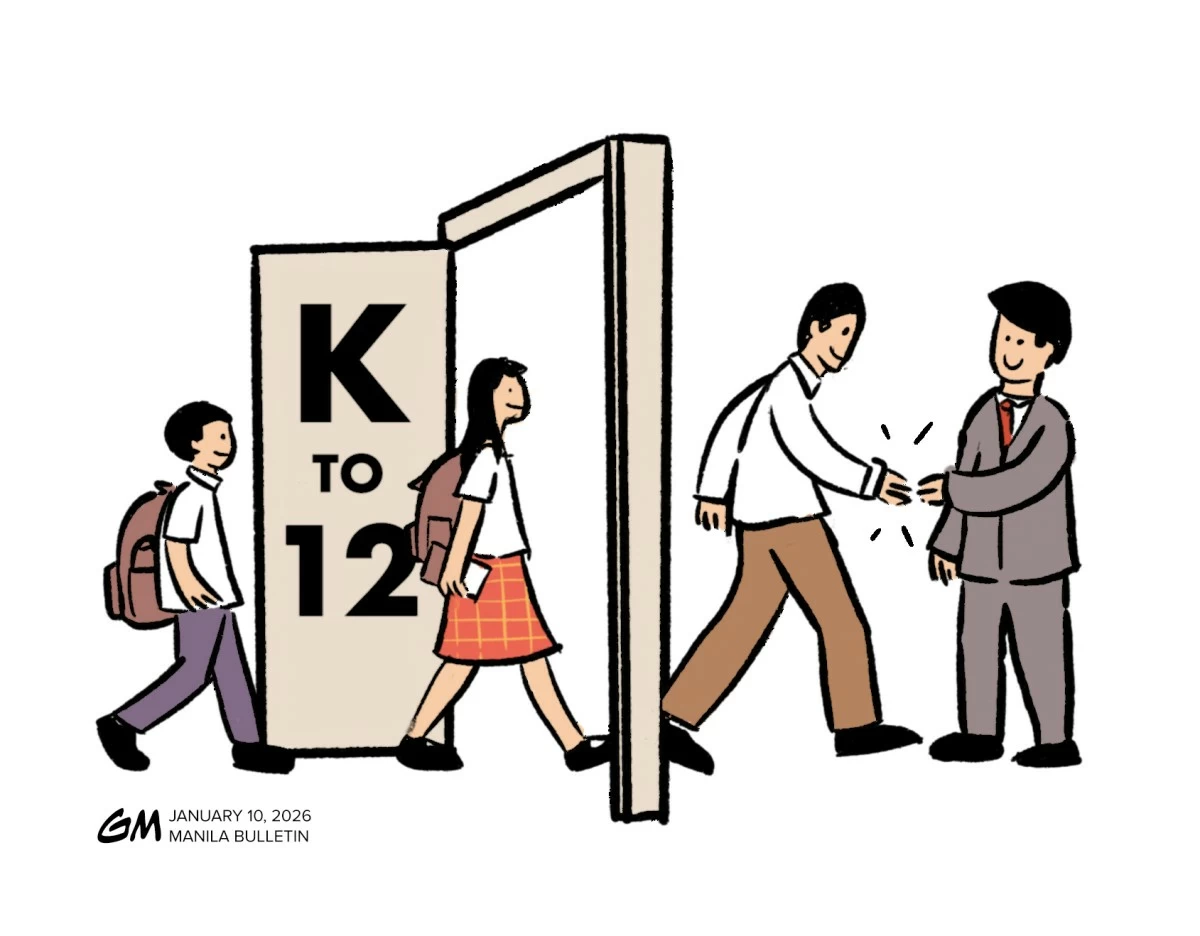
When the K to 12 education system was introduced, one of its strongest promises was simple yet transformative: senior high school graduates would be job-ready. Years later, that promise has been widely questioned, even by President Marcos Jr. himself. But recent commitments from key education agencies suggest that government is finally confronting the gaps—and taking concrete steps to ensure that K to 12 delivers a workforce prepared for real, available jobs.
At a recent Malacañang briefing, leaders of the Department of Education (DepEd), Commission on Higher Education (CHED), and Technical Education and Skills Development Authority (TESDA) acknowledged long-standing concerns about graduate employability, curriculum overload, and weak alignment across education sectors. More importantly, they outlined reforms that signal a shift from rigid design to flexible, market-responsive education.
One of the most significant changes is DepEd’s move to streamline the senior high school curriculum. What was once criticized as overly congested—with as many as 33 subjects—has been reduced to five core requirements, with the rest offered as electives. This reform recognizes a basic reality: students learn better when they are given focus and choice. In an age shaped by artificial intelligence and fast-changing industries, flexibility is no longer a luxury but a necessity. Allowing learners to combine academic and technical-vocational subjects empowers them to tailor their education to both their interests and labor market demands.
DepEd is also strengthening industry immersion, nearly doubling required work immersion hours from 300 to 640—roughly equivalent to a semester of real workplace exposure. This reform directly addresses employer complaints that graduates lack practical experience. Extended immersion allows students to develop technical competence, work discipline, and professional confidence—qualities that cannot be learned from textbooks alone.
CHED, meanwhile, is addressing another persistent problem: the mismatch between senior high school tracks and college courses. Many students enter degree programs unprepared because their SHS specialization does not align with their chosen field in higher education. By introducing bridging programs and working toward standardized assessments and cut-off scores, CHED aims to guide students more effectively while preventing wasted time and resources. These measures reinforce the idea that employability is not just about first jobs, but also about smooth transitions across educational levels.
TESDA’s contribution strikes at the heart of the K to 12 employability promise. By offering free national competency assessments to senior high school students—funded by the national government—TESDA ensures that graduates can leave school with nationally recognized certifications. Nearly 190,000 students have already earned National Certificates II and III aligned with their tracks, providing tangible proof of job readiness. For employers, these credentials reduce uncertainty; for graduates, they open doors.
Perhaps most encouraging is the growing coordination among DepEd, CHED, and TESDA. Efforts to recognize prior learning and align curricula allow students to move between technical-vocational training and higher education without being trapped in a single path. This “multiple entry and exit” approach reflects the realities of modern careers, where learning is continuous and nonlinear.
Still, reforms must translate into consistent implementation. Schools need adequate facilities, teachers need upskilling, and industry partnerships must be sustained nationwide—not just in urban centers. Employability also depends on job creation itself; education reform must go hand in hand with economic planning.
If these reforms are fully realized, K to 12 can finally fulfill its original vision: producing flexible, skilled, and employable graduates ready not only for today’s jobs, but for a future defined by change. The challenge now is not intent, but execution—and the future workforce is waiting.