ADVERTISEMENT

PH to harness AI for development as DepEd launches AGAP.AI, says PBBM

Published Jan 9, 2026 12:57 pm  |  Updated Jan 9, 2026 01:41 pm
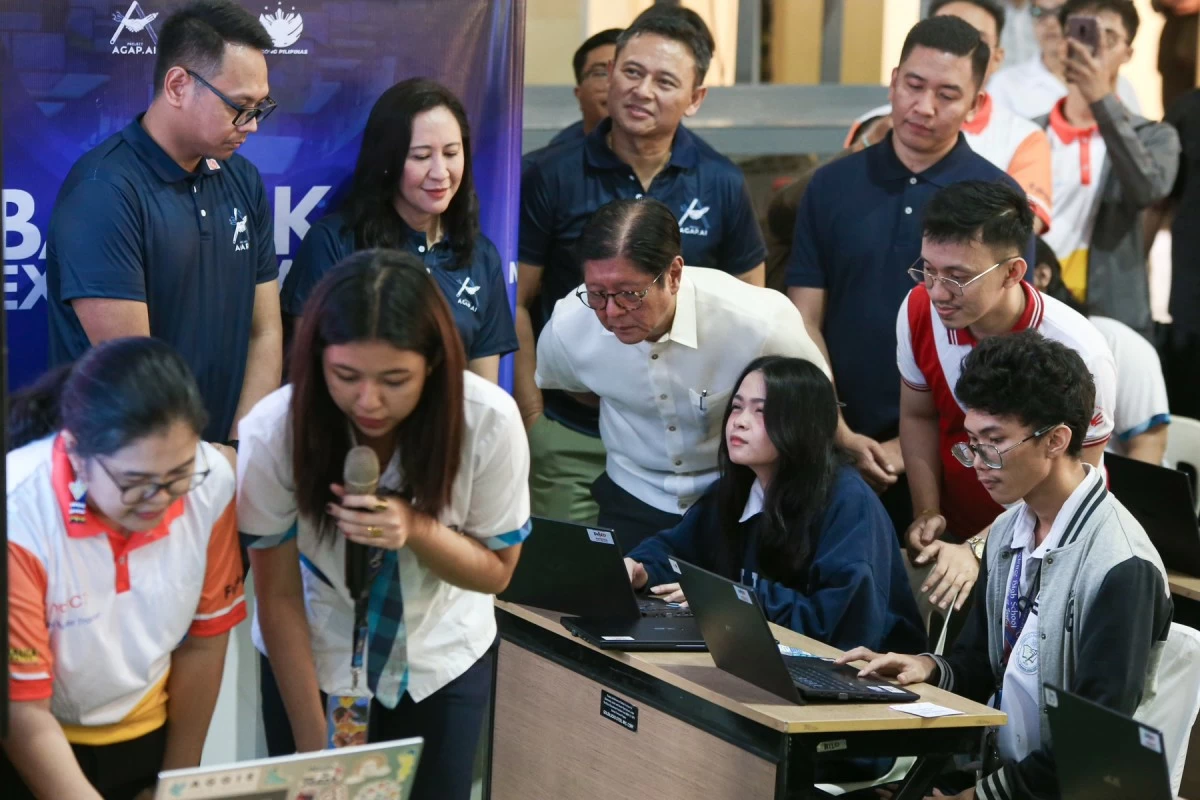
President Ferdinand 'Bongbong' Marcos Jr., with Education Secretary Sonny Angara and Quezon City Mayor Joy Belmonte, leads the launching of DepEd’s Project Accelerating Governance and Adaptive Pedagogy through Artificial Intelligence (AGAP.AI) at Quezon City Science High School on Jan. 9, 2026. AGAP.AI is the Department of Education’s flagship program for all AI-related initiatives in basic education. Anchored on the vision of Bagong Pilipinas and aligned with national and regional education development goals, the project promotes the responsible, ethical, and human-centered integration of AI to support teaching and learning, enhance digital readiness, and strengthen education governance. (Santi San Juan)
President Marcos said the Philippines will harness artificial intelligence to accelerate national development as he led the launch of the Department of Education (DepEd)’s Project Accelerating Governance and Adaptive Pedagogy through Artificial Intelligence, or AGAP.AI.
Speaking at the launch held at Quezon City Science High School on Friday, Jan. 9, Marcos said the government is positioning AI as a key driver of economic growth and long-term competitiveness.
“At the national level, we are leveraging AI as an engine for development. We are establishing the Philippine AI Program Framework for the future-proofing of our economy,” he said.
The President said the framework focuses on building robust infrastructure, including high-performance computing systems, while upskilling workers and educators through sustained investment in AI research and development.
“Through investment in AI research and development, we ensure that this technology delivers real benefits while remaining ethical and responsible,” he said.
According to the Chief Executive, AGAP.AI aims to integrate AI use and training in basic education, allowing students to learn how AI works, teachers to integrate it into lessons, and parents to guide children in using the technology safely and wisely.
Marcos explained that the program’s name reflects its purpose, noting that “agapay” means to support or to bridge, as the government works to narrow the gap between technology and education.
With this, he said the education sector now carries the responsibility of ensuring that students use AI confidently and ethically to stay ahead in their learning journey.
“This is what we are trying to do today: standing next to our people and bridging the gap between technology and education,” Marcos said.
As part of the initiative, the DepEd is developing the Foundational Guidelines on Artificial Intelligence in Basic Education, which will serve as the country’s first national framework for the ethical and responsible use of AI in schools.
The guidelines, the President explained, are being crafted through consultations with students, parents, teachers, AI experts, and education partners to ensure they are inclusive and comprehensive.
Marcos said that with support from the ASEAN Foundation and Google.org, DepEd will roll out a national AI skills training program expected to reach up to 1.5 million Filipinos, including learners, teachers, and parents.
These courses will cover responsible AI use, detecting misinformation, privacy and security, and AI literacy.
“We are also investing heavily in our teachers. Through AI-focused training modules, educators will be equipped to teach AI responsibly and creatively, whilst at the same time keeping up with the developing new technologies as they come down the pipeline,” he added.
President Marcos likewise said that DepEd will pilot emerging AI-powered tools to enhance classroom instruction and school operations while upholding fairness and data privacy.
“This means that students will learn how AI works, teachers can learn how to integrate AI into their lessons, and parents can guide their children in using AI safely and wisely at home,” he said.
“As we hit the ground running in 2026, once again, we start a new era in our educational system and in the way that we train our young people,” he added.
Beyond education policy, Marcos said the Philippines is also taking a regional role on AI as chair of the Association of Southeast Asian Nations (ASEAN) this year.
He added that the country is working toward a harmonized and human-centered AI ecosystem across Southeast Asia, focusing on agriculture, finance, healthcare, manufacturing, and education.
While describing himself as a tech enthusiast, Marcos stressed that AI should support learning and problem-solving but must not replace discipline, effort, and hard work.
“That is how we build a Bagong Pilipinas—one that is enabled by technology and powered by Filipinos who choose to learn, to work, and to aspire for a better future for all,” he said.

Related Tags

President Marcos Bongbong Marcos DepEd artificial intelligence AI AGAP.AI
ADVERTISEMENT
.most-popular .layout-ratio{ padding-bottom: 79.13%; } @media (min-width: 768px) and (max-width: 1024px) { .widget-title { font-size: 15px !important; } }

{{ articles_filter_1561_widget.title }}

.most-popular .layout-ratio{ padding-bottom: 79.13%; } @media (min-width: 768px) and (max-width: 1024px) { .widget-title { font-size: 15px !important; } }

{{ articles_filter_1562_widget.title }}

.most-popular .layout-ratio{ padding-bottom: 79.13%; } @media (min-width: 768px) and (max-width: 1024px) { .widget-title { font-size: 15px !important; } }

{{ articles_filter_1563_widget.title }}

{{ articles_filter_1564_widget.title }}

.mb-article-details { position: relative; } .mb-article-details .article-body-preview, .mb-article-details .article-body-summary{ font-size: 17px; line-height: 30px; font-family: "Libre Caslon Text", serif; color: #000; } .mb-article-details .article-body-preview iframe , .mb-article-details .article-body-summary iframe{ width: 100%; margin: auto; } .read-more-background { background: linear-gradient(180deg, color(display-p3 1.000 1.000 1.000 / 0) 13.75%, color(display-p3 1.000 1.000 1.000 / 0.8) 30.79%, color(display-p3 1.000 1.000 1.000) 72.5%); position: absolute; height: 200px; width: 100%; bottom: 0; display: flex; justify-content: center; align-items: center; padding: 0; } .read-more-background a{ color: #000; } .read-more-btn { padding: 17px 45px; font-family: Inter; font-weight: 700; font-size: 18px; line-height: 16px; text-align: center; vertical-align: middle; border: 1px solid black; background-color: white; } .hidden { display: none; }
function initializeAllSwipers() { // Get all hidden inputs with cms_article_id document.querySelectorAll('[id^="cms_article_id_"]').forEach(function (input) { const cmsArticleId = input.value; const articleSelector = '#article-' + cmsArticleId + ' .body_images'; const swiperElement = document.querySelector(articleSelector); if (swiperElement && !swiperElement.classList.contains('swiper-initialized')) { new Swiper(articleSelector, { loop: true, pagination: false, navigation: { nextEl: '#article-' + cmsArticleId + ' .swiper-button-next', prevEl: '#article-' + cmsArticleId + ' .swiper-button-prev', }, }); } }); } setTimeout(initializeAllSwipers, 3000); const intersectionObserver = new IntersectionObserver( (entries) => { entries.forEach((entry) => { if (entry.isIntersecting) { const newUrl = entry.target.getAttribute("data-url"); if (newUrl) { history.pushState(null, null, newUrl); let article = entry.target; // Extract metadata const author = article.querySelector('.author-section').textContent.replace('By', '').trim(); const section = article.querySelector('.section-info ').textContent.replace(' ', ' '); const title = article.querySelector('.article-title h1').textContent; // Parse URL for Chartbeat path format const parsedUrl = new URL(newUrl, window.location.origin); const cleanUrl = parsedUrl.host + parsedUrl.pathname; // Update Chartbeat configuration if (typeof window._sf_async_config !== 'undefined') { window._sf_async_config.path = cleanUrl; window._sf_async_config.sections = section; window._sf_async_config.authors = author; } // Track virtual page view with Chartbeat if (typeof pSUPERFLY !== 'undefined' && typeof pSUPERFLY.virtualPage === 'function') { try { pSUPERFLY.virtualPage({ path: cleanUrl, title: title, sections: section, authors: author }); } catch (error) { console.error('ping error', error); } } // Optional: Update document title if (title && title !== document.title) { document.title = title; } } } }); }, { threshold: 0.1 } ); function showArticleBody(button) { const article = button.closest("article"); const summary = article.querySelector(".article-body-summary"); const body = article.querySelector(".article-body-preview"); const readMoreSection = article.querySelector(".read-more-background"); // Hide summary and read-more section summary.style.display = "none"; readMoreSection.style.display = "none"; // Show the full article body body.classList.remove("hidden"); } document.addEventListener("DOMContentLoaded", () => { let loadCount = 0; // Track how many times articles are loaded const offset = [1, 2, 3, 4, 5, 6, 7, 8, 9, 10]; // Offset values const currentUrl = window.location.pathname.substring(1); let isLoading = false; // Prevent multiple calls if (!currentUrl) { console.log("Current URL is invalid."); return; } const sentinel = document.getElementById("load-more-sentinel"); if (!sentinel) { console.log("Sentinel element not found."); return; } function isSentinelVisible() { const rect = sentinel.getBoundingClientRect(); return ( rect.top < window.innerHeight && rect.bottom >= 0 ); } function onScroll() { if (isLoading) return; if (isSentinelVisible()) { if (loadCount >= offset.length) { console.log("Maximum load attempts reached."); window.removeEventListener("scroll", onScroll); return; } isLoading = true; const currentOffset = offset[loadCount]; window.loadMoreItems().then(() => { let article = document.querySelector('#widget_1690 > div:nth-last-of-type(2) article'); intersectionObserver.observe(article) loadCount++; }).catch(error => { console.error("Error loading more items:", error); }).finally(() => { isLoading = false; }); } } window.addEventListener("scroll", onScroll); });

Sign up by email to receive news.