ADVERTISEMENT

DepEd launches Project AGAP.AI to guide responsible AI use in basic education

Department targets 1.5 million teachers, learners, parents in nationwide AI training rollout

Published Jan 9, 2026 06:37 pm
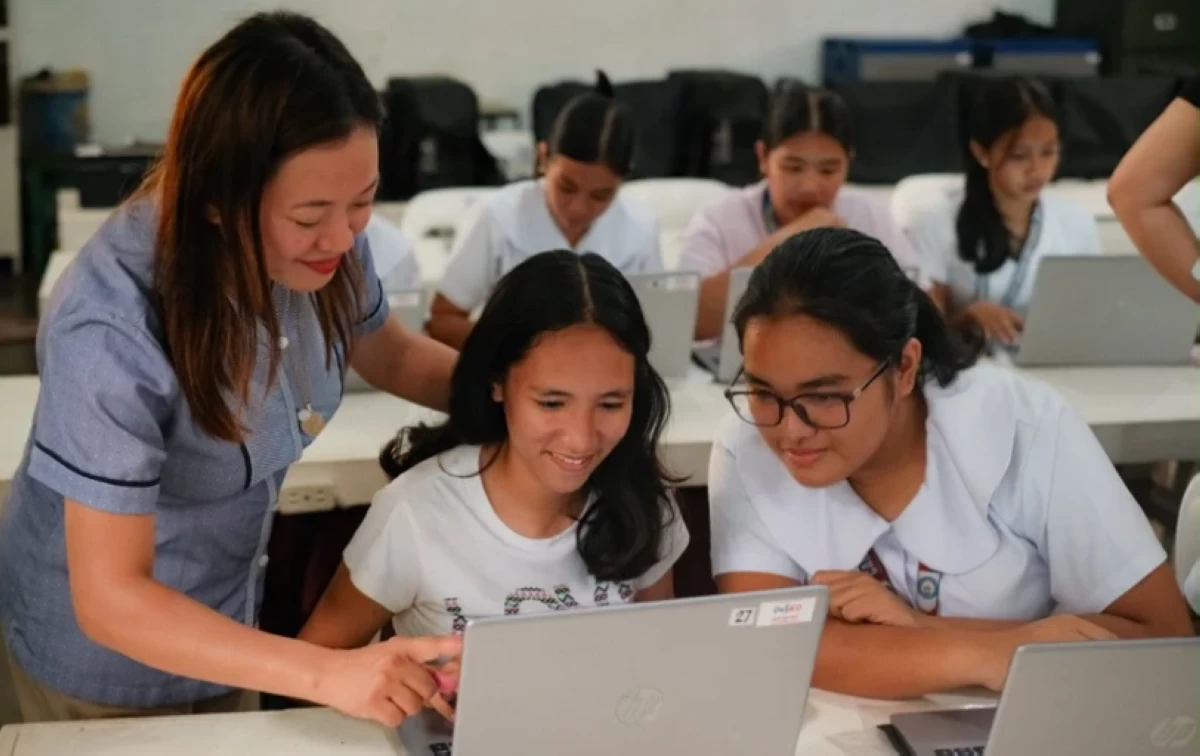
The Department of Education (DepEd) on January 9, 2026, launched Project AGAP.AI to roll out nationwide AI training and guidelines, equipping teachers and learners with responsible and ethical artificial intelligence skills starting 2026. (DepEd photo)
The Department of Education (DepEd) on Friday, January 9, launched Project AGAP.AI, a nationwide initiative aimed at equipping teachers, learners, parents, and school leaders with the skills and safeguards needed for the responsible use of artificial intelligence (AI) in basic education.
Formally known as the Accelerating Governance and Adaptive Pedagogy through Artificial Intelligence (AGAP.AI), the program is DepEd’s flagship response to the rapid integration of AI in education.
The initiative will be implemented in phases starting in 2026 and is aligned with the Bagong Pilipinas agenda and the Quality Basic Education Development Plan (QBEDP).
DepEd Secretary Sonny Angara said Project AGAP.AI provides a clear national framework to ensure that AI strengthens teaching, improves school governance, and delivers better learning outcomes across the public education system.
“Isang malinaw na framework, na nakaangkla sa Bagong Pilipinas at sa Quality Basic Education Development Plan (A clear framework, anchored on Bagong Pilipinas and the Quality Basic Education Development Plan),” Angara said in a statement.
“Para palakasin ang pagtuturo, pagandahin ang pamamahala, at maghatid ng mas mahusay na resulta sa buong education system (This is to strengthen teaching, improve governance, and deliver better results across the entire education system),” he explained.
“Makatao. Makaguro. Makabata. (‘Humane. Teacher-centered. Child-centered.’) This is how we build a future-ready Philippines,” he added.
Nationwide AI training rollout
A major component of Project AGAP.AI is large-scale capacity-building led by DepEd.
Throughout 2026, the department will roll out AI Ready ASEAN Philippines, a nationwide training program designed to reach up to 1.5 million participants, including 1.05 million learners, 300,000 teachers, and 150,000 parents.
The training, funded by the ASEAN Foundation and powered by Google.org, will introduce AI in plain language and cover practical classroom applications, ethics and data privacy, and ways to address risks such as misinformation.
DepEd said it is implementing the program with local partners such as Limitless Lab Organization, SmartCitiesPH Inc., Break the Fake Movement, CGPH Incorporated, and the ASEAN Youth Organization.
Moreover, DepEd formalized its partnership with the ASEAN Foundation through a Memorandum of Agreement signed during the program launch, reinforcing its commitment to inclusive and responsible AI literacy.
AI guidelines, curriculum reforms underway
To set clear guardrails, DepEd said it will release its Foundational Guidelines on the Integration of Artificial Intelligence in Basic Education, which will outline standards on responsible use, learner protection, inclusivity, and the ethical deployment of AI tools in schools.
Curriculum reforms are also in progress, with DepEd planning to integrate AI concepts into the basic education curriculum to strengthen learners’ AI literacy and computational thinking. In-service training modules focused on AI for teachers are scheduled for rollout by the second quarter of 2026 to support classroom implementation.
AI tools to support teaching and school management
At the system level, DepEd will pilot emerging AI-powered tools in 2026 to support teaching, assessment, and school management. These tools, to be developed by the Education Center for AI Research (ECAIR), are expected to enhance data-driven and evidence-based decision-making across the education sector.
Existing AI-powered platforms already in use will also be expanded, subject to national standards on reliability, fairness, and data privacy, DepEd said.
Project AGAP.AI supports the country’s broader digital transformation efforts and aligns with the ASEAN Vision 2045, positioning basic education as a key foundation in preparing Filipino learners for an increasingly AI-driven future. 

Related Tags

DepEd AI Artificial intelligence in Philippine education DepEd AI training teachers learners Responsible AI in basic education AI Ready ASEAN Philippines
ADVERTISEMENT
.most-popular .layout-ratio{ padding-bottom: 79.13%; } @media (min-width: 768px) and (max-width: 1024px) { .widget-title { font-size: 15px !important; } }

{{ articles_filter_1561_widget.title }}

.most-popular .layout-ratio{ padding-bottom: 79.13%; } @media (min-width: 768px) and (max-width: 1024px) { .widget-title { font-size: 15px !important; } }

{{ articles_filter_1562_widget.title }}

.most-popular .layout-ratio{ padding-bottom: 79.13%; } @media (min-width: 768px) and (max-width: 1024px) { .widget-title { font-size: 15px !important; } }

{{ articles_filter_1563_widget.title }}

{{ articles_filter_1564_widget.title }}

.mb-article-details { position: relative; } .mb-article-details .article-body-preview, .mb-article-details .article-body-summary{ font-size: 17px; line-height: 30px; font-family: "Libre Caslon Text", serif; color: #000; } .mb-article-details .article-body-preview iframe , .mb-article-details .article-body-summary iframe{ width: 100%; margin: auto; } .read-more-background { background: linear-gradient(180deg, color(display-p3 1.000 1.000 1.000 / 0) 13.75%, color(display-p3 1.000 1.000 1.000 / 0.8) 30.79%, color(display-p3 1.000 1.000 1.000) 72.5%); position: absolute; height: 200px; width: 100%; bottom: 0; display: flex; justify-content: center; align-items: center; padding: 0; } .read-more-background a{ color: #000; } .read-more-btn { padding: 17px 45px; font-family: Inter; font-weight: 700; font-size: 18px; line-height: 16px; text-align: center; vertical-align: middle; border: 1px solid black; background-color: white; } .hidden { display: none; }
function initializeAllSwipers() { // Get all hidden inputs with cms_article_id document.querySelectorAll('[id^="cms_article_id_"]').forEach(function (input) { const cmsArticleId = input.value; const articleSelector = '#article-' + cmsArticleId + ' .body_images'; const swiperElement = document.querySelector(articleSelector); if (swiperElement && !swiperElement.classList.contains('swiper-initialized')) { new Swiper(articleSelector, { loop: true, pagination: false, navigation: { nextEl: '#article-' + cmsArticleId + ' .swiper-button-next', prevEl: '#article-' + cmsArticleId + ' .swiper-button-prev', }, }); } }); } setTimeout(initializeAllSwipers, 3000); const intersectionObserver = new IntersectionObserver( (entries) => { entries.forEach((entry) => { if (entry.isIntersecting) { const newUrl = entry.target.getAttribute("data-url"); if (newUrl) { history.pushState(null, null, newUrl); let article = entry.target; // Extract metadata const author = article.querySelector('.author-section').textContent.replace('By', '').trim(); const section = article.querySelector('.section-info ').textContent.replace(' ', ' '); const title = article.querySelector('.article-title h1').textContent; // Parse URL for Chartbeat path format const parsedUrl = new URL(newUrl, window.location.origin); const cleanUrl = parsedUrl.host + parsedUrl.pathname; // Update Chartbeat configuration if (typeof window._sf_async_config !== 'undefined') { window._sf_async_config.path = cleanUrl; window._sf_async_config.sections = section; window._sf_async_config.authors = author; } // Track virtual page view with Chartbeat if (typeof pSUPERFLY !== 'undefined' && typeof pSUPERFLY.virtualPage === 'function') { try { pSUPERFLY.virtualPage({ path: cleanUrl, title: title, sections: section, authors: author }); } catch (error) { console.error('ping error', error); } } // Optional: Update document title if (title && title !== document.title) { document.title = title; } } } }); }, { threshold: 0.1 } ); function showArticleBody(button) { const article = button.closest("article"); const summary = article.querySelector(".article-body-summary"); const body = article.querySelector(".article-body-preview"); const readMoreSection = article.querySelector(".read-more-background"); // Hide summary and read-more section summary.style.display = "none"; readMoreSection.style.display = "none"; // Show the full article body body.classList.remove("hidden"); } document.addEventListener("DOMContentLoaded", () => { let loadCount = 0; // Track how many times articles are loaded const offset = [1, 2, 3, 4, 5, 6, 7, 8, 9, 10]; // Offset values const currentUrl = window.location.pathname.substring(1); let isLoading = false; // Prevent multiple calls if (!currentUrl) { console.log("Current URL is invalid."); return; } const sentinel = document.getElementById("load-more-sentinel"); if (!sentinel) { console.log("Sentinel element not found."); return; } function isSentinelVisible() { const rect = sentinel.getBoundingClientRect(); return ( rect.top < window.innerHeight && rect.bottom >= 0 ); } function onScroll() { if (isLoading) return; if (isSentinelVisible()) { if (loadCount >= offset.length) { console.log("Maximum load attempts reached."); window.removeEventListener("scroll", onScroll); return; } isLoading = true; const currentOffset = offset[loadCount]; window.loadMoreItems().then(() => { let article = document.querySelector('#widget_1690 > div:nth-last-of-type(2) article'); intersectionObserver.observe(article) loadCount++; }).catch(error => { console.error("Error loading more items:", error); }).finally(() => { isLoading = false; }); } } window.addEventListener("scroll", onScroll); });

Sign up by email to receive news.