








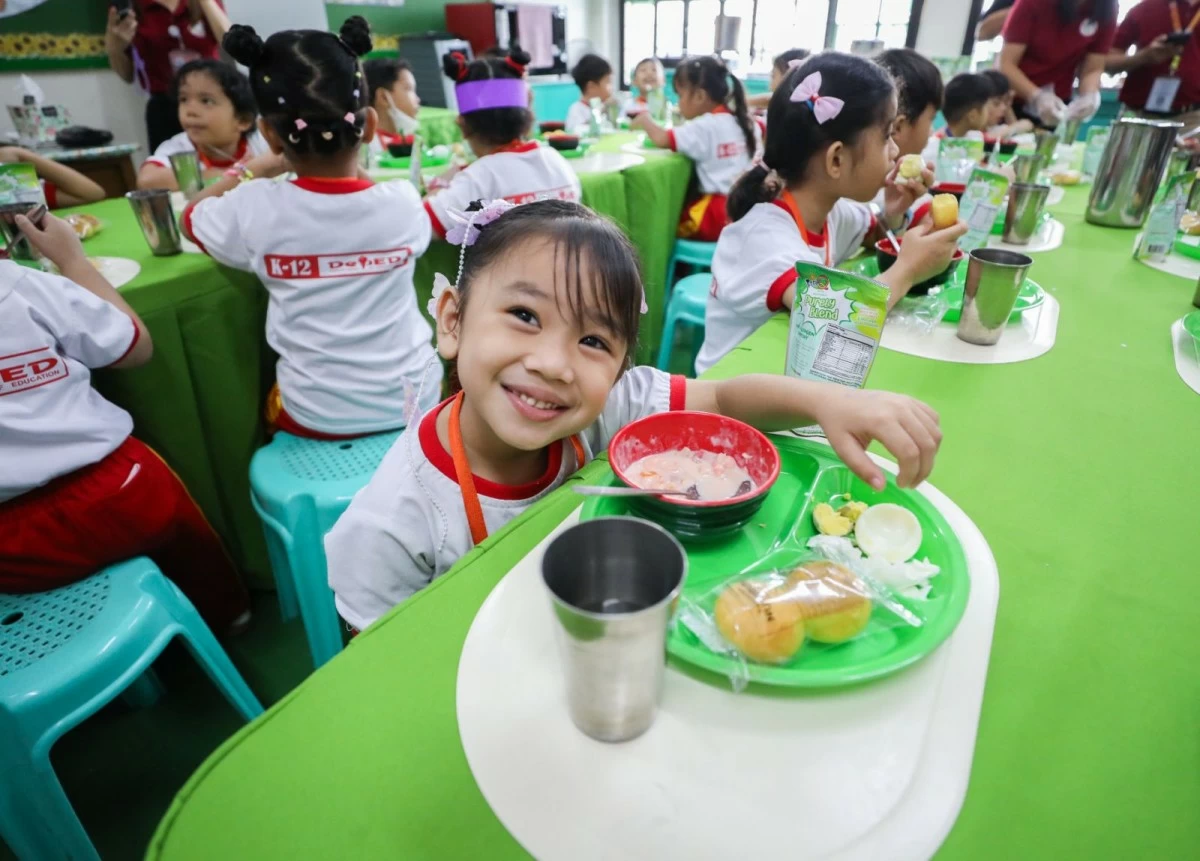
In a statement, DepEd said the expansion is made possible by the record budget allocation of P1.015 trillion for basic education.
With strong support from President Marcos and Congress, DepEd said it secured P25.7 billion to broaden the feeding program’s coverage, prioritizing early-grade learners and nutritionally at-risk children in higher grade levels.
Under the expanded SBFP, DepEd said it will provide nutritious meals for 200 feeding days to around 1.52 million kindergarten learners and 1.79 million Grade 1 learners.
An additional 1.18 million learners in Grades 2 to 6, classified as wasted or severely wasted, will also receive meals for the same duration.
DepEd Secretary Sonny Angara said the program directly addresses the link between hunger and learning outcomes.
“Malinaw po sa datos na hindi makakapag-aral nang maayos ang bata kung gutom siya (The data clearly show that a child cannot study well if they are hungry),” Angara said.
“Kaya pinalalawak natin ang School-Based Feeding Program para mas maraming mag-aaral ang mabigyan ng sapat na nutrisyon, lalo na sa mga unang baitang at sa mga pinaka-nangangailangan (That is why we are expanding the School-Based Feeding Program so that more learners can receive adequate nutrition, especially those in the early grades and those most in need),” he added.
Expanded coverage for vulnerable learners
For the first time, DepEd said the feeding program will include around 140,000 nutritionally at-risk, disadvantaged, and vulnerable learners beyond Grade 6, including pregnant learners enrolled in public schools, who will receive nutritional support for 180 feeding days.
This expanded component will be implemented in coordination with the Department of Health (DOH), the Department of Social Welfare and Development (DSWD), and the Department of the Interior and Local Government (DILG) to integrate maternal and child health services.
DepEd said the initiative reflects the government’s renewed focus on improving learning readiness by addressing hunger and malnutrition—long-standing factors affecting attendance, classroom participation, and academic performance, especially in disadvantaged communities.
AI-enabled system, LGU partnerships
To strengthen targeting and implementation, DepEd will roll out the System for Intelligent Growth and Learner Anthropometry (SIGLA), an AI-enabled platform designed to improve the collection and validation of learners’ health and nutrition data.
Local government units (LGUs) may also serve as implementing partners through memoranda of agreement, with DepEd encouraging stronger on-the-ground collaboration in program delivery.
In line with the Tatak Pinoy Act (Republic Act No. 11981), DepEd said priority will be given to locally produced and Philippine-made food products, supporting local farmers and producers while ensuring fresh and culturally appropriate meals for learners.
Milk feeding will be handled by the National Dairy Authority and the Philippine Carabao Center, supporting both learner nutrition and the local dairy industry.
DepEd said the expanded School-Based Feeding Program underscores the administration’s commitment to making schools not only centers of learning but also safe and supportive spaces where learners’ basic needs are met.
“Higit sa pagbibigay ng pagkain, layunin ng programa na matulungan ang mga bata na manatili sa paaralan at maging handa sa pagkatuto araw-araw (Beyond providing food, the program aims to help children stay in school and be ready to learn every day),” Angara said.