






Manila Bulletin
 Business
The Economy
2025 inflation sinks to nine-year low of 1.7% despite December uptick
Business
The Economy
2025 inflation sinks to nine-year low of 1.7% despite December uptick
Business
The Economy
2025 inflation sinks to nine-year low of 1.7% despite December uptick
2025 inflation sinks to nine-year low of 1.7% despite December uptick
Published Jan 6, 2026 09:59 am
|
Updated Jan 6, 2026 03:59 pm


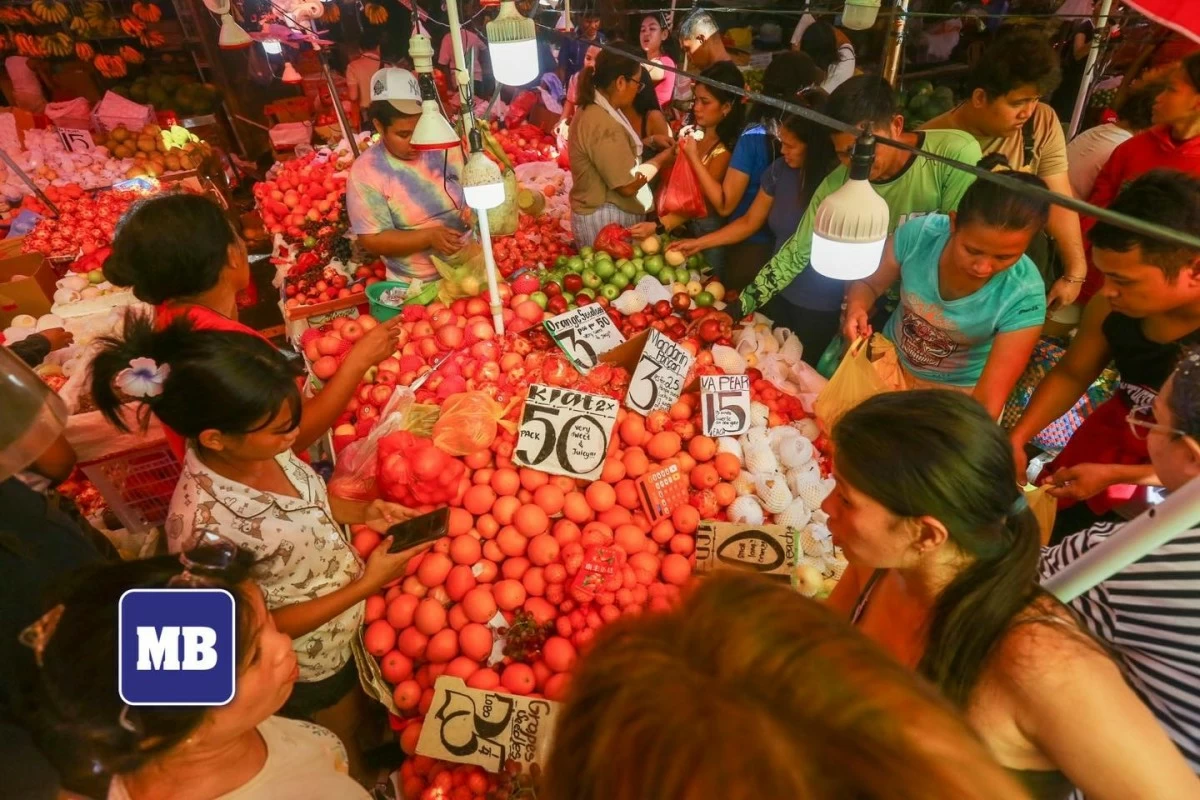
Davao City residents flock to the Bankerohan Market last Dec. 31 to buy round-shaped fruits, a practice believed to bring good luck and prosperity for the coming New Year. (Photo by Keith Bacongco | MB)
The country’s full-year inflation rate in 2025 settled at a nine-year low, even as inflation edged up to 1.8 percent in December from 1.5 percent a month earlier, driven mainly by higher prices of food and non-alcoholic beverages, the Philippine Statistics Authority (PSA) reported.
National Statistician Claire Dennis S. Mapa said in a briefing on Tuesday, Jan. 6, that headline inflation averaged 1.7 percent in 2025—its lowest level since 2016, when inflation stood at 1.3 percent—and significantly lower than the 3.2 percent recorded in 2024. The 2025 inflation rate also fell below the government’s target range of two to four percent.
On a month-on-month basis, Mapa attributed the uptick in December inflation to typhoons that struck in November, which mainly affected vegetable farms and led to higher prices, particularly in areas outside the National Capital Region (NCR).
While some items in the vegetable basket declined, Mapa said “most increased,” pushing overall vegetable inflation to 11.6 percent in December from four percent in the previous month.
He added that the fish basket also contributed to higher inflation in December, rising to nine percent from 8.6 percent a month earlier.
Rice, on the other hand, continued to register negative inflation, easing to -12.3 percent in December from -15.4 percent in the previous month. Full-year rice inflation likewise remained negative at -12.3 percent.
“Our rice prices are good,” Mapa said, noting that the decline in rice prices last year was among the main reasons full-year inflation eased in 2025.
Mapa said the average price of regular milled rice fell to ₱42.95 per kilo in 2025 from ₱50.40 in 2024, a decline of ₱7.45, with areas outside the NCR seeing the largest drops.
Well-milled rice prices also declined, averaging ₱49.20 per kilo in 2025 from ₱55.60 in 2024, while special rice prices fell to ₱59 per kilo from ₱64.20. Both recorded their biggest price decreases outside the NCR.
“So that’s one good thing we saw here. The price of rice per kilo really dropped,” Mapa said.
Despite full-year inflation remaining below target, Mapa cautioned that risks remain, particularly from food prices. “One of these is the price of food… because we saw an uptick this December,” he said.
For the bottom 30 percent of households, inflation eased to 0.3 percent in 2025 from 4.2 percent in 2024, with lower rice and food prices contributing most to the decline. “So if we can maintain the level of price of rice, it will have a big impact,” Mapa added.
Earlier, Department of Economy, Planning, and Development (DEPDev) Secretary Arsenio M. Balisacan said during the Presidential Communications Office (PCO) press briefing last Monday, Jan. 5, that full-year inflation averaged 1.7 percent in 2025 and is expected to remain low this year.
“We are targeting just two- to four-percent inflation, but I think we will achieve less than that,” Balisacan said.
In a statement on Tuesday, Balisacan said the Philippine economy has remained resilient against inflationary pressures despite global headwinds and domestic challenges, citing the government’s timely and targeted interventions.
“Building on this momentum, the government will continue to pursue prudent fiscal and monetary coordination and advance structural reforms to sustain the downward inflation trend and support inclusive growth in 2026 and beyond,” he said.
Balisacan added that the government aims to keep inflation within the two- to four-percent target range from 2026 to 2028, supported in part by the ₱297.1-billion allocation for the agriculture sector in the ₱6.793-trillion 2026 national budget.
“This budget prioritizes boosting farmer productivity and strengthening food security through measures such as the construction of farm-to-market roads (FMRs) and bridges, the development of food hubs, cold storage facilities, and rice mills, and programs to help maintain affordable prices of agricultural products,” he said.
He also said the Department of Energy (DOE) is fast-tracking the completion of 200 power generation projects to address rising electricity demand and ease energy-related price pressures, ensuring that new capacity comes online on schedule while meeting safety and reliability standards.
“These policy initiatives form part of our broader thrust to attain food security, improve human capital, and enhance the quality and efficiency of public service delivery—priorities that enable inclusive, broad-based growth for all Filipinos,” Balisacan said.
Meanwhile, Agriculture Secretary Francisco P. Tiu Laurel Jr. vowed stronger measures from the Department of Agriculture (DA) to shield consumers and stabilize markets after rising food prices—driven by holiday demand and supply disruptions—pushed December inflation higher.
“While rice prices continue to deflate, higher prices driven by holiday demand, weather damage, and supply bottlenecks lifted December inflation,” Tiu Laurel said. “This means the DA must move faster—tightening market monitoring, accelerating production, swiftly deploying available stocks, and expanding safety-net support like the ₱20 rice program to blunt price spikes.”
He added that the DA is expanding its “Benteng Bigas, Meron Na!” program, which sells rice at ₱20 per kilo and aims to reach up to 15 million households, or about 60 million Filipinos, by the end of 2026.
Tiu Laurel said the nationwide rollout of the subsidized rice program, now reaching more provinces and vulnerable sectors, will be accompanied by intensified supply monitoring and production support to address seasonal demand surges and weather-related disruptions.
Michael Ricafort, chief economist at Rizal Commercial Banking Corp. (RCBC), said inflation is expected to remain relatively low, staying at or slightly below two percent until February 2026 and averaging around two to three percent from March 2026 onward.