







Post-holiday travel surge begins Jan. 3
PNP says to boost patrols in major thoroughfares to assist in traffic management, deter road rage
Published Jan 2, 2026 01:22 pm


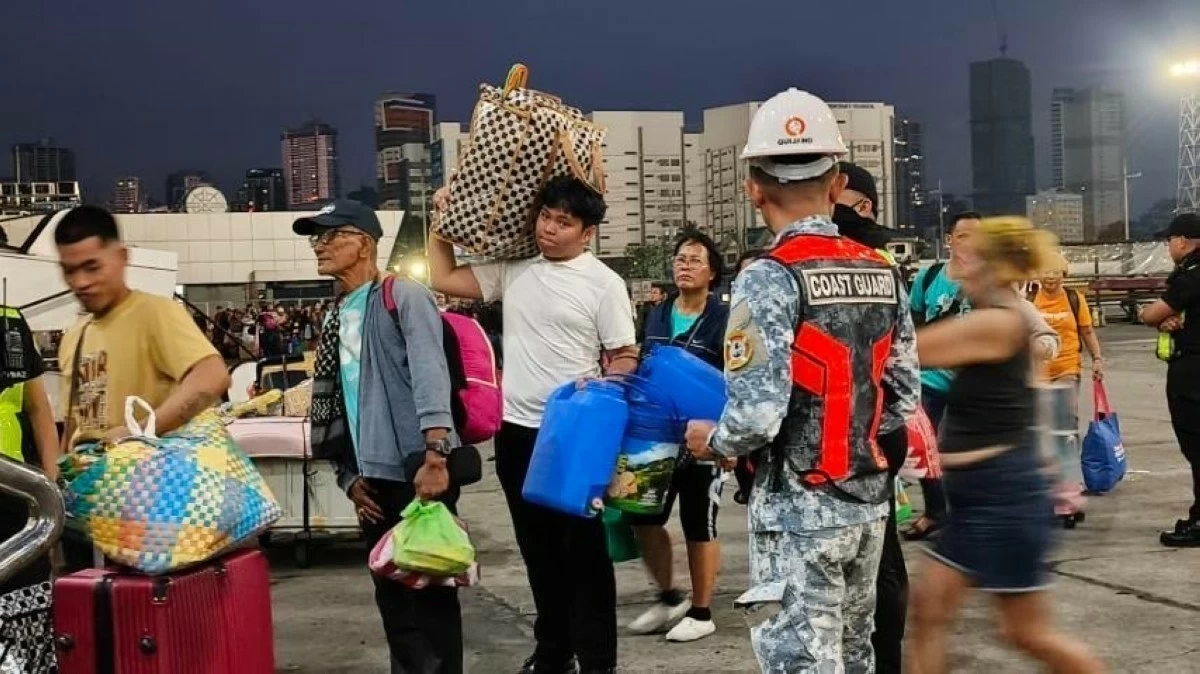
A Philippine Coast Guard (PCG) personnel conducts security checks as passengers pass by at the North Port Passenger Terminal in Tondo, Manila on Dec. 31, 2025. (Photo: PCG)
The Philippine Coast Guard (PCG) and Land Transportation Franchising and Regulatory Board (LTFRB) are bracing for a surge of travelers returning to cities as post-holiday land and sea travels ramp up starting Saturday, Jan. 3.
PCG spokesperson Capt. Noemie Cayabyab said the agency expects nearly six million passengers to pass through ports nationwide, up from five million last year.
“Compared to last year, we have been monitoring a slightly higher number of passengers starting December 20, and our monitoring will continue until January 4. Last year, we recorded five million passengers and this year we are expecting almost six million,” she said in a radio interview with DZXL News on Friday, Jan. 2.
“We are expecting that starting tomorrow (Saturday) until Sunday, around 500,000 to 750,000 passengers will flood our ports,” Cayabyab added.
From 12 midnight to 6 a.m. on Friday, the PCG recorded 14,282 outbound and 12,408 inbound passengers across various ports while 119 vessels and 42 motorbancas were inspected by all of the 16 Coast Guard districts nationwide.
Cayabyab said no reports of stranded passengers have been received so far although free rides will be offered again if any passengers are stranded due to insufficient commercial vessels, following last Christmas’ practice.
The PCG also pointed out that the overloading of commercial passenger vessels remains strictly prohibited.
It noted that both commercial and private vessels must adhere to capacity limits to ensure the proper use of life-saving equipment, and captains of private vessels are responsible for enforcing these measures.
Cayabyab added that the PCG may cancel or postpone trips based on weather advisories from the Philippine Atmospheric, Geophysical, and Astronomical Services Administration (PAGASA).
“But today, we do not see any weather disturbances that could cause cancellations. Usually, if a weather signal is raised at the port of origin, along the route, or at the destination, we will definitely cancel the vessel’s trip,” she said.
“Secondly, we also consider gale warnings. Currently, the waves on the northern seaboard are somewhat high. Normally, for smaller vessels, we advise them not to proceed or to stay at the port because the waves can become strong once they leave enclosed areas,” she added.
Cayabyab reminded passengers to buy tickets early and arrive at ports ahead of schedule, follow local directives, wear life vests on motorboats and motorbancas, and comply with security inspections.
She said prohibited items should not be brought on board to ensure a hassle-free journey.
LTFRB steps up inspections
The LTFRB also placed its personnel on heightened alert as millions of commuters return to cities following the long Christmas and New Year holidays.
LTFRB Chairperson Vigor D. Mendoza II said bus companies and other public transport operators were directed to ensure the roadworthiness of their vehicles before resuming full operations.
He said compliance will be checked through random and surprise inspections which will be conducted in coordination with other government agencies.
“Our goal is to ensure not only the roadworthiness of public utility vehicles but also the readiness of drivers,” Mendoza said.
He added that these measures are meant to prevent road crashes.
At least two fatal road accidents were recorded during the Yuletide exodus. Mendoza said the agency is aiming for zero road crashes as passenger volume increases after the holiday break.
The LTFRB also instructed all regional directors to immediately respond to commuter complaints, including reports against “snobbish” taxi drivers who cancel trips due to heavy traffic and long distances, and those who ask for excessive fare rates.
Mendoza said the agency will closely monitor taxi firms and ride-hailing services at bus terminals, seaports, and airports.
“Tututukan natin yung mga reklamo ng pagiging isnabero at pangongontrata ng ilang mga taxi drivers lalo na yung mga nasa airport (We will closely monitor complaints about taxi drivers who refuse passengers and those who engage in overcharging, especially at airports),” he noted.
Passengers were urged to report violations through the LTFRB hotline at 0956-761-0739. Mendoza said the agency will act swiftly on complaints involving public land transportation.
“Lalakas ang loob ng mga tiwaling PUV drivers kung walang magrereklamo. Magtulungan tayo tungkol sa bagay na ito (Corrupt PUV drivers will become bolder if no one complains. Let’s work together on this matter),” the LTFRB chief said.
PNP boosts highway patrols
Meanwhile, police forces across the country were placed on alert as millions of Filipinos begin returning to urban areas after the long holiday break.
The Philippine National Police (PNP) said officers will be stationed in bus terminals and major transportation hubs to ensure passenger safety and quickly respond to any incidents, said acting PNP chief Police Lt. Gen. Jose Melencio Nartatez Jr.
“The return of our kababayan from their home provinces is part of our security plan. Our personnel on the ground were instructed to make their presence felt from bus stations and other transport hubs from the point of origin to the point of destination, especially in Metro Manila and key urban areas,” Nartatez said.
Territorial police units and the Highway Patrol Group (HPG) have also been instructed to increase visibility along highways prone to traffic congestion. In Metro Manila, this includes the South Luzon Expressway and North Luzon Expressway.
Coordination with local government units and stakeholders is underway to manage traffic flow.
Authorities will also conduct inspections and enforce road safety measures for buses and other public utility vehicles.
“We are expecting a huge volume of vehicles and this means that we have to anticipate traffic jams. And in this type of situation, the tendency to engage in road rage is high so we want to ensure that we would be able to respond in the soonest possible time for any eventuality,” Nartatez said.
“But the best antidote to road rage is to plan your travel well and to be patient. Wala pong maidudulot ang init ng ulo sa kalsada (Anger on the road achieves nothing),” he added.
Nartatez urged motorists to plan their trips, remain patient, and avoid driving when fatigued or under the influence of alcohol.
He also reminded drivers to ensure their vehicles are roadworthy. He said mental and physical readiness are essential for long journeys to protect both their lives and the safety of their passengers.
“Iwasan nating magmaneho kung puyat or kung may hang over pa dahil buhay ninyo at ng inyong pamilya ang pinag-uusapan dito (Avoid driving when you are sleep-deprived or hungover because your life and your family’s life are at stake),” the cop cop said.