






 Philippines
National
18M 'functionally illiterate' Filipino high school graduates: DepEd vows reforms
Philippines
National
18M 'functionally illiterate' Filipino high school graduates: DepEd vows reforms
18M 'functionally illiterate' Filipino high school graduates: DepEd vows reforms
FLEMMS 2024 shows that over 18 million Filipino high school graduates are struggling with functional illiteracy, once again raising concerns about the quality of education


At A Glance
- The 2024 FLEMMS reveals that 18 million Filipino high school graduates are functionally illiterate, unable to meet updated literacy standards that require comprehension and the application of information in real-life situations
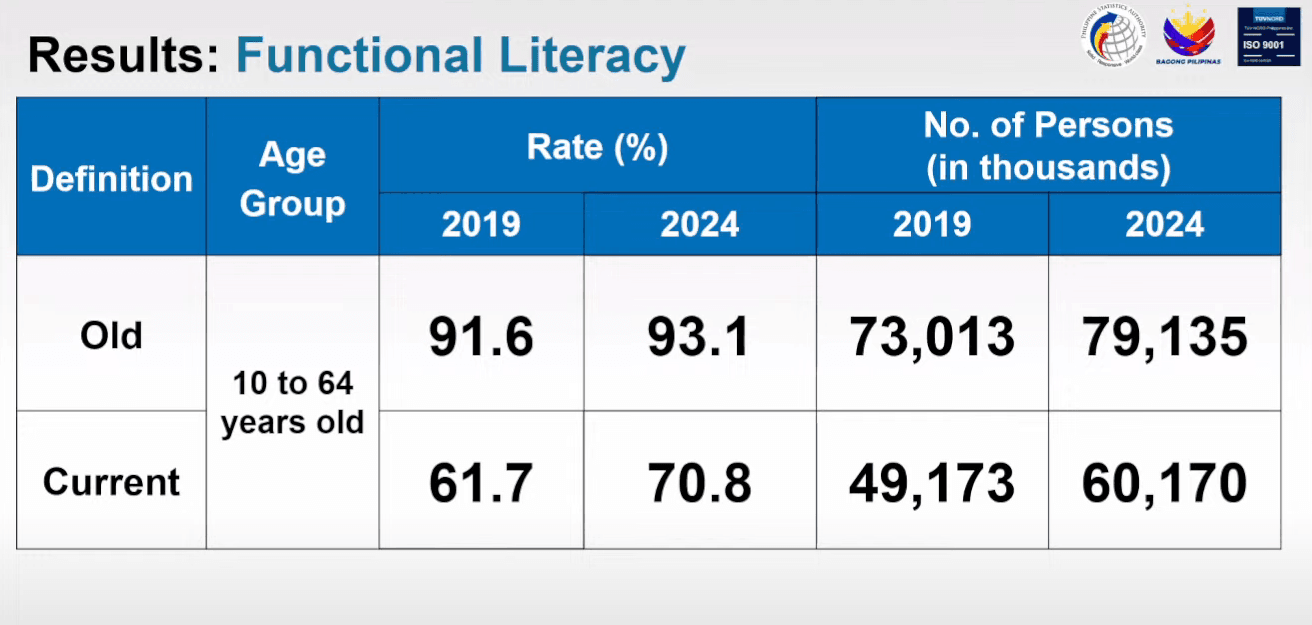
- In 2024, the Philippine Statistics Authority (PSA) revised the definition of functional literacy, expanding it beyond basic reading, writing, and numeracy to include higher-level comprehension skills. As a result, the number of functionally literate Filipinos dropped from 79 million to 60 million
- During an April 30 Senate hearing, senators questioned how students manage to graduate without functional literacy, noting that 21 percent of senior high school graduates failed to meet the new standard
- In response, DepEd Secretary Sonny Angara vowed to intensify literacy reforms and address past shortcomings to ensure that 'no child is left behind' in reading and comprehension

The Department of Education (DepEd) on Thursday, May 1, vowed to intensify literacy reforms following alarming survey results showing that 18.9 million Filipino students are graduating from high school despite being “functionally illiterate.”
“Hindi namin hahayaang may batang nahuhuli sa pagbasa at pag-unawa (We will not allow any child to be left behind in reading and comprehension),” said DepEd Secretary Sonny Angara in a statement, reiterating the department’s firm commitment as it ramps up efforts to address the challenges highlighted in the recent Functional Literacy, Education, and Mass Media Survey (FLEMMS) results.
The latest FLEMMS data revealed significant gaps in functional literacy among Filipino learners—an issue DepEd has long acknowledged and is now tackling head-on.
“The recent FLEMMS results on functional literacy highlight what we have long recognized—literacy must be at the heart of our education reforms,” Angara said.
With literacy positioned at the core of its education reform agenda, Angara said DepEd has launched a series of strategic interventions to ensure that no child is left behind.
FLEMMS results
EDCOM 2, the congressional body tasked with conducting a comprehensive national assessment of the Philippine education sector, said in a statement that approximately 18 million Filipinos who graduated from high school may be functionally illiterate.
This alarming figure, EDCOM 2 said, was revealed during the April 30 Senate hearing on the 2024 FLEMMS.
The hearing, led by Senator Sherwin Gatchalian, chairman of the Senate Committee on Basic Education and Co-Chair of the Second Congressional Commission on Education (EDCOM 2), highlighted what he called a “serious education crisis.”
“There are high school and junior high school graduates who did not pass the new definition of functional literacy,” Gatchalian said. “In other words, 18 million graduates from the system are not functionally literate,” he added.
The Philippine Statistics Authority (PSA), which conducted the FLEMMS in the second half of 2024, revised the definition of “functional literacy” to include higher-level comprehension skills, removing the previous assumption that high school graduates were automatically literate.
As a result, the number of functionally literate Filipinos dropped from 79 million (under the old definition) to 60 million (under the new definition) in the 2024 survey.
What is functional literacy?
Under the updated 2024 FLEMMS definition, functional literacy is no longer limited to basic reading, writing, and numeracy.
It now includes the ability to comprehend, process, and apply information in real-life situations—a skill that many graduates appear to lack.
PSA’s Adrian Cerezo confirmed that 21 percent of senior high school graduates do not meet this standard, prompting urgent calls for reform.
“This is a problem of basic education… paano sila nag-graduate ng hindi sila functionally literate? (How did they graduate if they are not functionally literate?)” Gatchalian asked. “We have seen students as old as 15 who still cannot read a simple story,” he added.
He also emphasized that the core goal of basic education should be to produce functionally literate individuals, yet many learners are falling through the cracks.
‘We are intensifying reforms’
Angara said DepEd has intensified its remedial and literacy programs nationwide.
“Kaya’t lalo naming pinatindi ang mga intervention—mula sa remedial at literacy programs, hanggang sa mas epektibong paggamit ng datos sa bawat paaralan (That’s why we have intensified our interventions—from remedial and literacy programs to the more effective use of data in every school),” Angara said.
These initiatives, he explained, aim to support struggling readers and learners with comprehension difficulties through targeted instruction and personalized learning strategies.
“Nilaliman na rin namin ang teaching at assessment method (We have also deepened our teaching and assessment methods),” he said.
To make these interventions more effective, DepEd is also pushing for better utilization of student performance data at the school level.
Teachers are now empowered to use localized data to identify learning gaps and tailor their teaching methods accordingly—ensuring that every learner receives the support they need.
Another key component of DepEd’s literacy push is the transformation of both teaching and assessment methods.
Moving away from traditional rote memorization, the department is now focusing on cultivating critical thinking and 21st-century skills.
“Sa halip na memorization, hinuhubog namin ang mga mag-aaral para maging critical thinker at may 21st-century skills (Instead of rote memorization, we are shaping students to become critical thinkers equipped with 21st-century skills),” Angara said.
“Kumikilos ang DepEd para itama ang kahapon at ihanda ang bawat bata para sa mas matibay na kinabukasan (DepEd is taking action to correct the past and prepare every child for a stronger future),” Angara said.
“In the old definition, there were about 79.135 million constituents considered functional literate, but in the new definition, the number of functional literate went down to 60.170 million constituents or a difference of 18.965 million constituents,” Gatchalian noted, applying the figures to those who completed secondary education.
“In other words, there were high school graduates and junior high school graduates who graduated from our system but are not functional literate,” he said.
“They can read, they can write but they cannot comprehend or they cannot understand. So, this is the gravity of our situation right now and I support the new definition because, now they (PSA) have a good picture of where we are in terms of basic literacy and functional literacy,” Gatchalian stressed.
The result of the PSA study should be considered not just a crisis but a national emergency, said ACT Teachers Partylist Rep. France Castro.
“When one out of five senior high school graduates cannot comprehend a simple story despite years of schooling, we are looking at a systemic failure that threatens our country's future,” Castro added.
For former ACT Teachers Representative and current party-list nominee Antonio Tinio, the alarming literacy crisis is a direct result of chronic underfunding of public education.
"For decades, we have been warning about the consequences of neglecting our education system," Tinio said. (With Hannah Torregoza)
RELATED STORY: