







Miami's 'Little Venezuela' fears Trump's moves against migration


DORAL, Fla. (AP) — Wilmer Escaray left Venezuela in 2007 and enrolled at Miami Dade College, opening his first restaurant six years later.
Today he has a dozen businesses that hire Venezuelan migrants like he once was, workers who are now terrified by what could be the end of their legal shield from deportation.
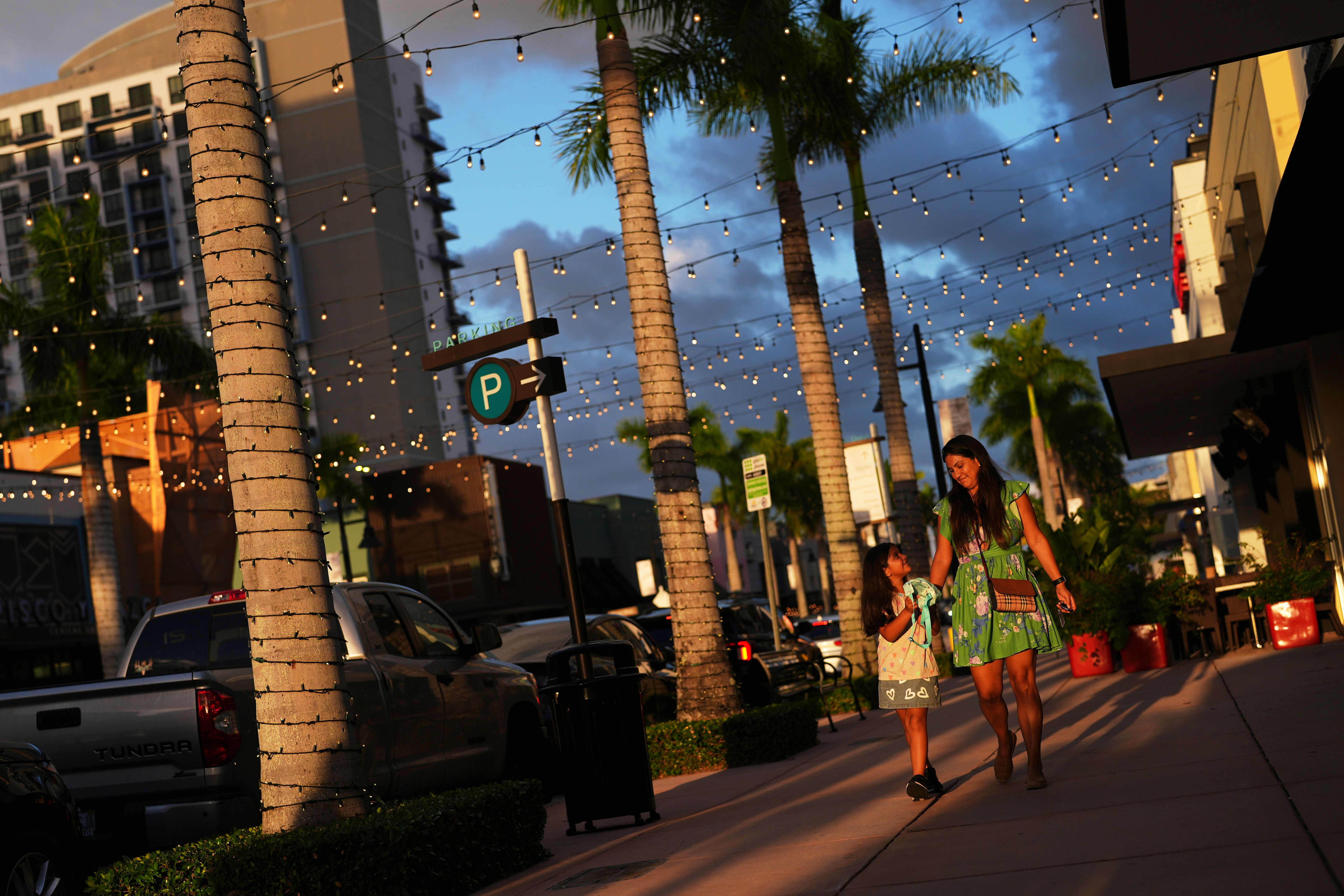 A woman and child walk down a commercial street, in Doral, Fla., Saturday, April 5, 2025. (AP Photo/Rebecca Blackwell)
Since the start of February the Trump administration has ended two federal programs that together allowed more 700,000 Venezuelans to live and work legally in the U.S. along with hundreds of thousands of Cubans, Haitians and Nicaraguans.
In the largest Venezuelan community in the United States, people dread what could face them if lawsuits that aim to stop the government fail. It's all anyone discusses in “Little Venezuela” or “Doralzuela,” a city of 80,000 people surrounded by Miami sprawl, freeways and the Florida Everglades.
Deportation fears in Doralzuela
People who lose their protections would have to remain illegally at the risk of being deported or return home, an unlikely route given the political and economic turmoil in Venezuela.
“It’s really quite unfortunate to lose that human capital because there are people who do work here that other people won’t do,” Escaray, 37, said at one of his “Sabor Venezolano” restaurants.
Spanish is more common than English in shopping centers along Doral's wide avenues, and Venezuelans feel like they're back home but with more security and comfort.
A sweet scent wafts from round, flat cornmeal arepas sold at many establishments. Stores at gas stations sell flour and white cheese used to make arepas and T-shirts and hats with the yellow, blue and red stripes of the Venezuelan flag.
New lives at risk
John came from Venezuela nine years ago and bought a growing construction company with a partner. He and his wife are on Temporary Protected Status, or TPS, which Congress created in 1990 for people in the United States whose homelands are considered unsafe to return due to natural disaster or civil strife. Beneficiaries can live and work while it lasts but TPS carries no path to citizenship.
Born in the U.S., their 5-year-old daughter is a citizen. John, 37, asked to be identified by first name only for fear of being deported.
His wife helps with administration at their construction business while working as a real-estate broker. The couple told their daughter that they may have to leave the United States. Venezuela is not an option.
“It hurts us that the government is turning its back on us,” John said. “We aren’t people who came to commit crimes; we came to work, to build.”
A federal judge ordered on March 31 that temporary protected statuswould stand until a legal challenge's next stage in court and at least 350,000 Venezuelans were temporarily spared becoming illegal. Escaray, the owner of the restaurants, said nearly all of his 150 employees are Venezuelan and more than 100 are on TPS.
The federal immigration program that allowed more than 500,000 Cubans, Venezuelans, Haitians and Nicaraguans to work and live legally in the U.S. — humanitarian parole — expires April 24 absent court intervention.
Politics of migration
Venezuelans were one of the main beneficiaries when former President Joe Biden sharply expanded TPS and other temporary protections. Trump tried to end them in his first term and now his second.
The end of the temporary protections has generated little political reaction among Republicans except for three Cuban-American representatives from Florida who called for avoiding the deportations of affected Venezuelans. Mario Díaz Ballart, Carlos Gimenez and Maria Elvira Salazar have urged the government to spare Venezuelans without criminal records from deportation and review TPS beneficiaries on a case-by-case basis.
The mayor of Doral, home to a Trump golf club since 2012, wrote a letter to the president asking him to find a legal pathway for Venezuelans who haven’t committed crimes.
“These families do not want handouts,” said Christi Fraga, a daughter of Cuban exiles. “They want an opportunity to continue working, building, and investing in the United States.”
A country's elite, followed by the working class
About 8 million people have fled Venezuela since 2014, settling first in neighboring countries in Latin America and the Caribbean. After the COVID-19 pandemic, they increasingly set their sights on the United States, walking through the notorious jungle in Colombia and Panama or flying to the United States on humanitarian parole with a financial sponsor.
In Doral, upper-middle-class professionals and entrepreneurs came to invest in property and businesses when socialist Hugo Chávez won the presidency in the late 1990s. They were followed by political opponents and entrepreneurs who set up small businesses. In recent years, more lower-income Venezuelans have come for work in service industries.
They are doctors, lawyers, beauticians, construction workers and house cleaners. Some are naturalized U.S. citizens or live in the country illegally with U.S.-born children. Others overstay tourist visas, seek asylum or have some form of temporary status.
Thousands went to Doral as Miami International Airport facilitated decades of growth.
Frank Carreño, president of the Venezuelan American Chamber of Commerce and a Doral resident for 18 years, said there is an air of uncertainty.
“What is going to happen? People don't want to return or can't return to Venezuela,” he said.