







Muntinlupa LGU enacts ordinance vs fake PWD IDs


The Muntinlupa City government enacted an ordinance against fake, falsified and tampered persons with disability (PWD) identification cards.
Mayor Ruffy Biazon signed City Ordinance No. 2025-325, or the Anti-fake PWD ID Ordinance, which was passed by the Muntinlupa City Council last month, “providing for policies and penalties designed to counteract the proliferation of fake, falsified or tampered persons with disability identification cards in the City of Muntinlupa.”
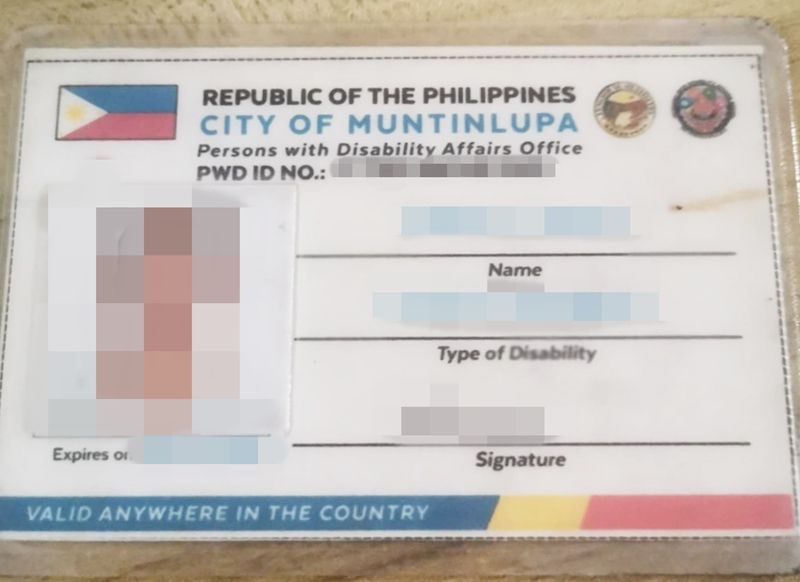
A PWD ID issued by the Muntinlupa City government
The Muntinlupa City government issues PWD IDs to “Filipino residents of Muntinlupa with permanent disabilities due to any one or more of the following types of disabilities: deaf/hard of hearing, intellectual, leaming, mental, orthopedic, physical, psychosocial, speech and language impairment, visual, people with cancer and people with rare diseases.”
The PWD ID is used as the basis for the grant of special discounts, benefits and privileges under several laws.
The ordinance was enacted as “there is an urgent need to undertake preventive and remedial measures to counteract the alarming nationwide proliferation of fake, falsified, and/or tampered Persons with Disability identification cards in the interest of honesty, social justice and market integrity,” according to the local law.
The PWD ID in Muntinlupa is issued by the Muntinlupa City Persons with Disability Affairs Office (PDAO), which are “required by merchants, entities or agencies to be presented before discounts, benefits and privileges made available to may be extended.”
Under the Muntinlupa law, fake PWD IDs refer “to counterfeit PWD IDs that are created to resemble legitimate PWD IDs issued by the Muntinlupa City PDAO, any Local Government Unit, the National Council on Disability Affairs, or any authorized issuing authority, as the case may be.”
Falsified PWD IDs are PWD IDs “issued by the Muntinlupa City PDAO but are found to have been issued on the basis of willfully submitted false or misleading information and/or documentary requirements, such as but not limited to, the Certificate of Disability issued by the authorized physician.”
Tampered PWD IDs are “PWD IDs that have undergone unauthorized modification or alteration, by any means, of any of the figures, letters, words or signs contained in the PWD ID.”
The ordinance covers “all individuals, whether residents or non-residents of Muntinlupa, as well as all private and public establishments, agencies, institutions and entities operating in the City of Muntinlupa.”
The ordinance requires all business establishments, institutions and government agencies in Muntinlupa to “verify the validity and authenticity of all PWD ID cards, whether issued by the City Government of Muntinlupa or not, presented by an individual who wish to avail of any discount, benefit or privilege made available by existing laws only to bonafide PWDs using the Online Muntinlupa City PWD ID Verification Tool at https://pdao.muntinlupacity.gov.ph/ for Muntinlupa-issued PWD IDs, the Department of Health-Philippine Registry of Persons With Disability (DOH-PRPVVD) Online Verification tool for all PWD IDS or any available method of verification.”
Aiding in, abetting or commission of the following acts are prohibited under the Muntinlupa ordinance:
1. The use or mere possession of fake, falsified, or altered PWD ID card/s;
2. Tampering, alteration and/or falsification of a PWD ID;
3. The willful submission of false information in the application, renewal or updating of information for a PWD ID card;
4. The issuance of false Certificate of Disability, Laboratory or Radiology report by any physician or medical practitioner in relation to the application for a PWD ID;
5 Giving and receiving any consideration, whether in money or in kind, in relation to the application for a PWD;
6. Phishing information or fraudulently sending emails, text messages and the like purporting to be from reputable individuals or government agencies in order to induce individuals to reveal personal information in relation to the application for a PWD ID;
7. The unauthorized use of a PWD ID card, without valid excuse, by any person other that the one to whom it was issued;’
8. Non-verification of the PWD ID presented by a business establishment or government agency as provided for in Section 5 of this Ordinance;
9. Non-posting of this Ordinance in all business establishments and government agencies operating in the City of Muntin/upa as provided for in Section 6 of this Ordinance;
10. The sale, trade, exchange, printing, reproduction, preparation and/or manufacturing of fake PWD ID card/s.
Criminal and administrative penalties or sanctions may be imposed under national laws and legal issuances.
The penalties for violation of prohibited acts Nos. 1 to 9 under ordinance are:
- 1st offense - P2,000
- 2nd offense - P4,000
- 3rd offense and succeeding offenses - “P5,000 fine and, wherever applicable, 1-year ineligibility to all Muntinlupa City Government benefits and programs that are not mandatory by virtue of national laws such as but not limited to Muntinlupa scholarship allowances, Muntinlupa seniors' allowances and other Muntinlupa grants/gifts whether in cash or in kind.”
Violation of item No. 10 under Section 7:
1st offense and succeeding offenses - “P5,000 fine and imprisonment of not more than six (6) months, as the courts may decide, as well as 1 -year ineligibility to all Muntinlupa Government benefits and programs that are not mandatory by virtue of national laws.”
The ordinance emphasized that “private and public establishments or individuals cannot deny and withhold PWD benefits and privileges solely because the authenticity of the PWD ID card cannot be verified at the time of presentation.”
“Conversely, said refusal Of benefits and privileges is allowed if it can be verified beyond reasonable doubt at the time of presentation that the PWD ID presented is fake, falsified and/or tampered. In both cases, the incident shall be immediately reported by the establishment or individual to whom the PWD ID was presented to the Muntinlupa Persons with Disability Affairs Office,” according to the ordinance.
It added that “private Individuals and establishments are not legally allowed to confiscate fake PWD IDs even if it is evident that the ID presented is counterfeit. Only the Philippine National Police and Authorized Government Agencies and Officials can confiscate suspected fake, falsified and/or tampered PWD IDs. Pursuant to this, private establishments are hereby directed to immediately contact local authorities for proper action.”