






 Philippines
National
PH, New Zealand sign visiting forces deal amid 'deteriorating’ security environment
Philippines
National
PH, New Zealand sign visiting forces deal amid 'deteriorating’ security environment
PH, New Zealand sign visiting forces deal amid 'deteriorating’ security environment


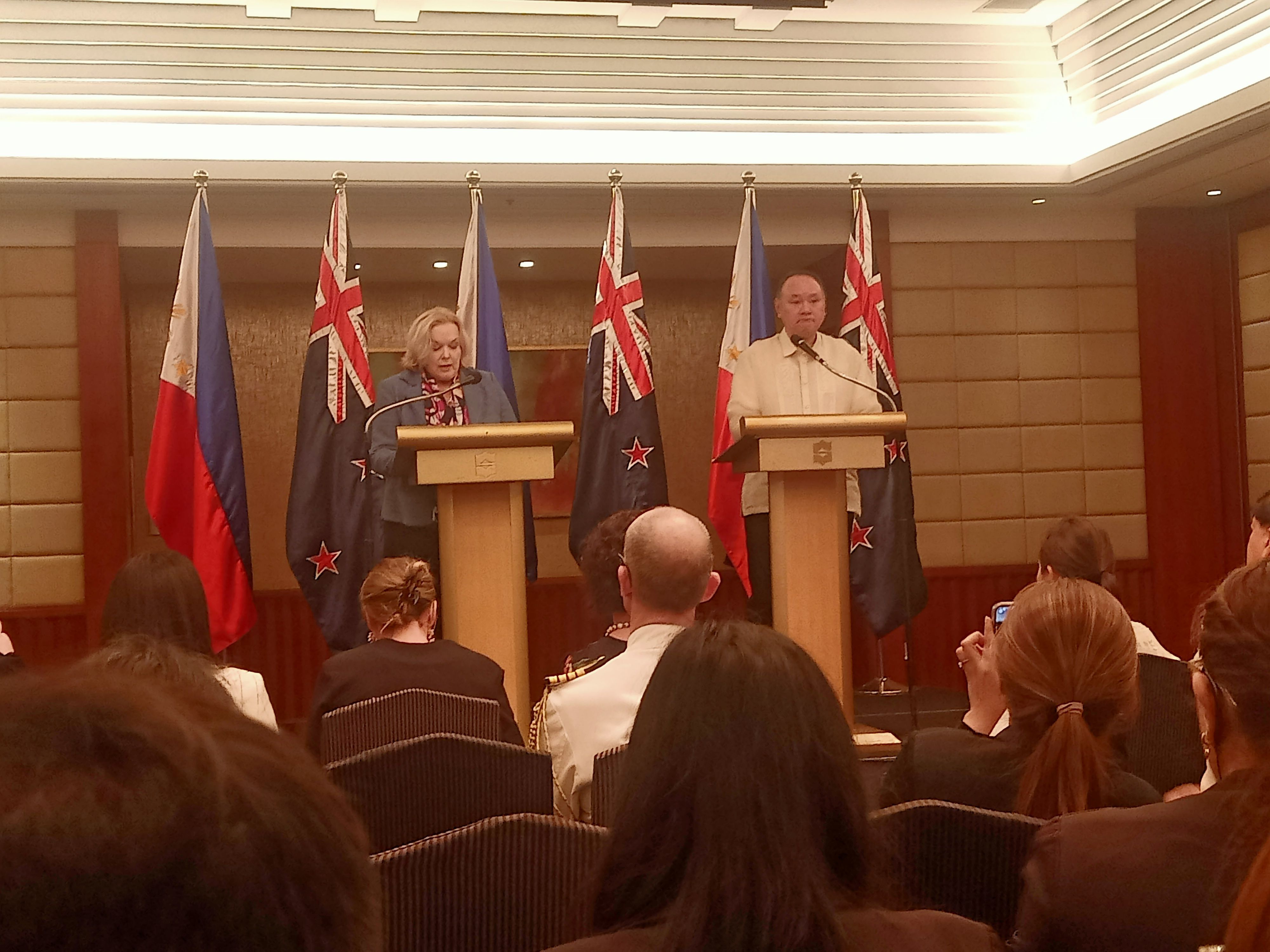
The Philippines signed a troop agreement with New Zealand to allow both nations’ militaries to hold large-scale exercises in each other’s territories and enhance their bilateral defense relations amid the “deteriorating” security environment in the Indo-Pacific region.
Department of National Defense (DND) Secretary Gilberto Teodoro Jr. and New Zealand Defense Minister Judith Collins signed the Status of Visiting Forces Agreement (SoVFA) on Wednesday, April 30, formalizing the rules and legal protections governing the temporary presence of military forces from either country in the territory of the other.
“The strategic environment that we are operating in is deteriorating. As a result, we have vowed to step up and play our part in working with others in our region,” Collins said in a press conference in Makati City.
“Our militaries already work well together and this agreement will create conditions for even more seamless cooperation in the defense space,” she added. “We expect that bilateral defense activity will increase in the future.”
The top officials agreed to strengthen defense industry cooperation, capabilities on air and maritime domain awareness, defense supply chain management, and education and training exchanges.
The New Zealand defense minister explained that the partnership with the Philippines was born from the understanding of the “risks” to the international rules-based order amid aggressive actions by one party.
Like the Philipines, Collins said that New Zealand is a maritime nation that relies on trade routes, emphasizing the importance of the South China Sea to them as about $3 billion in global trade passes through the key waterway every year.
While Collins did not mention any country that causes the risks to the region, the New Zealand has recognized the 2016 arbitral ruling which invalidated China’s claims in the South China Sea.
Meanwhile, Teodoro said New Zealand has been a “partner” by the Philippines in upholding the United Nations Convention on the Law of the Sea (UNCLOS) and other international laws supporting the country’s position in the WPS.
He said the motivating factor why the Philippines has been teaming up with other like-minded countries like the New Zealand is the "overreach" by the People's Republic of China (PRC).
“Now we have come to face the reality in both our countries that peace doesn’t come for free. It is not a free dividend but must be committed to. And thus, we are committed to our mutual resilience,” Teodoro stressed.
"Their actions have resulted in a grave damage to the goodwil that the Chinese people should have in the whole world," he said.
He said the security threats being faced by the Philippines and New Zealand are "not dissimilar." "Through the SOVFA, interoperability, other enhanced exchanges shall be done for collective resilience in the Indo-Pacific region,” the DND secretary added.
Apart from military exercises, the agreement would also enable the provision of support by either country in the event of a natural disaster.
Teodoro thanked the Filipino community in New Zealand for upholding the highest standards of humanity, civility and good citizenship there. There are about 100,000 Filipinos in New Zealand.
Aside from New Zealand, the DND has also negotiated a similar pact with Canada and France.
Meanwhile, the Philippines has a VFA with the United States and Australia, and is awaiting Japan to ratify the Reciprocal Access Agreement (RAA).
AFP rebuts Chinese military
As this developed, the Armed Forces of the Philippines (AFP) stood firm in exercising the country’s sovereign rights within its maritime domain after the Chinese military conducted routine patrols in the South China Sea in response to joint patrols by the Philippines with allied nations as part of Balikatan Exercises.
“The conduct of joint exercises and maritime domain awareness operations within our territorial waters and exclusive economic zone is not a provocation—it is preparedness,” AFP spokesperson Col. Francel Margareth Padilla said.
The Chinese People’s Liberation Army’s (PLA) Southern Theater Command said it conducted “routine patrols” in the South China Sea after accusing the Philippines of violating China’s maritime rights and “colluding with external forces” to organize joint patrols.
The AFP has conducted war games and coordinated naval patrols with counterparts from the US, Japan, and Australia in the West Philippine Sea (WPS) as part of this year’s Balikatan.
Apart from the Balikatan, the Philippine Navy’s (PN) Philippine Fleet also successfully test-fired two launchers of the Mistral 3 Surface-to-Air Missile (SAM) off the coast of San Antonio, Zambales last April 28.
In a live fire exercise, the guided-missile frigate BRP Jose Rizal (FF150) hit with pinpoint accuracy two drone targets provided by the US Indo-Pacific Command (Indopacom).
The MISTRAL 3 is a versatile, combat proven short-range air defense missile system with a "fire and forget" capability developed by MBDA of France, which means that once launched, the missile will autonomously track and destroy its target without further input from the operator.
The Philippine Air Force (PAF) and US Pacific Air Forces (Pacaf) also carried out a combined air patrol in the WPS on April 29. Three FA-50 aircraft from the PAF were utilized, along with one B-1B Bomber aircraft, and two F-16 and F-18 aircraft from the US counterpart.
Rear Adm. Roy Vincent Trinidad, PN spokesperson for WPS, also raised the possibility of establishing closer military cooperation with Taiwan through the regular conduct of warship transits across the Taiwan Strait, further angering China.
Trinidad said this could pave the way for the establishment of a formal defense and military cooperation between the Philippines and Taiwan, a self-ruled island that China claims as its renegade province.
Padilla underscored that the AFP’s partnership with the US, a treaty ally, “reflects shared values and a collective commitment to safeguarding peace, security, and the rules-based international order.”
“To be clear: the Philippines is a sovereign state. No foreign power can dictate how we defend our home or with whom we stand in solidarity,” Padilla stressed.