







PH-Japan ACSA: What is it and how would it benefit Manila?


The Acquisition and Cross-Servicing Agreement (ACSA), a new logistics deal that the Philippines and Japan are currently negotiating, will pave the way for an increased security and defense cooperation between the two countries, Japanese Foreign Ministry spokesperson Kitamura Toshihiro said on Wednesday, April 30.
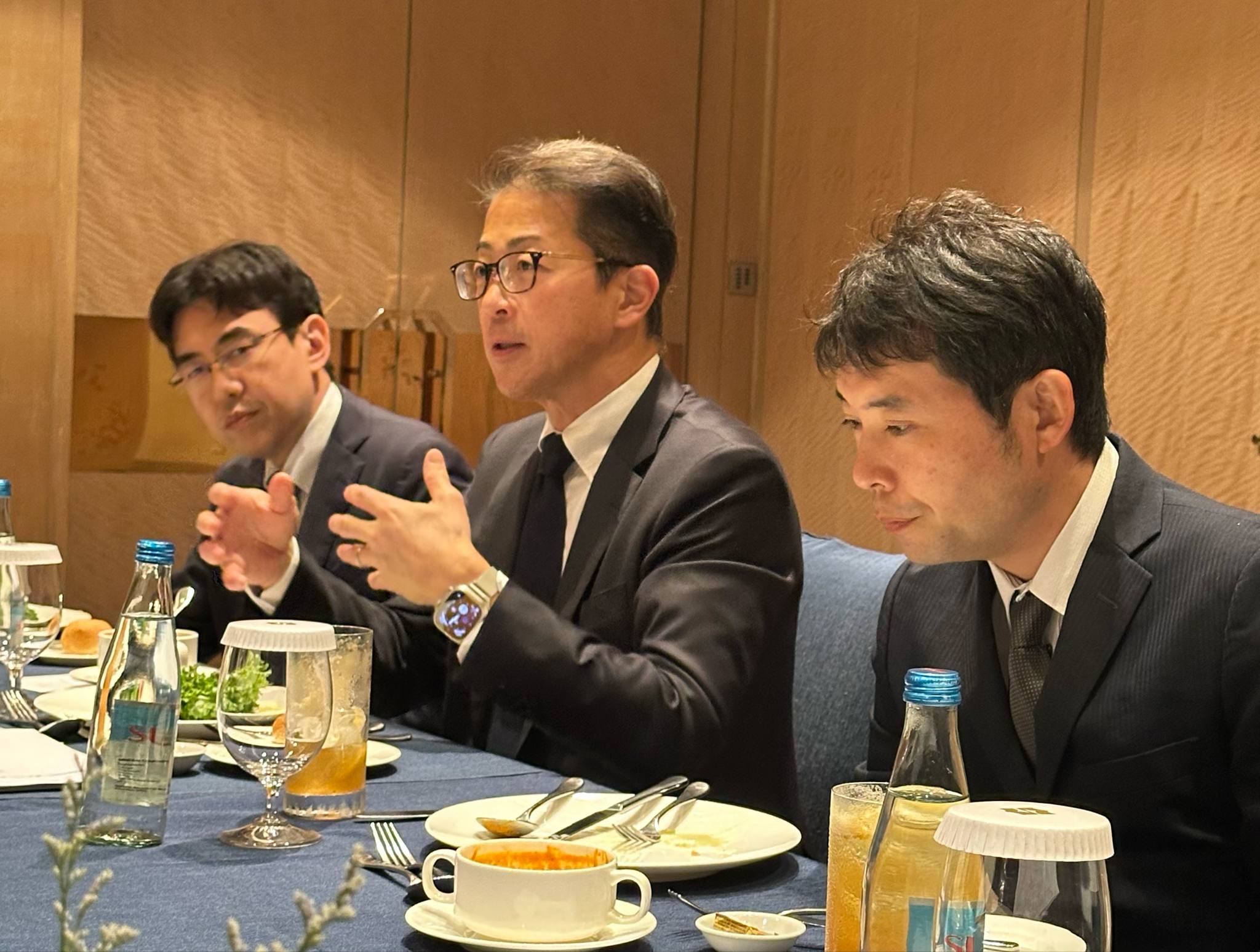 Japan Ministry of Foreign Affairs spokesperson Kitamura Toshihiro (center) speaks to some members of Philippine media about the two countries' negotiation on the Acquisition and Cross-Servicing Agreement or ACSA in Taguig City on April 30, 2025. Also in the photo are Misumi Takahito (left) and Shigehiro Matsuda (right). (Raymund Antonio/MANILA BULLETIN)
In a press briefing for select members of the Philippine media at the Shangri-La the Fort in Taguig City, the Japanese official explained that without a legal framework, Japan’s maritime vessels cannot even refuel in the Philippines because of legal restrictions.
“But under this ACSA agreement, it is quite easy to exchange such kind of refueling or some piece or equipment in case of the accident, something like that. So it's kind of, to be honest, that is a, how can I say, procedural or technical agreement between two countries,” he said.
“So, ACSA itself doesn't guarantee any kind of operation. But with ACSA, we can conduct more smoothly the joint training, joint exercise or exchange of people between two countries,” the diplomat added.
Japan currently has a similar logistics deal with the United States, Australia, United Kingdom, Canada, France, India, Germany, and Italy, though the one with Italy has yet to be ratified.
The ACSA, Kitamura explained, will provide the procedure that will facilitate “the payment or provision of any kind of material required for the joint exercise or joint activities,” allowing Japanese forces to easily participate in the Balikatan Exercises with the United States, for example.
The Japanese official said that “negotiations will start right away” on the ACSA, but stressed that discussions have already been going on since the start of the year, when Japanese Foreign Minister Iwaya Takeshi visited the country in January and Japanese Defense Minister Nakatani Gen the next month.
“And through those occasions, they have already mentioned the possibility of the starting negotiation of ACSA. So I think that at our level, the discussion has already started. But negotiation itself, I'm not sure whether it has already started or not,” he added.
He also raised the possibility of including the information security agreement in the negotiations for the new logistics deal because it “will be useful to further promote” cooperation activities and joint activities between the two countries.
But while the ACSA deal is still being negotiated, Japan has already shown its commitment to the security of the Philippines by providing 297 meters and another 44 meters, with an incoming 597 meters, of patrol vessels to the Philippine Coast Guard (PCG) under the Official Development Assistance (ODA).
Kitamura also said that Japan has been able to provide defense-related materials to the Armed Forces of the Philippines (AFP) under the Official Security Assistance (OSA).
“And under this OSA framework, we have decided for two consecutive years the coastal surveillance system that we will be utilizing in order to monitor our domain awareness, maritime domain awareness for the Coast Guard,” he said.
“So anyway, we would like to work further with the Philippine Government and Philippine forces for the security and stability of this region.”
The high-level visits of Japanese officials to the Philippines emphasized the importance that Japan places on its relationship with its long-time strategic partner.
“As for the importance of Philippines, yes, Philippines is very important. So that's why we have already sent Foreign Minister and Defense Minister this year, and now Prime Minister is visiting here. And this is because we believe that in order to maintain stability and prosperity of the region, we believe that the cooperation with Philippines is quite important and even crucial to realize that,” he added.