ADVERTISEMENT

Chinese imports, US exports surge in Q1 as Philippines navigates trade war

Published Apr 30, 2025 06:43 am

TRUMP TARIFFS.jpg

Chinese imports to the Philippines and Philippine exports to the United States (US) surged in the first quarter, amid escalating trade tensions between Washington and Beijing that threaten to disrupt the global economy.

The latest preliminary Philippine Statistics Authority (PSA) data on Wednesday, April 30, showed that the value of imported goods from China during the January-to-March period climbed 25.6 percent year-on-year to $8.93 billion—the largest among all import sources, and accounting for over a fourth of total first-quarter imports worth $31.98 billion.

The increase in Chinese imports during the first quarter was three times faster than the total import growth rate of 8.4 percent.

In March alone, imported products from China reached $3.1 billion, up by a faster 36.2 percent year-on-year, outpacing the month's 11.9-percent import growth.

The second-largest import source in the first quarter was Japan, although with only $2.61 billion worth—much smaller than Chinese imports.

The end-March growth in imports from China was outpaced only by Australia's 26.6 percent, although the value of Australian imports into the Philippines during the first three months was just $776.71 million.

As a share of total first-quarter imports, products from China accounted for 27.9 percent, up from 24.1 percent a year ago.

Chinese imports held the only double-digit share among all foreign sources of merchandise sold to the Philippines.

The Philippines is a net importer of the goods it consumes.

The think tank Capital Economics earlier warned that net-importing countries like the Philippines should brace for a barrage of Chinese goods, as China seeks alternative markets to the US amid an intensifying trade war between the two economic giants.

In the first quarter, the country's trade-in-goods deficit—resulting from more imports than exports—widened to $12.71 billion from $11.26 billion a year ago. March's trade deficit ballooned by 23.1 percent year-on-year to $4.13 billion.

This persistent trade deficit puts pressure on the country's current account, or net dollar earnings from goods and services exports, whose deficit is projected by the Bangko Sentral ng Pilipinas (BSP) to further widen to $19.8 billion this year, equivalent to 3.9 percent of gross domestic product (GDP), from $17.5 billion last year.

The lingering current account deficit, in turn, puts depreciation pressure on the Philippine peso—even as the local currency has gained at least one percent against the US dollar since US President Donald Trump announced a tariff spree last April 2, his so-called "Liberation Day."

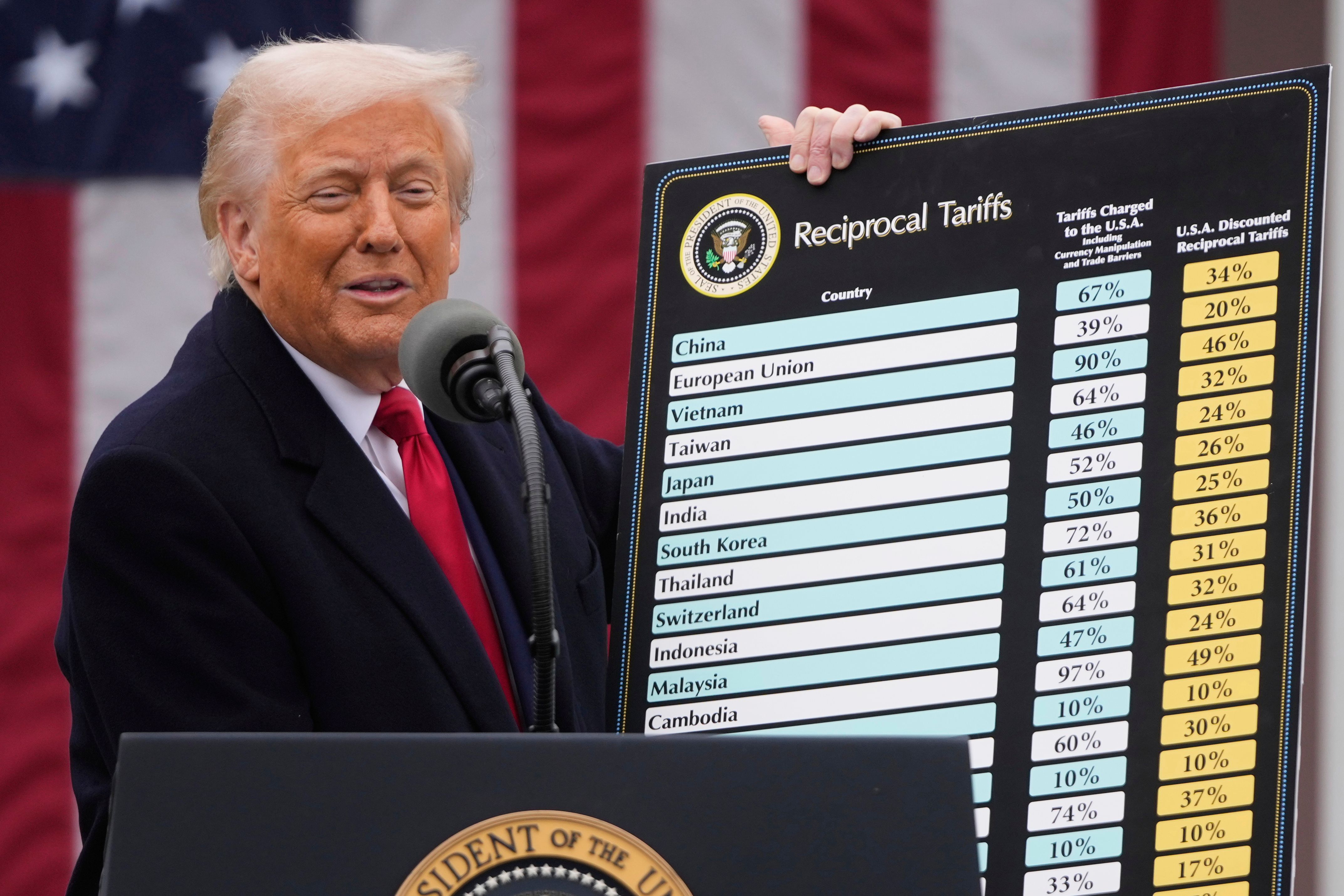
While deferred by 90 days, Philippine exports to the US are poised to be slapped with a 17-percent reciprocal tariff, prompting negotiations this week between Filipino and American trade and economic officials in Washington, D.C., in a bid to lower the levy.

Reciprocal tariffs would be imposed on trading partners with which the US has a trade deficit, and it does not help that Philippine exports to America grew 11.8 percent year-on-year to $3.22 billion in the first quarter—outpacing total export growth of 5.7 percent during the same period.

March exports to the US jumped by 12.8 percent year-on-year to $1.11 billion, making America the top destination for Philippine-made goods in the first three months.

The share of US-bound Philippine exports to total overseas sales during the three-month period also rose to 16.7 percent, from 15.8 percent a year ago.

In contrast, the Philippines' imports from the US in March slid 15.5 percent year-on-year to $605.11 million, allowing for a modest 1.3-percent first-quarter increase to $1.97 billion. The US ranked as the Philippines' fifth-biggest import source during the first three months, with a 6.1-percent share of the total.

Philippine exports to mainland China, meanwhile, dropped 9.8 percent year-on-year to $762.78 million in March, resulting in a 4.7-percent first-quarter decline to $2.07 billion.

China ranked as the fourth-largest export market for Philippine products in the first quarter, although Hong Kong, its special administrative region (SAR), received a larger $2.62 billion in exports from the Philippines during the same period—mostly semiconductors and electronics components.

While Philippine officials see manufacturing and export opportunities arising from the country's relatively lower reciprocal tariff compared to many of its Southeast Asian neighbors, Capital Economics said in an April 29 report that the Philippines would be unlikely to gain US market share.

"Demographics are much more favorable in the Philippines, but the country's unstable politics—it is rated as the least stable country in Southeast Asia—and its failure to make needed improvements to infrastructure and the broader business environment may mean that it struggles to capitalize on any opportunities," Capital Economics Asia-Pacific head Marcel Thieliant, senior Asia economist Gareth Leather, and chief Asia economist Mark Williams said in the report.

Related Tags

merchandise exports Philippine Statistics Authority (PSA) trade deficit Donald Trump merchandise imports reciprocal tariffs trade war
ADVERTISEMENT
.most-popular .layout-ratio{ padding-bottom: 79.13%; } @media (min-width: 768px) and (max-width: 1024px) { .widget-title { font-size: 15px !important; } }

{{ articles_filter_1561_widget.title }}

.most-popular .layout-ratio{ padding-bottom: 79.13%; } @media (min-width: 768px) and (max-width: 1024px) { .widget-title { font-size: 15px !important; } }

{{ articles_filter_1562_widget.title }}

.most-popular .layout-ratio{ padding-bottom: 79.13%; } @media (min-width: 768px) and (max-width: 1024px) { .widget-title { font-size: 15px !important; } }

{{ articles_filter_1563_widget.title }}

{{ articles_filter_1564_widget.title }}

.mb-article-details { position: relative; } .mb-article-details .article-body-preview, .mb-article-details .article-body-summary{ font-size: 17px; line-height: 30px; font-family: "Libre Caslon Text", serif; color: #000; } .mb-article-details .article-body-preview iframe , .mb-article-details .article-body-summary iframe{ width: 100%; margin: auto; } .read-more-background { background: linear-gradient(180deg, color(display-p3 1.000 1.000 1.000 / 0) 13.75%, color(display-p3 1.000 1.000 1.000 / 0.8) 30.79%, color(display-p3 1.000 1.000 1.000) 72.5%); position: absolute; height: 200px; width: 100%; bottom: 0; display: flex; justify-content: center; align-items: center; padding: 0; } .read-more-background a{ color: #000; } .read-more-btn { padding: 17px 45px; font-family: Inter; font-weight: 700; font-size: 18px; line-height: 16px; text-align: center; vertical-align: middle; border: 1px solid black; background-color: white; } .hidden { display: none; }
function initializeAllSwipers() { // Get all hidden inputs with cms_article_id document.querySelectorAll('[id^="cms_article_id_"]').forEach(function (input) { const cmsArticleId = input.value; const articleSelector = '#article-' + cmsArticleId + ' .body_images'; const swiperElement = document.querySelector(articleSelector); if (swiperElement && !swiperElement.classList.contains('swiper-initialized')) { new Swiper(articleSelector, { loop: true, pagination: false, navigation: { nextEl: '#article-' + cmsArticleId + ' .swiper-button-next', prevEl: '#article-' + cmsArticleId + ' .swiper-button-prev', }, }); } }); } setTimeout(initializeAllSwipers, 3000); const intersectionObserver = new IntersectionObserver( (entries) => { entries.forEach((entry) => { if (entry.isIntersecting) { const newUrl = entry.target.getAttribute("data-url"); if (newUrl) { history.pushState(null, null, newUrl); let article = entry.target; // Extract metadata const author = article.querySelector('.author-section').textContent.replace('By', '').trim(); const section = article.querySelector('.section-info ').textContent.replace(' ', ' '); const title = article.querySelector('.article-title h1').textContent; // Parse URL for Chartbeat path format const parsedUrl = new URL(newUrl, window.location.origin); const cleanUrl = parsedUrl.host + parsedUrl.pathname; // Update Chartbeat configuration if (typeof window._sf_async_config !== 'undefined') { window._sf_async_config.path = cleanUrl; window._sf_async_config.sections = section; window._sf_async_config.authors = author; } // Track virtual page view with Chartbeat if (typeof pSUPERFLY !== 'undefined' && typeof pSUPERFLY.virtualPage === 'function') { try { pSUPERFLY.virtualPage({ path: cleanUrl, title: title, sections: section, authors: author }); } catch (error) { console.error('ping error', error); } } // Optional: Update document title if (title && title !== document.title) { document.title = title; } } } }); }, { threshold: 0.1 } ); function showArticleBody(button) { const article = button.closest("article"); const summary = article.querySelector(".article-body-summary"); const body = article.querySelector(".article-body-preview"); const readMoreSection = article.querySelector(".read-more-background"); // Hide summary and read-more section summary.style.display = "none"; readMoreSection.style.display = "none"; // Show the full article body body.classList.remove("hidden"); } document.addEventListener("DOMContentLoaded", () => { let loadCount = 0; // Track how many times articles are loaded const offset = [1, 2, 3, 4, 5, 6, 7, 8, 9, 10]; // Offset values const currentUrl = window.location.pathname.substring(1); let isLoading = false; // Prevent multiple calls if (!currentUrl) { console.log("Current URL is invalid."); return; } const sentinel = document.getElementById("load-more-sentinel"); if (!sentinel) { console.log("Sentinel element not found."); return; } function isSentinelVisible() { const rect = sentinel.getBoundingClientRect(); return ( rect.top < window.innerHeight && rect.bottom >= 0 ); } function onScroll() { if (isLoading) return; if (isSentinelVisible()) { if (loadCount >= offset.length) { console.log("Maximum load attempts reached."); window.removeEventListener("scroll", onScroll); return; } isLoading = true; const currentOffset = offset[loadCount]; window.loadMoreItems().then(() => { let article = document.querySelector('#widget_1690 > div:nth-last-of-type(2) article'); intersectionObserver.observe(article) loadCount++; }).catch(error => { console.error("Error loading more items:", error); }).finally(() => { isLoading = false; }); } } window.addEventListener("scroll", onScroll); });

Sign up by email to receive news.