






 Philippines
National
#MakatiDeclaration: PH leads adoption of strategic action plan for middle-income countries
Philippines
National
#MakatiDeclaration: PH leads adoption of strategic action plan for middle-income countries
#MakatiDeclaration: PH leads adoption of strategic action plan for middle-income countries


The Philippines and the Like-Minded Group for Middle-Income Countries (LMG-MICs), has adopted on Tuesday, April 29, the Makati Declaration on Middle-Income Countries, which will serve as a roadmap for member-states to address present challenges to their continuous growth, lack of access to funding opportunities, and impact of climate change.
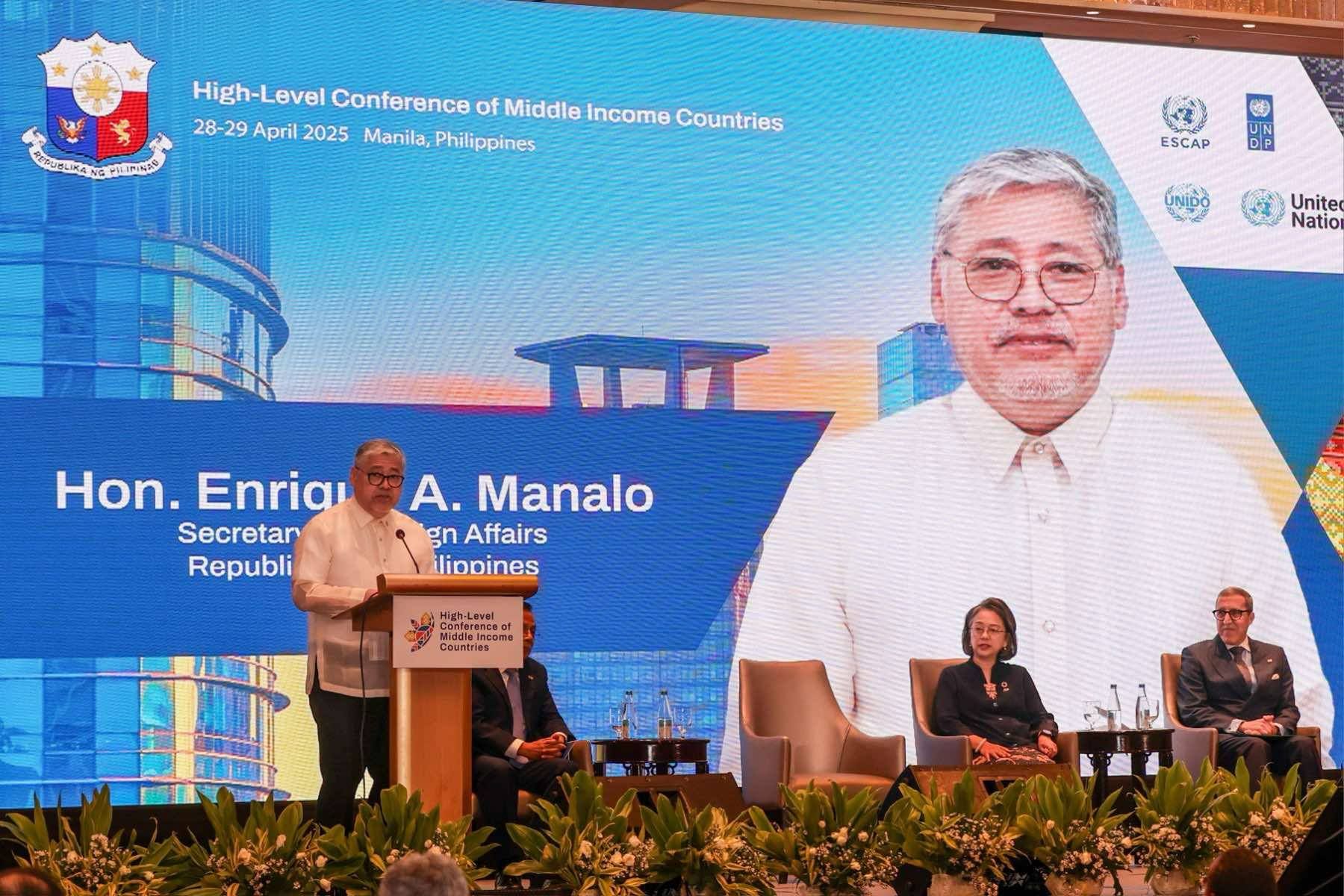
DFA Secretary Enrique Manalo delivers his speech during the High-Level Conference of Middle-Income Countries held in Makati City. The Philippines is the host of the global forum as it takes over the chairmanship of the Like-Minded Group on MICs from Morocco. (Photo from Sec. Manalo)
Initiated and led by the Philippines, the adoption of the Makati Declaration by ministers and high-level representatives of MICs at the High-Level Ministerial Conference of MICs at the Makati Shangri-La Hotel underscored the priorities of the countries moving forward.
Department of Foreign Affairs (DFA) Secretary Enrique Manalo explained that the roadmap will help MICs come up with strategies to rally the international community to create tailored support for middle-income economies.
“Despite experiencing rapid economic growth, MICs continue to face specific challenges such as inequality, unemployment, and the devastating effects of climate change,” the DFA chief said during a press conference.
The conference, which brought together Armenia, Belarus, Chile, Colombia, Costa Rica, Dominican Republic, Ecuador, El Salvador, Guatemala, Honduras, Jamaica, Lebanon, Mexico, Morocco, Namibia, Panama, Peru, the Philippines, and Uruguay, was guided by the theme, “Breaking New Grounds: Towards a Strategic Plan of Action for Middle-Income Countries.”
“Also, MICs are often left out of concessional financing and enhanced development cooperation opportunities, while at the same time managing competing priorities, as well as debt burdens,” Manalo added.
Organized by the DFA, the United Nations Economic and Social Commission for Asia and the Pacific (UNESCAP), the United Nations Industrial Development Organization (UNIDO), and the United Nations Resident Coordinator’s Office in the Philippines, the conference aimed “to bring out insightful, practical, impactful, customizable and scalable solutions to the concerns of MICs.”
Key priorities
A copy of the declaration showed the key priorities for the MICs. These include financing for development, establishing non-traditional metrics to measure development, debt sustainability, climate action and finance, digital transformation and innovation, and gender equality, decent work, and social protection.
Manalo also explained that the declaration “puts forward a roadmap for the continued work of the LMG in the UN, especially to promote a Strategic Program of Action for MICs,” which would help alert the international community about the MICs’ need for “targeted and tailored support.”
“The road ahead will include ensuring that the needs of MICs are recognized and addressed in various UN processes, such as the 4th International Conference on Financing for Development and the High-Level Political Forum on the SDGs (Sustainable Development Goals) later this year,” he added.
As chair, the DFA chief expressed during a press conference the Philippines’ commitment “to all 53 paragraphs” of the declaration.
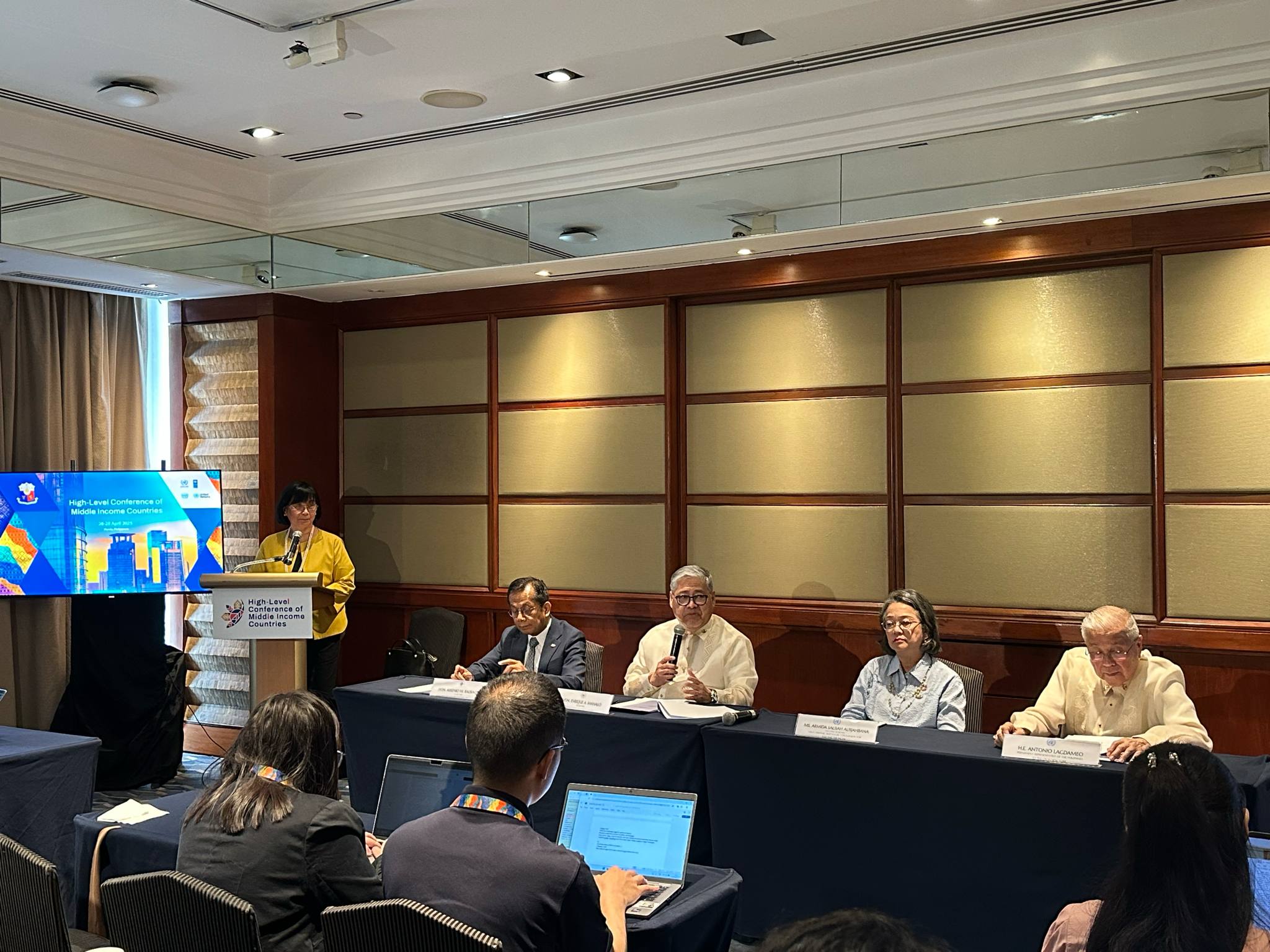 (Seated from left) NEDA Secretary Arsenio Balisacan and DFA Secretary Enrique Manalo hold a press conference on the adoption of the Makati Declaration. Also in the photo are (seated from right) are Permanent Representative of the Philippines to the UN in New York Antonio Lagdameo and Executive Secretary Armida Salsiah Alisjahbana of the UN Economic and Social Commission for Asia and The Pacific. (Raymund Antonio/MANILA BULLETIN)
“Our commitment is to see how we can, through appropriate action, achieve in cooperation, of course, with all our members of the mix, as well as the relevant UN agencies, to see how we can achieve sustainable action on various issues, and our commitment to participate and work together in terms of the various forthcoming major conferences,” Manalo stressed.
Some of the other priorities for the MICs is to ensure inclusive development cooperation, UN and social development, global multi-stakeholder partnerships, multi-stakeholder partnerships, and South-South and triangular cooperation.
“So we're committed to all of these, and committed to actions which will achieve those basic objectives. So, I think basically, the Makati Declaration is also fully consistent with the Philippine development priorities,” he added.
Multilateralism
With the declaration pushing for inclusivity in the United Nations system in terms of financing and reaching the SGDs, National Economic and Development Authority (NEDA) Secretary Arsenio Balisacan said it is also a call for “more global cooperation.”
“I think the clear realization is that, at least among the members, that acting as a group can achieve better outcomes, at least globally, compared to a situation where one country is explosing its own agenda in the global arena. So, it gives a fresh breath, in a way, to multilateralism,” he told the media.
“So, we are acting as one, we are pushing for a return to a regime where countries can expand their markets, can access trade, finance, technology, in better situations. And for a country like us, a small country, having all this, working with this bigger number of countries, will enable us, enhance our capacity to achieve those desired outcomes,” he explained.
The NEDA chief furthered that while the Philippines’ main source of growth is domestic-driven, it also needs “to expand our pillars of growth” for continued and sustained growth.
“And that means investment and exports. So, ensuring that those two pillars are accessible to us will tell a lot about the sustainability of our economic agenda,” Balisacan added.
Challenges
The conference was also an opportunity for the LMG-MICs to identify the specific challenges that hinder their growth trajectory.
Manalo said the list includes “high levels of inequality, low growth, persistent poverty, unemployment, loss of biodiversity, the risks from natural disasters and climate change, especially disaster risks, reliance on primary commodity exports, high levels of external debt, volatility of exchange rates, capital flows, and digital divide.”
“It doesn't mean that all the countries face this, but the members of the groups face it, some to a larger extent, some to a lesser extent, but these are basic problems,” he furthered, adding that “potential trade wars” could also have an impact on countries.
The declaration also addressed these potential challenges, sharing that only 27 countries transitioned from the middle-income to high-income classification since 2000, with many countries experiencing a reversal to the middle-income category.
The LMG-MICs noted that at least 11 countries switched “back and forth” at least once before reaching their high-income statuses.
“We recognize that middle-income countries experience frequent growth slowdowns and, if left unaddressed, this loss of economic dynamism can cause countries to get stuck in what is referred to as the ‘middle-income trap’,” the declaration read.
Currently, over 100 countries have been classified by the World Bank as middle-income. This accounts for around 75 percent of the global population, 60 percent of the world’s poor, and one third of the global GDP.