

ADVERTISEMENT

Middle-income countries must adhere to int'l rules-based order to achieve growth—DFA chief

Published Apr 28, 2025 04:36 am

Department of Foreign Affairs (DFA) Secretary Enrique Manalo on Monday, April 28, underscored the need for middle-income countries (MICs) like the Philippines to adhere to the international rules-based order to fulfill its potential of becoming “pacemakers” of the global economy and international peace security.
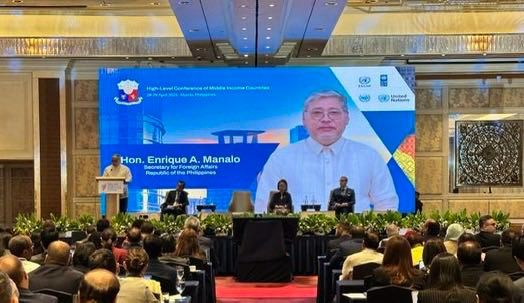
Manalo_MICs2.jpeg
DFA Secretary Enrique Manalo delivers a keynote speech at the High-Level Conference of Middle-Income Countries in Makati City on Monday, April 28, 2025. (Photo from Sec. Manalo via X post) 


In his keynote speech during the opening of the High-Level Conference of Middle-Income Countries (HLC-MICs) at the Makati Shangri-La Hotel, the DFA chief said that the group of MICs must have a “strong united voice” and must acknowledge that “we need each other.”
 

Hosted by the Philippines, who takes on the chairmanship of the Like-Minded Group of Middle-Income Countries, the HLC-MICs runs from April 28 to 29.


“Carving a steady path for all middle income countries behooves us to support strongly an international rules-based order underpinned by equity and justice. President Ferdinand R. Marcos Jr., has described this order as the ballast of the international community amidst periods of turmoil and change,” he told the attendees.
 

Emphasizing the role of poor MICs as “critical contributors” to the so-called last-mile run for meeting the United Nations’ Sustainable Development Goals (SDGs) in 2030, Manalo said there is a need to “surge through internal and external challenges to attain our national development goals within an acceptable time frame.”
 

The 105 MICs comprise 75 percent of the world’s population and one-third of the global gross domestic product (GDP).
 

“With 105 middle-income countries comprising 75 percent of the world’s population and one-third of global GDP, we are a formidable group whose strong, united voice can propel us as pacemakers of the global economy, and international peace, and security,” he described.
 

The DFA secretary said that the “conversations” in the conference will “ aim for concerted action to leverage the right tools and resources to assist middle income countries throughout their growth trajectory.”
 

These actions will include healthy economic policies that will help MICs escape the “middle-income trap.”
 

“Let us pursue solutions suited to evolving context and needs. We should take decisive steps to mainstream green transitions, resilience strategies and innovation as new frontiers for growth and economic enablers,” Manalo said.
 

“We need to replace out-dated metrics, finance and development assistance models to promote more empowering, robust and inclusive approaches and partnerships,” he added.
 

In the Philippines, specifically, this meant: the government must ensure that “economic growth is well-distributed through investments in social protection programs and enhancing social safety nets”; and must strengthen national institutions based on the rule of law and guided by good governance as “strong institutions.”
 

For the last to happen, Manalo explained there must be transparency in fiscal management.
 

The DFA chief said the Philippines must also improve the Filipinos’ access to education and place importance on upskilling workforces, which includes using the senior high school’s STEM (Science, Technology, Engineering, and Mathematics) track “to meet the demands of modern economies.”
 

As the country works to diversify its economies and target higher-value sectors, Manalo said that climate and biodiversity resilience must also be integrated into the policies and for the government to support small and medium enterprises (SMEs).
 

“And lastly, reshaping the contours and shifting the focus of our long-standing development partnerships while taking a more active role as a South-south and technical cooperation partner to nations in the Pacific, Asia, Latin America and the Caribbean and Africa,” he added.
 

“Like many MICs, the Philippines recognizes that good economics means investing in people, prioritizing environmental sustainability, ecological and climate resilience, and harnessing technology as a force for good and inclusion.”
 

Although the Philippines is “poised” to achieve upper-middle-income economy status, he noted that the country must be optimistic and realistic.
 

“That is why we are looking forward to learning more from our MICs counterparts on lessons learned about growing in greater resilience and sustainability and leaving no one behind,” he added.

Related Tags

Enrique Manalo middle-income countries DFA GDP
ADVERTISEMENT
.most-popular .layout-ratio{ padding-bottom: 79.13%; } @media (min-width: 768px) and (max-width: 1024px) { .widget-title { font-size: 15px !important; } }

{{ articles_filter_1561_widget.title }}

.most-popular .layout-ratio{ padding-bottom: 79.13%; } @media (min-width: 768px) and (max-width: 1024px) { .widget-title { font-size: 15px !important; } }

{{ articles_filter_1562_widget.title }}

.most-popular .layout-ratio{ padding-bottom: 79.13%; } @media (min-width: 768px) and (max-width: 1024px) { .widget-title { font-size: 15px !important; } }

{{ articles_filter_1563_widget.title }}

{{ articles_filter_1564_widget.title }}

.mb-article-details { position: relative; } .mb-article-details .article-body-preview, .mb-article-details .article-body-summary{ font-size: 17px; line-height: 30px; font-family: "Libre Caslon Text", serif; color: #000; } .mb-article-details .article-body-preview iframe , .mb-article-details .article-body-summary iframe{ width: 100%; margin: auto; } .read-more-background { background: linear-gradient(180deg, color(display-p3 1.000 1.000 1.000 / 0) 13.75%, color(display-p3 1.000 1.000 1.000 / 0.8) 30.79%, color(display-p3 1.000 1.000 1.000) 72.5%); position: absolute; height: 200px; width: 100%; bottom: 0; display: flex; justify-content: center; align-items: center; padding: 0; } .read-more-background a{ color: #000; } .read-more-btn { padding: 17px 45px; font-family: Inter; font-weight: 700; font-size: 18px; line-height: 16px; text-align: center; vertical-align: middle; border: 1px solid black; background-color: white; } .hidden { display: none; }
function initializeAllSwipers() { // Get all hidden inputs with cms_article_id document.querySelectorAll('[id^="cms_article_id_"]').forEach(function (input) { const cmsArticleId = input.value; const articleSelector = '#article-' + cmsArticleId + ' .body_images'; const swiperElement = document.querySelector(articleSelector); if (swiperElement && !swiperElement.classList.contains('swiper-initialized')) { new Swiper(articleSelector, { loop: true, pagination: false, navigation: { nextEl: '#article-' + cmsArticleId + ' .swiper-button-next', prevEl: '#article-' + cmsArticleId + ' .swiper-button-prev', }, }); } }); } setTimeout(initializeAllSwipers, 3000); const intersectionObserver = new IntersectionObserver( (entries) => { entries.forEach((entry) => { if (entry.isIntersecting) { const newUrl = entry.target.getAttribute("data-url"); if (newUrl) { history.pushState(null, null, newUrl); let article = entry.target; // Extract metadata const author = article.querySelector('.author-section').textContent.replace('By', '').trim(); const section = article.querySelector('.section-info ').textContent.replace(' ', ' '); const title = article.querySelector('.article-title h1').textContent; // Parse URL for Chartbeat path format const parsedUrl = new URL(newUrl, window.location.origin); const cleanUrl = parsedUrl.host + parsedUrl.pathname; // Update Chartbeat configuration if (typeof window._sf_async_config !== 'undefined') { window._sf_async_config.path = cleanUrl; window._sf_async_config.sections = section; window._sf_async_config.authors = author; } // Track virtual page view with Chartbeat if (typeof pSUPERFLY !== 'undefined' && typeof pSUPERFLY.virtualPage === 'function') { try { pSUPERFLY.virtualPage({ path: cleanUrl, title: title, sections: section, authors: author }); } catch (error) { console.error('ping error', error); } } // Optional: Update document title if (title && title !== document.title) { document.title = title; } } } }); }, { threshold: 0.1 } ); function showArticleBody(button) { const article = button.closest("article"); const summary = article.querySelector(".article-body-summary"); const body = article.querySelector(".article-body-preview"); const readMoreSection = article.querySelector(".read-more-background"); // Hide summary and read-more section summary.style.display = "none"; readMoreSection.style.display = "none"; // Show the full article body body.classList.remove("hidden"); } document.addEventListener("DOMContentLoaded", () => { let loadCount = 0; // Track how many times articles are loaded const offset = [1, 2, 3, 4, 5, 6, 7, 8, 9, 10]; // Offset values const currentUrl = window.location.pathname.substring(1); let isLoading = false; // Prevent multiple calls if (!currentUrl) { console.log("Current URL is invalid."); return; } const sentinel = document.getElementById("load-more-sentinel"); if (!sentinel) { console.log("Sentinel element not found."); return; } function isSentinelVisible() { const rect = sentinel.getBoundingClientRect(); return ( rect.top < window.innerHeight && rect.bottom >= 0 ); } function onScroll() { if (isLoading) return; if (isSentinelVisible()) { if (loadCount >= offset.length) { console.log("Maximum load attempts reached."); window.removeEventListener("scroll", onScroll); return; } isLoading = true; const currentOffset = offset[loadCount]; window.loadMoreItems().then(() => { let article = document.querySelector('#widget_1690 > div:nth-last-of-type(2) article'); intersectionObserver.observe(article) loadCount++; }).catch(error => { console.error("Error loading more items:", error); }).finally(() => { isLoading = false; }); } } window.addEventListener("scroll", onScroll); });

Sign up by email to receive news.