

ADVERTISEMENT

Iran's president visits those injured in port explosion that killed at least 40 people

Published Apr 28, 2025 12:46 am

DUBAI, United Arab Emirates (AP) — Iran's president on Sunday visited those injured in a huge explosion that rocked one of the Islamic Republic's main ports, a facility purportedly linked to an earlier delivery of a chemical ingredient used to make missile propellant.
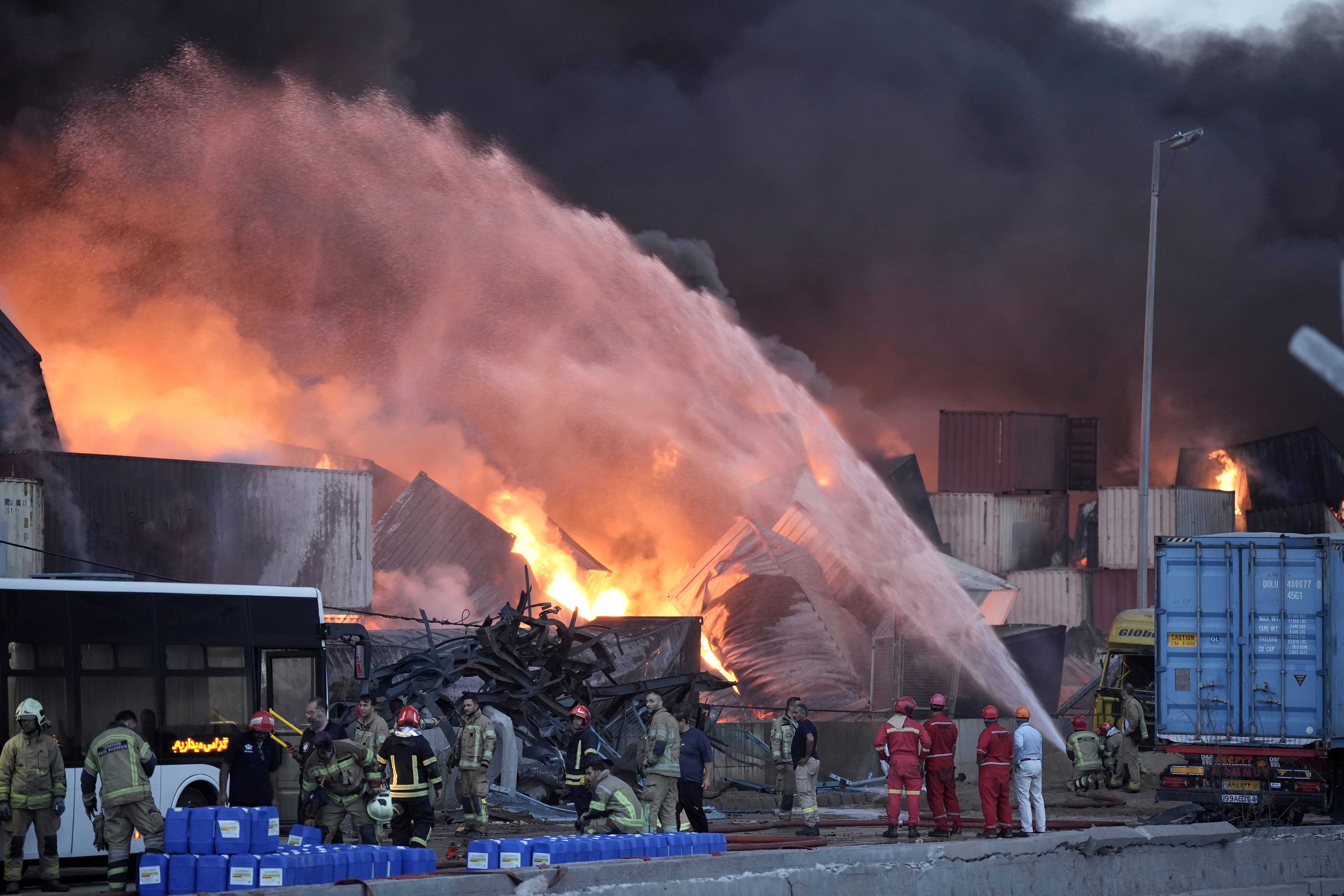
AP25117498706242.jpgFirefighters try to extinguish the fire, Sunday, April 27, 2025, after a massive explosion and fire rocked a port near the southern port city of Bandar Abbas, Iran, on Saturday. (Mahdi Nori/Fars News Agency via AP)

The visit by President Masoud Pezeshkian came as the toll from Saturday's blast at the Shahid Rajaei port outside of Bandar Abbas in southern Iran's Hormozgan province rose to 40 with about 1,000 others injured.

While Iran's military sought to deny the delivery of ammonium perchlorate from China, new videos emerged showing an apocalyptic scene at the still-smoldering port. A crater that appeared meters (yards) deep sat surrounded by burning smoke so dangerous that authorities closed schools and businesses in the area.

Containers appeared smashed or thrown as if discarded toys, while the burned carcasses of trucks and cars sat around the site.

“We have to find out why it happened,” Pezeshkian said during a meeting with officials aired by Iranian state television.

Authorities described the fire as being under control, saying emergency workers hoped that it would be fully extinguished later Sunday. Overnight, helicopters and heavy cargo aircraft flew repeated sorties over the burning port, dumping seawater on the site. Satellite pictures taken Sunday by Planet Labs PBC and analyzed by The Associated Press showed a huge plume of black smoke still over the site.

Provincial Gov. Mohammad Ashouri gave the latest death toll, Iranian state TV reported. Pir Hossein Kolivand, head of Iran’s Red Crescent society, said that only 190 of about 1,000 injured remained hospitalized on Sunday, according to a statement carried by an Iranian government website. The governor declared three days of mourning.

Private security firm Ambrey says the port received missile fuel chemical in March. It was part of a shipment of ammonium perchlorate from China by two vessels to Iran, first reported in January by the Financial Times. The chemical used to make solid propellant for rockets was going to be used to replenish Iran’s missile stocks, which had been depleted by its direct attacks on Israel during the war with Hamas in the Gaza Strip.

Ship-tracking data analyzed by the AP put one of the vessels believed to be carrying the chemical in the vicinity in March, as Ambrey said.

“The fire was reportedly the result of improper handling of a shipment of solid fuel intended for use in Iranian ballistic missiles,” Ambrey said.

In a first reaction on Sunday, Iranian Defense Ministry spokesman Gen. Reza Talaeinik denied that missile fuel had been imported through the port.

“No sort of imported and exporting consignment for fuel or military application was (or) is in the site of the port,” he told state television by telephone. He called foreign reports on the missile fuel baseless — but offered no explanation for what material detonated with such incredible force at the site. Talaeinik promised authorities would offer more information later.

It’s unclear why Iran wouldn’t have moved the chemicals from the port, particularly after the Beirut port blast in 2020. That explosion, caused by the ignition of hundreds of tons of highly explosive ammonium nitrate, killed more than 200 people and injured more than 6,000 others. However, Israel did target Iranian missile sites where Tehran uses industrial mixers to create solid fuel — meaning potentially that it had no place to process the chemical.

Social media footage of the explosion on Saturday at Shahid Rajaei saw reddish-hued smoke rising from the fire just before the detonation. That suggests a chemical compound being involved in the blast, like in the Beirut explosion.

Meanwhile on Sunday, Russian President Vladimir Putin deployed several emergency aircraft to Bandar Abbas to provide assistance.

Related Tags

World news
ADVERTISEMENT
.most-popular .layout-ratio{ padding-bottom: 79.13%; } @media (min-width: 768px) and (max-width: 1024px) { .widget-title { font-size: 15px !important; } }

{{ articles_filter_1561_widget.title }}

.most-popular .layout-ratio{ padding-bottom: 79.13%; } @media (min-width: 768px) and (max-width: 1024px) { .widget-title { font-size: 15px !important; } }

{{ articles_filter_1562_widget.title }}

.most-popular .layout-ratio{ padding-bottom: 79.13%; } @media (min-width: 768px) and (max-width: 1024px) { .widget-title { font-size: 15px !important; } }

{{ articles_filter_1563_widget.title }}

{{ articles_filter_1564_widget.title }}

.mb-article-details { position: relative; } .mb-article-details .article-body-preview, .mb-article-details .article-body-summary{ font-size: 17px; line-height: 30px; font-family: "Libre Caslon Text", serif; color: #000; } .mb-article-details .article-body-preview iframe , .mb-article-details .article-body-summary iframe{ width: 100%; margin: auto; } .read-more-background { background: linear-gradient(180deg, color(display-p3 1.000 1.000 1.000 / 0) 13.75%, color(display-p3 1.000 1.000 1.000 / 0.8) 30.79%, color(display-p3 1.000 1.000 1.000) 72.5%); position: absolute; height: 200px; width: 100%; bottom: 0; display: flex; justify-content: center; align-items: center; padding: 0; } .read-more-background a{ color: #000; } .read-more-btn { padding: 17px 45px; font-family: Inter; font-weight: 700; font-size: 18px; line-height: 16px; text-align: center; vertical-align: middle; border: 1px solid black; background-color: white; } .hidden { display: none; }
function initializeAllSwipers() { // Get all hidden inputs with cms_article_id document.querySelectorAll('[id^="cms_article_id_"]').forEach(function (input) { const cmsArticleId = input.value; const articleSelector = '#article-' + cmsArticleId + ' .body_images'; const swiperElement = document.querySelector(articleSelector); if (swiperElement && !swiperElement.classList.contains('swiper-initialized')) { new Swiper(articleSelector, { loop: true, pagination: false, navigation: { nextEl: '#article-' + cmsArticleId + ' .swiper-button-next', prevEl: '#article-' + cmsArticleId + ' .swiper-button-prev', }, }); } }); } setTimeout(initializeAllSwipers, 3000); const intersectionObserver = new IntersectionObserver( (entries) => { entries.forEach((entry) => { if (entry.isIntersecting) { const newUrl = entry.target.getAttribute("data-url"); if (newUrl) { history.pushState(null, null, newUrl); let article = entry.target; // Extract metadata const author = article.querySelector('.author-section').textContent.replace('By', '').trim(); const section = article.querySelector('.section-info ').textContent.replace(' ', ' '); const title = article.querySelector('.article-title h1').textContent; // Parse URL for Chartbeat path format const parsedUrl = new URL(newUrl, window.location.origin); const cleanUrl = parsedUrl.host + parsedUrl.pathname; // Update Chartbeat configuration if (typeof window._sf_async_config !== 'undefined') { window._sf_async_config.path = cleanUrl; window._sf_async_config.sections = section; window._sf_async_config.authors = author; } // Track virtual page view with Chartbeat if (typeof pSUPERFLY !== 'undefined' && typeof pSUPERFLY.virtualPage === 'function') { try { pSUPERFLY.virtualPage({ path: cleanUrl, title: title, sections: section, authors: author }); } catch (error) { console.error('ping error', error); } } // Optional: Update document title if (title && title !== document.title) { document.title = title; } } } }); }, { threshold: 0.1 } ); function showArticleBody(button) { const article = button.closest("article"); const summary = article.querySelector(".article-body-summary"); const body = article.querySelector(".article-body-preview"); const readMoreSection = article.querySelector(".read-more-background"); // Hide summary and read-more section summary.style.display = "none"; readMoreSection.style.display = "none"; // Show the full article body body.classList.remove("hidden"); } document.addEventListener("DOMContentLoaded", () => { let loadCount = 0; // Track how many times articles are loaded const offset = [1, 2, 3, 4, 5, 6, 7, 8, 9, 10]; // Offset values const currentUrl = window.location.pathname.substring(1); let isLoading = false; // Prevent multiple calls if (!currentUrl) { console.log("Current URL is invalid."); return; } const sentinel = document.getElementById("load-more-sentinel"); if (!sentinel) { console.log("Sentinel element not found."); return; } function isSentinelVisible() { const rect = sentinel.getBoundingClientRect(); return ( rect.top < window.innerHeight && rect.bottom >= 0 ); } function onScroll() { if (isLoading) return; if (isSentinelVisible()) { if (loadCount >= offset.length) { console.log("Maximum load attempts reached."); window.removeEventListener("scroll", onScroll); return; } isLoading = true; const currentOffset = offset[loadCount]; window.loadMoreItems().then(() => { let article = document.querySelector('#widget_1690 > div:nth-last-of-type(2) article'); intersectionObserver.observe(article) loadCount++; }).catch(error => { console.error("Error loading more items:", error); }).finally(() => { isLoading = false; }); } } window.addEventListener("scroll", onScroll); });

Sign up by email to receive news.