






 Philippines
National
'Ship-killer’ NMESIS sees action in Balikatan as Chinese vessels spotted in Zambales
Philippines
National
'Ship-killer’ NMESIS sees action in Balikatan as Chinese vessels spotted in Zambales
'Ship-killer’ NMESIS sees action in Balikatan as Chinese vessels spotted in Zambales


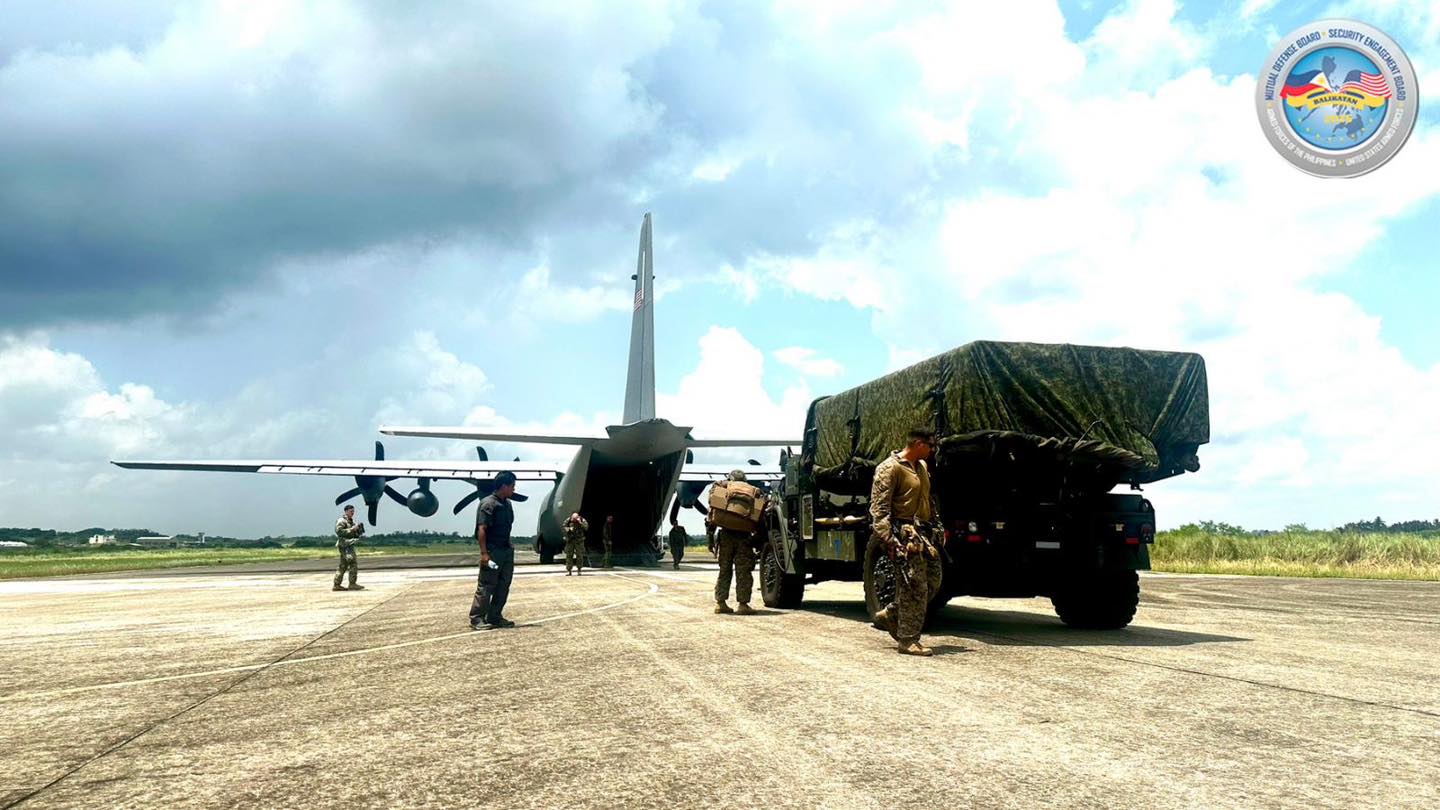
The highly anticipated participation of the Navy-Marine Expeditionary Ship Interdiction System (NMESIS) of the United States Marine Corps (USMC) finally happened in the ongoing Balikatan Exercises as three Chinese vessels were detected in the vicinity waters of Zambales on Saturday, April 26.
The USMC successfully inserted the NMESIS anti-ship missile system during the maritime key terrain security operations (MKTSO)-North events on Saturday, April 26.
Lt. Col. John Paul Salgado, chief of Balikatan’s combined joint information bureau, said the exercise tested the capability of the Armed Forces of the Philippines (AFP) and USMC to position the NMESIS for the MKTSO-North.
The NMESIS is a land-based missile system designed to target and deter hostile naval forces. It enhances maritime domain awareness and strengthens the defensive posture of the Philippines and United States in securing key maritime areas.
“The NMESIS provides the combined and joint force a flexible and expedient sea denial capacity, contributing to the collective defense of both countries,” Salgado said.
Chinese presence during Divtacs
The utilization of the NMESIS missile system coincided with the monitoring of Chinese People’s Liberation Army-Navy (PLA-N) vessels near Philippine and allied ships participating in the maritime multilateral exercise (MME) about 60 nautical miles west of Palauig, Zambales.
Philippine Navy (PN) spokesperson Capt. John Percie Alcos identified the Chinese vessels as a Jiangkai II-class frigate with bow number “579”, a vessel with bow number “500”, and a Dongdiao II-class auxiliary surveillance ship with bow number “797”.
However, Alcos said that the presence of the Chinese ships did not interrupt the Balikatan Exercises.
“Despite the presence of these PLA-N vessels, the training activities proceeded without disruption,” he stated. “The activities of the Chinese naval vessels have been addressed in accordance with international law and protocols, and Philippine Navy ships remain focused on their training objectives alongside our allies.”
Accordingly, BRP Ramon Alcaraz (PS16) and BRP Apolinario Mabini (PS36) continued sailing with friendly naval ships USS Savannah (LCS 28) and USS Comstock (LSD 45), as well as Philippine Coast Guard (PCG) offshore patrol vessel BRP Gabriela Silang (OPV 8301).

The vessels conducted a division tactics (Divtacs) drill aimed at enhancing interoperability and coordination through the execution of tactical maneuvers.
The exercise – held 21 nautical miles west off the coast of San Felipe, Zambales – focused on improving the fleet’s ability to operate as a cohesive unit by practicing tactical signals, maneuvering procedures, and command and control.
At present, BRP Ramon Alcaraz continues to monitor the presence and activities of the PLA-N vessels.
Showdown of aircraft carriers
The US Navy also deployed the Nimitz Carrier Strike Group, led by its flagship Nimitz-class aircraft carrier USS Nimitz (CVN 68), to the Philippine Sea following a scheduled port visit to Guam.
The Nimitz Carrier Strike Group consists of USS Nimitz (CVN 68), Carrier Air Wing (CVW) 17, and Destroyer Squadron (DESRON) 9.
The presence of the US aircraft carrier was felt after Chinese aircraft carrier Shandong (CV-17) and eight escort vessels were detected roughly a hundred nautical miles northwest of Burgos, Ilocos Norte on April 22.
In a statement, the US Navy said the Nimitz Carrier Strike Group conducted day and night flight evolutions, showcasing the carrier air wing’s ability to rapidly launch and recover aircraft in a variety of conditions.
“Operating forward as a strike group hones our ability to maintain persistent and capable forces at sea, always ready to provide our leaders with a broad spectrum of military capabilities to respond to any crisis or contingency,” said Rear Adm. Maximilian Clark, commander of Carrier Strike Group 11.