






 World
Negotiations between Iran, US over Tehran's nuclear program return to secluded Oman
World
Negotiations between Iran, US over Tehran's nuclear program return to secluded Oman
Negotiations between Iran, US over Tehran's nuclear program return to secluded Oman


MUSCAT, Oman (AP) — Negotiations between Iran and the United States over Tehran's rapidly advancing nuclear program will return on Saturday to the secluded sultanate of Oman, where experts on both sides will start hammering out the technical details of a possible deal.
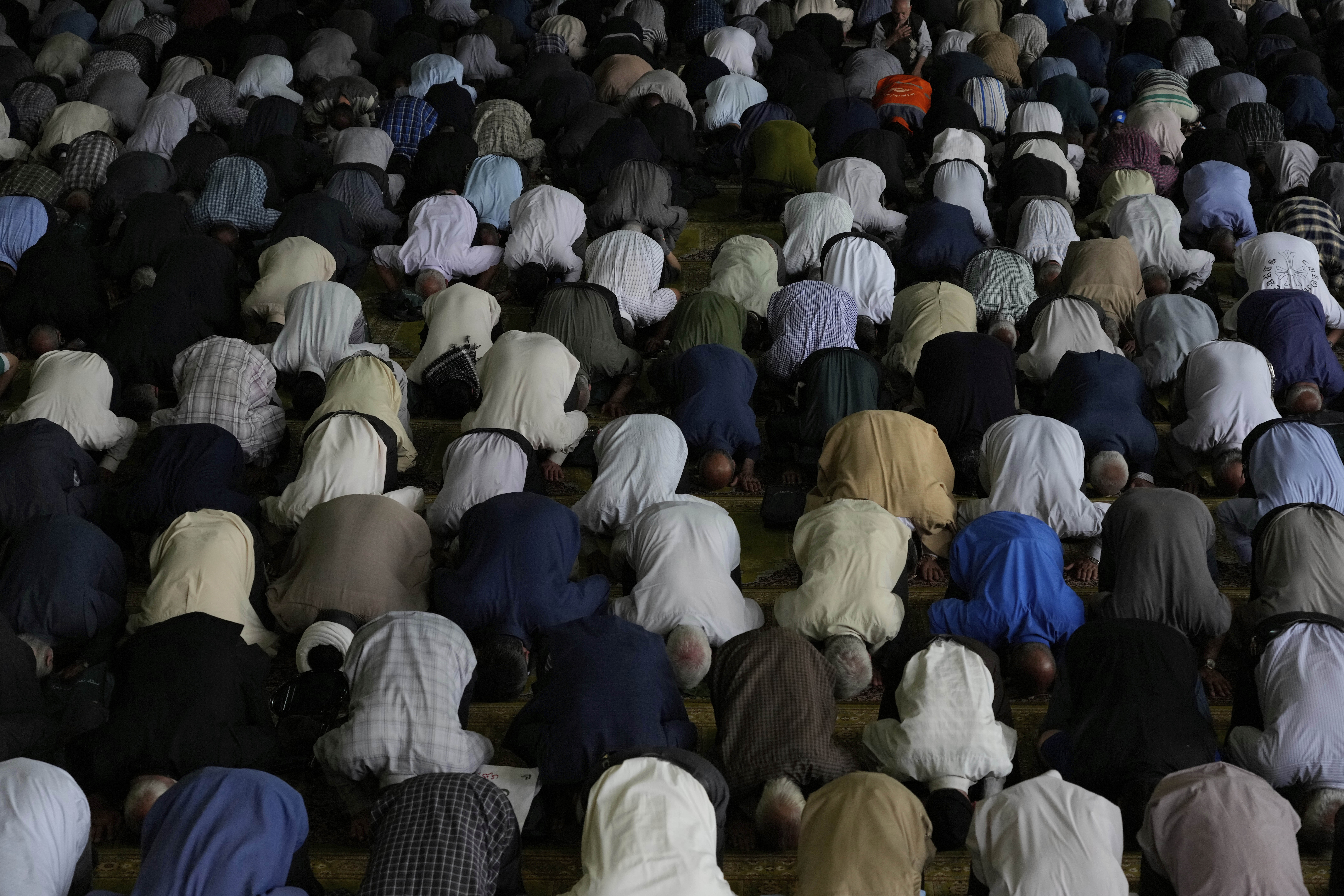
WORSHIPPERS pray during the prayer ceremony at the Tehran University campus in Tehran, Iran, Friday, April 25, 2025. (AP)
The talks seek to limit Iran's nuclear program in exchange for the lifting of some of the crushing economic sanctions the US has imposed on the Islamic Republic closing in on half a century of enmity.
US President Donald Trump has repeatedly threatened to unleash airstrikes targeting Iran's program if a deal isn't reached. Iranian officials increasingly warn that they could pursue a nuclear weapon with their stockpile of uranium enriched to near weapons-grade levels.
Neither Iran nor the US has offered any explanation on why the talks will return to Muscat, the Omani capital nestled in the Hajar Mountains. Oman has been a mediator between Tehran and Washington. Last weekend's talks in Rome offered a more-equal flight distance between Iranian Foreign Minister Abbas Araghchi and US Mideast envoy Steve Witkoff, who are leading the negotiations.
But Rome remains in mourning after the death of Pope Francis, whose funeral will be held on Saturday. And Iranian state television, in covering last weekend's talks, complained at length on air about the "paparazzi" gathered across the street from the Omani Embassy in Rome's Camilluccia neighborhood.
Araghchi himself took time out Friday night to sign copies of his latest memoir, "The Power of Negotiation," at the Muscat International Book Fair. But he found himself swarmed by cameras even in the Omani capital, showing the intense international interest in the talks.
Asked by The Associated Press about the negotiations on Saturday, Aragchi simply replied: "I'm here for the book."
The Muscat talks come as Iran appears to have lined up Chinese and Russian support. Araghchi traveled to Moscow last week and this week visited Beijing.
On Thursday, Chinese, Iranian, and Russian representatives met the head of the International Atomic Energy Agency, the United Nations' nuclear watchdog that likely will verify compliance with any accord like it did with Tehran's 2015 nuclear deal with world powers. That deal included China and Russia, as well as France, Germany, and the United Kingdom, in addition to Iran and the US.
However, Iran has greatly restricted the IAEA's inspections – leading to fears internationally that centrifuges and other nuclear material could be diverted for non-peaceful purposes.
The IAEA offered no readout from the talks, but China's state-run Xinhua news agency on Friday described the three nations as saying the agency has "the necessary potential and expertise to contribute constructively to this process."
"China, Russia, and Iran emphasized that political and diplomatic engagement based on mutual respect remains the only viable and practical path for resolving the Iran nuclear issue," the report said. It added that China respects Iran's "right to the peaceful use of nuclear energy."
The Trump administration has kept France, Germany, and the UK out of its direct negotiations with Iran, something similarly reflected in Witkoff's negotiations with Russia over ending its war on Ukraine. Witkoff traveled Friday to Moscow ahead of Saturday's meeting in Muscat.
Araghchi meanwhile has said he's open to visiting Berlin, London and Paris to discuss the negotiations.
"The ball is now in the E3's court," Araghchi wrote on the social platform X on Thursday, using an acronym for the countries. "They have an opportunity to do away with the grip of Special Interest groups and forge a different path."
From the Iranian side, Iranian Deputy Foreign Minister Majid Takht-e Ravanchi will lead Tehran's expert team, said Mohammad Golzari, an Iranian government official. Takht-e Ravanchi took part in the 2015 nuclear talks.
The US technical team, which is expected to arrive in Oman on Friday, will be led by Michael Anton, the director of US Secretary of State Marco Rubio's policy planning staff. Anton does not have the nuclear policy experience of those who led America's efforts in the 2015 talks.
He was an early supporter of Trump, describing the 2016 election as a "charge the cockpit or you die" vote. "A Hillary Clinton presidency is Russian Roulette with a semi-auto," Anton wrote. "With Trump, at least you can spin the cylinder and take your chances." He also criticized "Iran sycophancy" in the same essay.
Rubio, speaking on a podcast released this week, also kept up a Trump line that Iran needed to stop its enrichment of uranium entirely.
"If Iran wants a civil nuclear program, they can have one just like many other countries can have one, and that is they import enriched material," Rubio said.
However, former CIA director Bill Burns, who took part in the secret negotiations that led to the 2015 nuclear deal, expressed skepticism Iran would give up its program like Libya did in 2003.
"I don't personally think that this Iranian regime is going to agree to...zero domestic enrichment," Burns said in a talk Monday at the University of Chicago. "To hold out for the Libya model is virtually to ensure that you're not going to be able to reach an agreement."
But Iran has insisted that keeping its enrichment is key. Witkoff also has muddied the issue by first suggesting in a television interview that Iran could enrich uranium at 3.67 percent, then later saying that all enrichment must stop.
Meanwhile, one more wildcard is Israel, whose devastating war on Hamas in the Gaza Strip grinds on. Trump initially announced the Iran talks with Prime Minister Benjamin Netanyahu at his side. But Israel, which for years has targeted Iran's nuclear program with attacks on its facilities and scientists, has kept open the possibility of airstrikes to destroy Tehran's enrichment sites.
On Monday, Israel's military conducted drills preparing for possible new Iranian missile attacks, the country's public broadcaster KAN reported. Araghchi has described Iranian security services as being "on high alert given past instances of attempted sabotage and assassination operations designed to provoke a legitimate response."
However, Iranians on Friday in Tehran remained hopeful the talks could be successful, as the Iranian rial has rebounded from historic lows.
"It's OK to negotiate, to make the nuclear program smaller or bigger, and reach a deal," Tehran resident Farzin Keivan said. "Of course, we shouldn't give them everything. After all, we've suffered a lot for this program."