







Galvez urges support for conflict-hit areas at AmCham summit


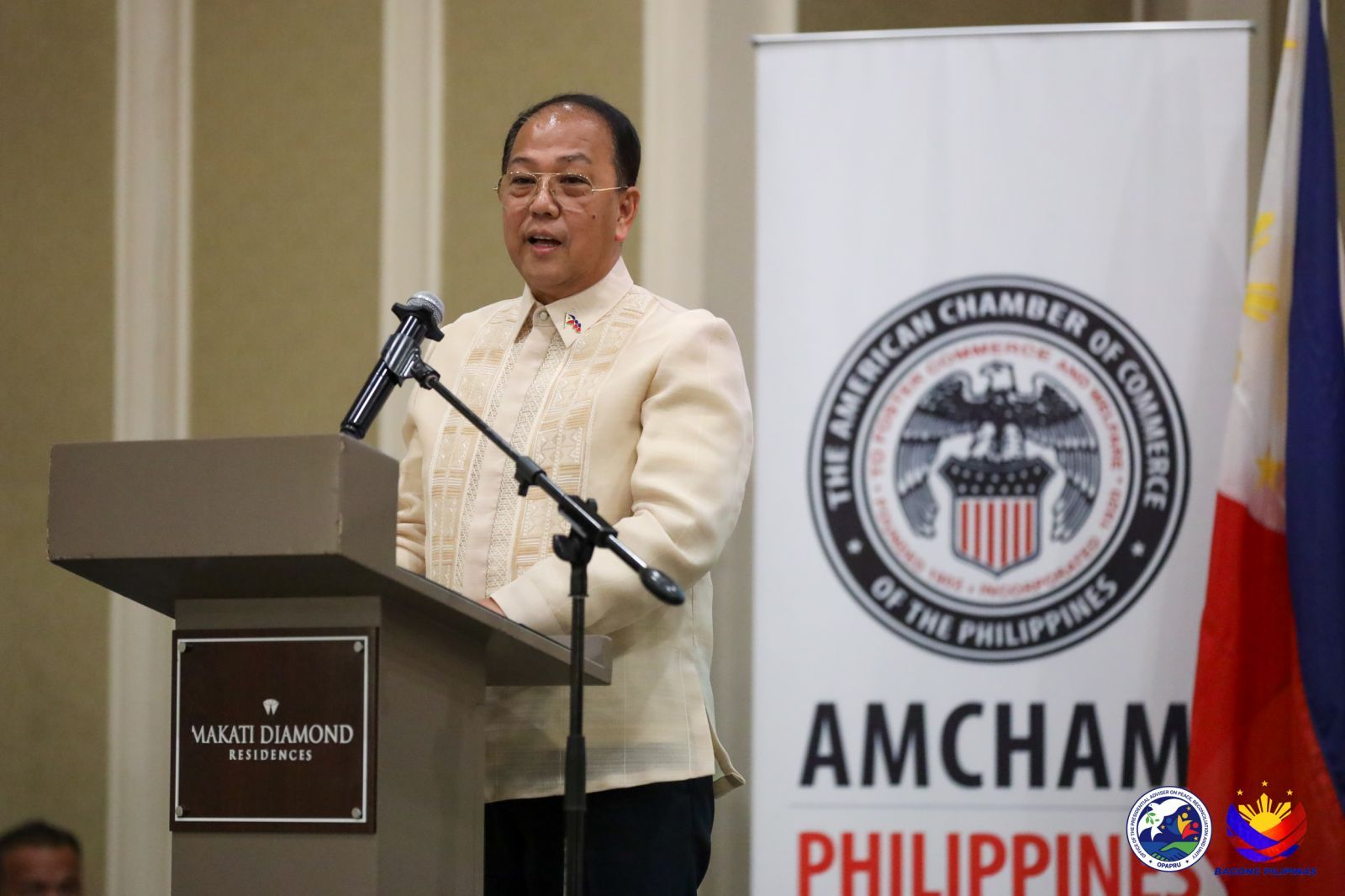
Presidential Peace Adviser Carlito Galvez Jr. underscored the critical role of the private sector in building a resilient peace process as he appealed for assistance to areas impacted by various conflicts.
“Active trade and commerce must be present in normalization. The participation of the private sector is, therefore, very crucial in making peace resilient,” Galvez said during his talk at the American Chamber of Commerce of the Philippines (AmCham) Summit 2025 last April 24 in Makati City.
According to him, functioning local economies are critical in making sure that the lives of those who have previously lived in conflict will not return to an environment of violence.
Galvez emphasized that while many peace processes are being pursued worldwide, they remain highly vulnerable to various factors that could undermine the gains achieved under them.
He cited the 2016 Conflict Trends Report by the Peace Research Institute of Oslo (PRIO), which found that the average peace process collapses after just seven years.
“This tells us that many peace processes around the world remain vulnerable or fragile,” Galvez noted. “The vulnerability of a peace process can be linked to many factors. But I believe that it can be mainly attributed to the pressing need for more concrete, creative tools or opportunities for people to jump back and recover from the consequences of conflict.”
Galvez stressed that a signed peace agreement is not the end goal but the beginning of transformative work.
“A signed peace agreement only remains a piece of paper without the implementation of political and socio-economic interventions that make it a living reality for our people to always respect the rule of law and promote social justice and development,” he noted.
Various initiatives were spearheaded by the international donor community and private sector to foster peace and development in once conflict-affected and conflict-vulnerable communities.
These include the community-driven peacebuilding programs worth $12 million being implemented by the Japanese government and the additional pledge of €27 million by the European Union for peace and development interventions in the Bangsamoro region, which will be carried out in partnership with the Mindanao Development Authority (MinDA) and the Bangsamoro government.
Galvez also mentioned recently signed agreements made by the Office of the Presidential Adviser on Peace, Reconciliation and Unity (OPAPRU) with the private sector, such as the Institute for Economics and Peace (IEP), a world-renowned think tank, which would enable the government to make an accurate assessment of the progress made by the country using the lens of the global peace index.
The OPAPRU has also partnered with Kennemer Eco Solutions to transform communities into productive centers through forest protection, land restoration, biodiversity conservation, high-value crop farming, and socio-cultural interventions.
The peace adviser called on stakeholders to work together in sustaining peace and fostering resilience in communities.
Galvez highlighted the "remarkable transformation" that is taking place in the Bangsamoro region as a compelling example of what happens when individuals and communities choose to walk the path of peace.
“The continued peace and development in Bangsamoro provinces make them conducive for business and tourism. Investors are now considering doing business in Bangsamoro,” he pointed out.