






 Philippines
National
More Chinese vessels detected in PH waters amid ongoing Balikatan drills – Navy
Philippines
National
More Chinese vessels detected in PH waters amid ongoing Balikatan drills – Navy
More Chinese vessels detected in PH waters amid ongoing Balikatan drills – Navy


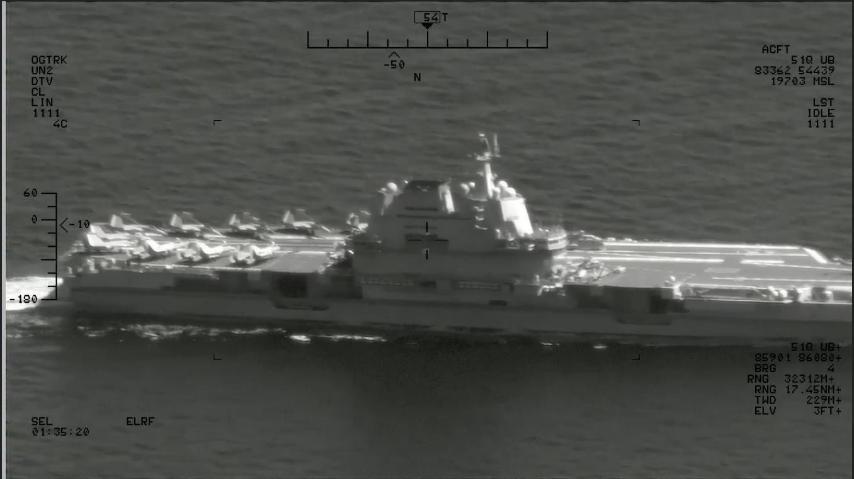
The Philippine Navy (PN) said that the Chinese aircraft carrier detected within the country’s archipelagic waters was accompanied by eight other vessels arranged in “unusual formations” as the Balikatan Exercises between the Armed Forces of the Philippines (AFP) and United States Indo-Pacific Command (Indopacom) continue.
Aircraft carrier Shandong (CV-17) was escorted by six People’s Liberation Army-Navy (PLA-N) destroyers and frigates, and two support vessels. One of the support vessels was identified as an electronic surveillance ship with tail number AGI-797.
“This was one of the larger or unusual formations we have monitored,” said Rear Adm. Roy Vincent Trinidad, PN spokesperson for West Philippine Sea (WPS).
The Chinese vessels were first detected roughly a hundred nautical miles northwest of Burgos, Ilocos Norte on April 22. On the night of April 23, they came within the bounds of the Philippines’ exclusive economic zone (EEZ) on the western part of Cagayan.
Trinidad said the PN challenged the Chinese warships through radio communication by its land-based monitoring systems but “we didn’t get any reply.”
“While the normal procedure is for warship or foreign ship to reply, there are some instances na hindi sumasagot ang mga ito (that they do not answer). This is one particular instance that the Shandong carrier battle group did not give any reply,” he noted.
“The Naval Forces Northern Luzon wanted to deploy larger warships but they were committed to Balikatan,” he admitted, although stressing that the PN does not give any meaning to the deployment, whether or not it was connected to the Balikatan drills.
Read: PH Navy monitors Chinese aircraft carrier, another vessel off Northern Luzon waters
The Chinese ships were usually operating out of the PLA’s South Sea Fleet so the PN did not notice where they came from.
Still, Trinidad insisted that the presence of Chinese warships in the country’s waters was not a cause for concern.
“Why not? We know they are there, we monitor them, we challenge them, we are aware of their presence.”
Balikatan
As this developed, naval forces from the AFP and US Indopacom started on Thursday a multilateral maritime event (MME), a crucial component of the ongoing Balikatan Exercises.
The activity, which will take place until April 29, “focuses on enhancing the interoperability and coordination between the allied nations within the Philippines' archipelagic waters, spanning from the vicinity of Subic Bay up to the Northern Luzon Joint Operational Area,” the AFP said.
Filipino and American troops also conducted simultaneous cyber defense exercises (CYDEX) across various AFP units.
The CYDEX was observed by representatives from the Colombian Armed Forces, Canadian Armed Forces, Japan Air Self-Defense Force, the Philippine Coast Guard (PCG), and the AFP Cyber Command’s Cybersecurity Incident Response Team.
“This exercise is a key component of this year’s Balikatan, designed to strengthen mutual cyber defense capabilities and enhance interoperability in responding to evolving digital challenges. CYDEX brought together personnel from both nations to simulate real-world scenarios, share best practices, and develop coordinated response strategies to defend critical information infrastructure,” the AFP said.
According to the AFP, cybersecurity is a vital aspect of modern military operations and through the CYDEX, the importance of collaborative training in addressing cyber challenges was underscored.
“This exercise not only enhances technical capabilities but also strengthens trust and coordination with allied nations,” the AFP said.