







First Couple to fly to Vatican tonight for Pope's funeral


At A Glance
- On Wednesday, April 23, Marcos declared a period of national mourning over the death of Pope Francis. Based on Proclamation No. 871, signed by Executive Secretary Lucas Bersamin, the mourning period will last until the Pope's burial.
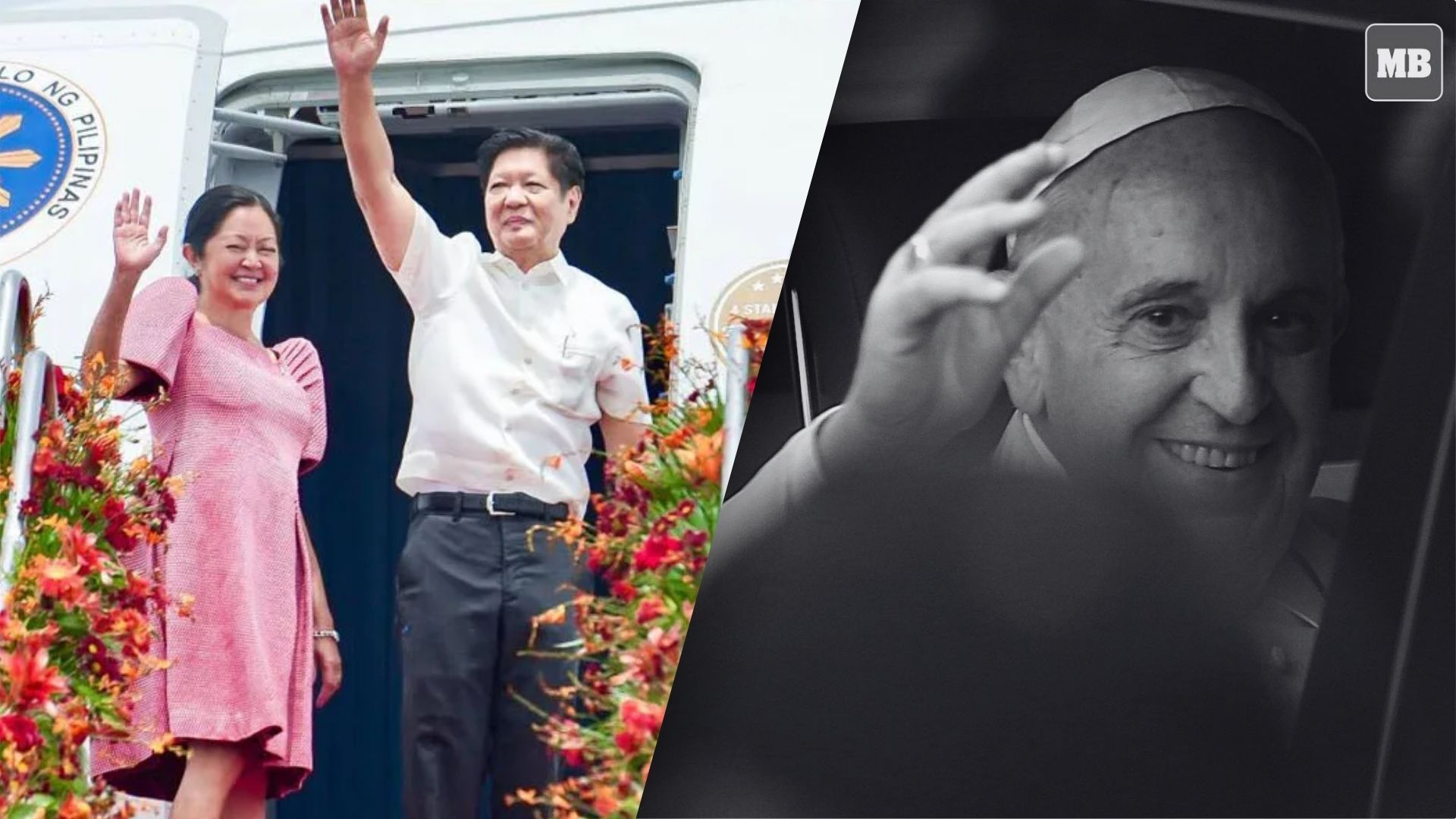
President Marcos and First Lady Liza Araneta-Marcos were scheduled to leave Thursday night, April 24, to join other world leaders and the faithful at the funeral of Pope Francis at the Vatican’s St. Peter's Basilica on Saturday, April 26.
"Mamayang gabi po ang pag-alis ng First Couple (The First Couple will leave the country tonight). The funeral will be attended by the First Couple this Saturday, April 26," Communications Undersecretary Claire Castro announced on Thursday morning.
Executive Secretary Lucas Bersamin, Justice Secretary Jesus Crispin Remulla, and Agrarian Secretary Conrado Estrella III would serve as government caretakers while the President is out of the country.
The Palace Press Officer, however, did not divulge information on whether there were other activities for the President in Europe or when the First Couple would return to Manila.
She also did not say who will be joining the First Couple on the trip to the Vatican.
"Hihingin ko na lamang yung detalye. Ito lamang ang ibinigay sa atin pansamantala (Again, I will just request the details. This is the only information we’ve been given for now)," Castro said.
"Pag binigay na po sa atin ng ahensya ng DFA ang detalye dito, ibibigay ko po sa inyo," Castro said. Once the Department of Foreign Affairs provides us the details, I will give them to you)," she added.
Castro likewise could not confirm if any of the President's local engagements this weekend will be canceled or postponed.
"Hindi ko po masasagot sa ngayon dahil hindi pa po ako nabibigyan ng detalye kung ano po yung kanilang magiging itinerary (I can’t answer that for now because I haven’t been given details of their itinerary)," she said.
Marcos described Francis as the best pope of his lifetime, saying the pontiff taught humanity to extend kindness and care to one another.
National mourning
Marcos has declared a period of national mourning over the death of Pope Francis.
Based on Proclamation No. 871, signed by Executive Secretary Lucas Bersamin on April 23, the mourning period will last until the Pope's burial.
During this period, Philippine flags in government buildings and installations worldwide shall be flown at half-mast from sunrise to sunset.
"The passing of Pope Francis is a moment of profound sorrow for the Catholic Church and for the Filipino people, who recognize him as a global leader of compassion and a tireless advocate for peace, justice, and human dignity," Marcos wrote in his proclamation.
"This nation expresses solidarity with the world as our generation mourns the passing of His Holiness, Pope Francis, with loving prayers for his eternal peace," he added.
According to Marcos, Pope Francis holds a special place in the hearts of the Filipino people, particularly for his Apostolic Visit to the Philippines in January 2015.
Since becoming the Catholic Church's 266th pope on March 13, 2013, until his passing, the President said Pope Francis devoted his ministry to the care of the poor, marginalized, and vulnerable, advocating tirelessly for social justice, equality, and interfaith dialogue.
Respect the process
The Catholic Bishops’ Conference of the Philippines (CBCP) has urged the faithful to refrain from publicly promoting Luis Antonio Cardinal Tagle as a potential successor, underscoring the need to uphold the sanctity and independence of the papal election process.
In an interview with church-run Radio Veritas, CBCP Episcopal Commission on Public Affairs Executive Secretary Rev. Fr. Jerome Secillano cautioned against calls circulating online and within Church circles pushing for the Filipino cardinal to be elected as the next pontiff.
“We leave it to the cardinal electors to decide who will succeed Pope Francis. It’s not prudent for the public to promote Cardinal Tagle as the next Pope, as this could create the impression that the conclave might be swayed by external influences if Cardinal Tagle is elected as the next pontiff,” he said.
Secillano, who also serves as the spokesperson of the Archdiocese of Manila, stressed that the election of the new Pope must be conducted with complete freedom and without any form of external pressure or lobbying.
“The independence of the electors must be respected, and the least we can do is pray for Cardinal Tagle and the other cardinal electors,” he added.
Cardinal Tagle, 67, currently serves as the Pro-Prefect of the Vatican’s Dicastery for Evangelization, one of the most influential offices in the Roman Curia.
Previously, he served as Archbishop of Manila from 2011 to 2019, before being appointed by Pope Francis to his Vatican post.
He is widely regarded as a close ally of the late Pope and a strong advocate for pastoral outreach, interreligious dialogue, and missionary work.
The conclave is a sacred assembly of cardinal electors convened to choose a new Pope following the death or resignation of a pontiff.
Only cardinals under the age of 80 at the time of the Pope’s passing are eligible to vote.
Deliberations are held behind closed doors at the Sistine Chapel in the Vatican, under strict secrecy and guided by prayerful discernment.
Per CBCP, there are currently 135 cardinal electors around the world, including three from the Philippines—Cardinal Tagle; Kalookan Bishop Pablo Virgilio Cardinal David, who is the current CBCP president; and Manila Archbishop Jose Cardinal Advincula.
Despite public admiration for Cardinal Tagle’s leadership and global stature, Church officials stressed that the faithful must allow the conclave to proceed without undue influence, and instead unite in prayer for the future of the Church.
As preparations for the conclave are expected to begin soon, the Vatican continues to lead the Church in a period of mourning and reflection, honoring Pope Francis’ transformative legacy centered on compassion, humility, synodality, and care for the marginalized.
Public viewing
At the Vatican, throngs of the faithful made their way to the 16th century St. Peter’s Basilica’s main altar to see Pope Francis lying in state in a simple wooden coffin at the start of three days of public viewing ahead of his funeral.
The Vatican kept the doors open all night due to higher-than-expected turnout, closing the basilica for just an hour Thursday morning for cleaning.
The public viewing was scheduled to resume Thursday, a day after it began with numbers that were so strong that the Vatican said it would consider longer hours to meet the demand. Nearly 20,000 people paid their respects in the first 8 1/2 hours.
In the first 8 1/2 hours, 19,430 people paid their respects to the pope.
Francis was laid out in red robes, clasping a rosary and wearing a bishop’s miter, the traditional pointed headdress. Mourners waited hours to reach the casket, which was behind a cordon. Some held their cell phones aloft as they neared to snap photos in what has become a modern ritual.
Francis’ casket wasn’t put on an elevated bier — as was the case with past popes — but placed on a ramp, facing the pews. It was in keeping with his wishes for the rituals surrounding a papal funeral to be simplified to reflect his belief that the pope’s role is that of simple pastor, not world leader.
Cardinals, meanwhile, met in private to finalize preparations for Saturday's funeral and plan the conclave to elect Francis' successor. (With reports from Jel Santos and The Associated Press)